
Free AI Tools & Online Earning Guides
Free AI Tools & Online Earning Guides
Use this free CGPA to percentage calculator to convert your CGPA into a percentage in one click — or work backwards from a percentage to a CGPA. It works as a complete CGPA calculator too: enter your semester SGPAs (or subject grade points) and get your cumulative CGPA plus its percentage equivalent. Every major formula is built in — CBSE (× 9.5), the direct × 10 scale, VTU / AKTU / JNTU, Mumbai University and Anna University — so the cgpa to percentage calculator result matches the rule your own board or university actually uses.
Add one row per semester (SGPA) or per subject (grade point). Add credits if your university weights semesters by credits — leave credits empty for a simple average.
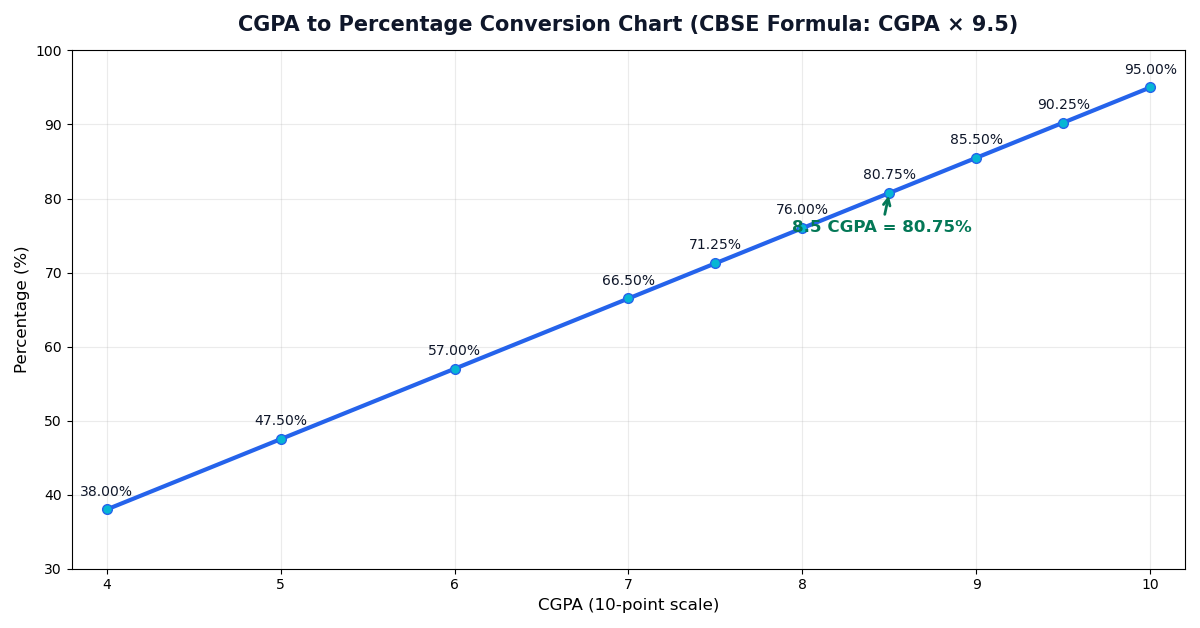
The most common cgpa to percentage formula is Percentage = CGPA × 9.5. CBSE derived the 9.5 factor from real results data: students in the top grade band (91–100 marks) scored about 95 marks on average, and 95 ÷ 10 grade points = 9.5. It is an indicative conversion, not an exact equivalence — which is why different universities publish different formulas:
| Board / University | Formula | CGPA 8.2 equals |
|---|---|---|
| CBSE (Class 10 & 12), Delhi University, most boards | CGPA × 9.5 | 77.9% |
| Direct 10-point scale (several state universities) | CGPA × 10 | 82.0% |
| VTU, AKTU, JNTU and similar technical universities | (CGPA − 0.75) × 10 | 74.5% |
| Mumbai University (10-point scale) | 7.1 × CGPA + 11 | 69.2% |
| Anna University | (CGPA × 10) − 0.5 | 81.5% |
The same 8.2 CGPA can mean anything from 69.2% to 82% depending on the institution — always confirm the formula printed on your mark sheet or transcript before using a converted percentage on an application.
Official references: the × 9.5 conversion is published by the Central Board of Secondary Education (CBSE), and university-level conversion rules in India are overseen by the University Grants Commission (UGC). Always treat the formula printed on your own mark sheet as the final authority.
| CGPA | Percentage | CGPA | Percentage |
|---|---|---|---|
| 10.0 | 95.00% | 6.8 | 64.60% |
| 9.8 | 93.10% | 6.6 | 62.70% |
| 9.6 | 91.20% | 6.4 | 60.80% |
| 9.4 | 89.30% | 6.2 | 58.90% |
| 9.2 | 87.40% | 6.0 | 57.00% |
| 9.0 | 85.50% | 5.8 | 55.10% |
| 8.8 | 83.60% | 5.6 | 53.20% |
| 8.6 | 81.70% | 5.4 | 51.30% |
| 8.4 | 79.80% | 5.2 | 49.40% |
| 8.2 | 77.90% | 5.0 | 47.50% |
| 8.0 | 76.00% | 4.8 | 45.60% |
| 7.8 | 74.10% | 4.6 | 43.70% |
| 7.6 | 72.20% | 4.4 | 41.80% |
| 7.4 | 70.30% | 4.2 | 39.90% |
| 7.2 | 68.40% | 4.0 | 38.00% |
| 7.0 | 66.50% | 3.0 | 28.50% |
CGPA is the average of your semester SGPAs. Without credits it is a simple average: (8.1 + 7.8 + 8.3 + 8.0) ÷ 4 = 8.05 CGPA. With credits it is weighted: CGPA = Σ (SGPA × Credits) ÷ Σ Credits. Box 3 above handles both automatically — fill the credits column only if your university publishes credit values per semester.
Here is how the cgpa to percentage calculator works out the most searched conversions, step by step, on the CBSE × 9.5 formula:
| Your CGPA | Calculation | Percentage | What it means |
|---|---|---|---|
| 9.5 | 9.5 × 9.5 | 90.25% | Outstanding — top grade band |
| 9.0 | 9.0 × 9.5 | 85.50% | Excellent |
| 8.5 | 8.5 × 9.5 | 80.75% | Excellent — first class with distinction range |
| 8.0 | 8.0 × 9.5 | 76.00% | Very good — first class |
| 7.5 | 7.5 × 9.5 | 71.25% | Good — first class range |
| 7.0 | 7.0 × 9.5 | 66.50% | Good — comfortably above average |
| 6.0 | 6.0 × 9.5 | 57.00% | Average — second class range |
A good CGPA depends on where you study, but on the Indian and Pakistani 10-point scale these bands are a useful guide:
Applying to the US, Canada or Germany? Those systems grade on a 4.0 GPA scale. A widely used indicative conversion is GPA ≈ CGPA × 0.4 on a 10-point CGPA: 10 CGPA ≈ 4.0 GPA, 9 ≈ 3.6, 8 ≈ 3.2, 7 ≈ 2.8 and 6 ≈ 2.4. Treat this only as a rough guide — most foreign universities and credential evaluators (such as WES) apply their own country-specific tables and many ask you not to self-convert at all.
Most Pakistani universities grade on the HEC 4.0 GPA scale rather than a 10-point CGPA, and each university publishes its own percentage equivalence — as a rough guide, a 3.0/4.0 GPA usually sits around 65–70% and a 3.7/4.0 around 85%. If your transcript is on the 4.0 scale, use your university’s official equivalence table for applications; if it is on a 10-point scale, the calculator above with the direct × 10 or CBSE × 9.5 formula gives the closest estimate. School boards in Pakistan (BISE) award marks and percentages directly, so no conversion is needed at matric and intermediate level.
Multiply your CGPA by 9.5 (CBSE standard): for example, 8.5 × 9.5 = 80.75%. If your university publishes a different formula — VTU uses (CGPA − 0.75) × 10 — use that instead. Box 1 of the calculator does both.
9 CGPA × 9.5 = 85.5% on the CBSE scale, or 90% on the direct × 10 scale.
8 CGPA × 9.5 = 76% (CBSE scale), 80% on the direct scale, and 72.5% under the VTU formula.
Average your semester SGPAs. If semesters carry different credits, weight each SGPA by its credits: Σ (SGPA × Credits) ÷ Σ Credits. Box 3 of this page does it automatically.
No — it is an indicative conversion published by boards and universities for admissions and job applications. Your official percentage, if needed, is the one your institution prints on your transcript or conversion certificate.
On the CBSE scale, CGPA 10 converts to 95% — the formula caps at 95 by design. On the direct × 10 scale, CGPA 10 = 100%.
Yes — divide by the same factor: Percentage ÷ 9.5 on the CBSE scale (76% ÷ 9.5 = CGPA 8.0). Box 2 of the calculator reverses every formula.
No. All calculations run in your browser on this device — nothing is uploaded or saved.
7 CGPA equals 66.5% on the CBSE formula (7 × 9.5 = 66.5). That sits in the first-class range at many universities and clears the common 60% eligibility cut-off for jobs and postgraduate admissions.
Yes — 7.5 CGPA converts to 71.25% (CBSE), which sits in the first-class range at most universities and clears the 60–65% eligibility cut-off used by most employers and postgraduate programmes.
First class usually starts at 60%, which is about 6.3 CGPA on the CBSE × 9.5 formula (60 ÷ 9.5). First class with distinction typically starts at 70–75%, about 7.4–7.9 CGPA. Enter your target percentage in box 2 of this calculator to get the exact CGPA for your university’s formula.
Found this calculator useful? Bookmark it for result season — and explore the free tools and guides at AI Earn Tools Hub.