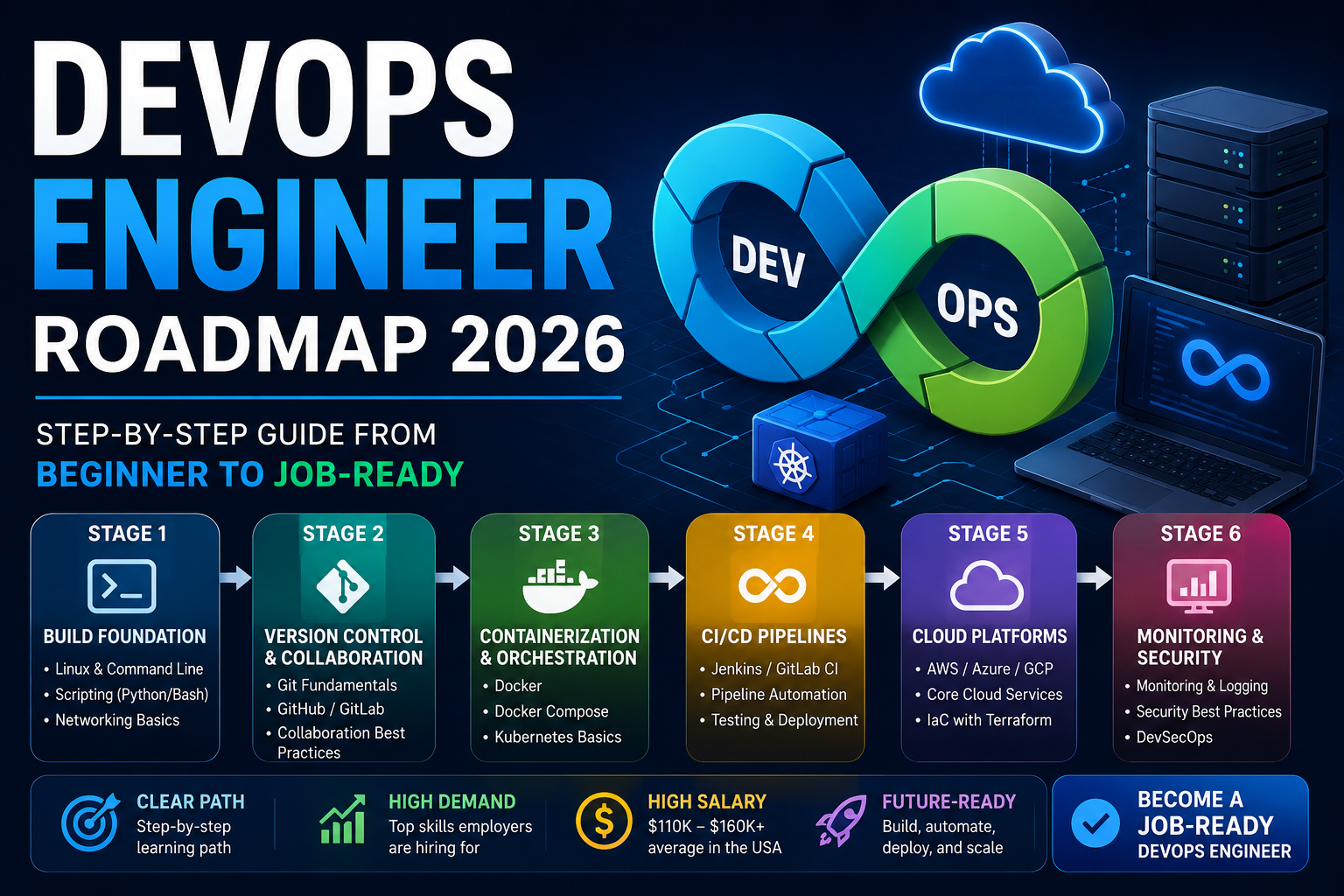
If you are looking for a clear and practical DevOps Engineer Roadmap 2026, you have come to the right place. DevOps engineering is one of the most in-demand and highest-paying careers in the technology industry today. However, with so many tools, skills, and technologies to learn, it can feel overwhelming to know where to start. That is exactly why this complete step-by-step guide exists — to give you a clear, structured path from absolute beginner to job-ready DevOps engineer in 2026.
Whether you are a software developer looking to transition into DevOps, a system administrator wanting to modernize your skills, or a complete beginner exploring the field for the first time, this DevOps Engineer Roadmap 2026 will give you everything you need to move forward with confidence.
What Is a DevOps Engineer?
Before following the DevOps Engineer Roadmap 2026, it is important to understand what the role actually involves. A DevOps engineer is a technology professional who bridges the gap between software development and IT operations. The goal of DevOps is to shorten the software development lifecycle, improve deployment frequency, and deliver high-quality software faster and more reliably.
In practice, DevOps engineers are responsible for:
- Building and maintaining CI/CD pipelines
- Managing cloud infrastructure and server environments
- Automating repetitive development and deployment tasks
- Monitoring application performance and system health
- Collaborating closely with development, QA, and operations teams
- Ensuring security is embedded throughout the development process
In 2026, the DevOps role has evolved significantly. It now overlaps with cloud engineering, platform engineering, and site reliability engineering (SRE), making it one of the most versatile and valuable roles in modern tech organizations.
Why Follow a DevOps Engineer Roadmap in 2026?
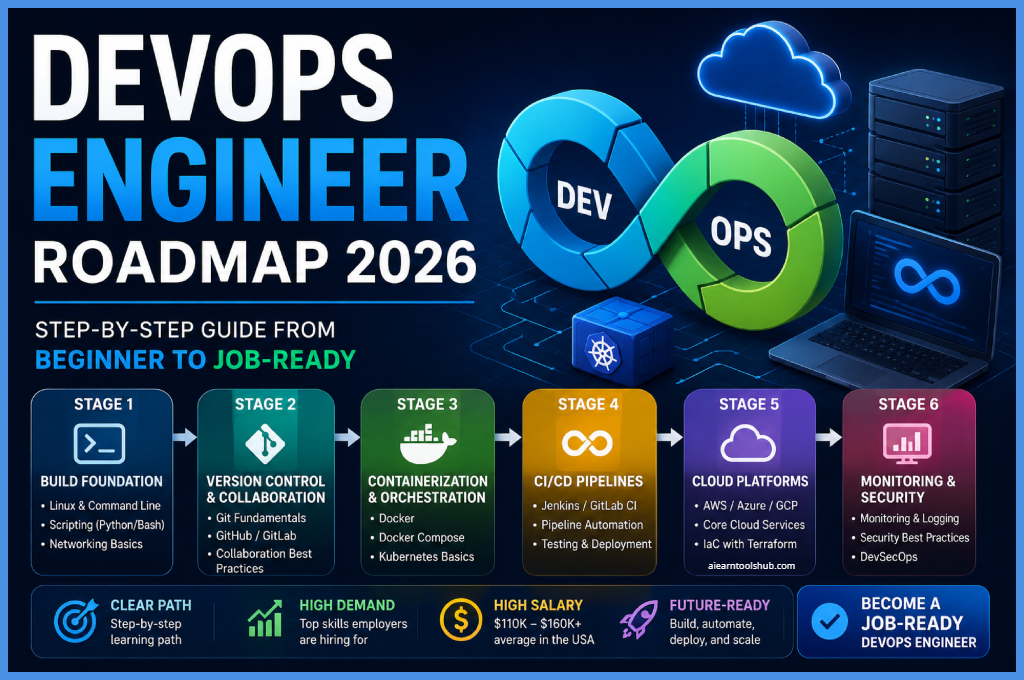
The technology landscape changes rapidly, and the skills required of a DevOps engineer in 2026 are different from what was needed just a few years ago. Following a structured DevOps Engineer Roadmap 2026 helps you avoid wasting time learning outdated tools, focus on skills that employers are actively hiring for, and build a logical progression from foundational knowledge to advanced expertise.
Furthermore, DevOps engineers in 2026 command impressive salaries. According to industry data, the average DevOps engineer earns between $110,000 and $160,000 per year in the United States, with senior roles and cloud specializations pushing even higher. This makes it one of the most financially rewarding career paths in technology.
Stage 1 — Build a Strong Foundation
Every successful DevOps journey begins with a solid foundation. Before touching any DevOps-specific tools, make sure you are comfortable with the following fundamentals.
Learn Linux and the Command Line
Linux is the operating system that powers the vast majority of servers, cloud environments, and containerized applications in the world. Therefore, strong Linux skills are absolutely non-negotiable for any DevOps engineer.
What to learn:
- File system navigation and permissions
- Process management and system monitoring
- Shell scripting with Bash
- Networking basics (IP addresses, DNS, ports, firewalls)
- Package management with apt and yum
Recommended resources: Linux Foundation courses, The Linux Command Line book by William Shotts, and free platforms like OverTheWire for hands-on practice.
Learn a Programming or Scripting Language
DevOps engineers are not full-stack developers, but they do need to write scripts and automate tasks regularly. In 2026, the most valuable languages for DevOps professionals are:
- Python – the most widely used language for automation, scripting, and tooling
- Bash – essential for shell scripting and system automation
- Go (Golang) – increasingly popular for building DevOps tools and cloud-native applications
- YAML – not a programming language, but critical for configuration files across Kubernetes, Ansible, and CI/CD pipelines
Start with Python and Bash. Once you are comfortable with these two, you will have the scripting foundation needed for most DevOps tasks.
Understand Networking Basics
A solid understanding of networking fundamentals is essential for any DevOps engineer. Specifically, you should understand:
- How DNS works and how to configure it
- TCP/IP protocols and how data travels across networks
- Load balancing concepts and how traffic is distributed
- SSL/TLS certificates and HTTPS configuration
- Firewalls, security groups, and network access control
Stage 2 — Master Version Control and Collaboration
Git and GitHub
Version control is the backbone of modern software development and DevOps workflows. In 2026, Git remains the industry standard for source code management, and GitHub, GitLab, and Bitbucket are the most widely used platforms for collaboration.
What to learn:
- Git fundamentals — commits, branches, merges, and pull requests
- GitFlow and trunk-based development workflows
- Code review processes and collaboration best practices
- Managing repositories, issues, and project boards
Moreover, understanding Git at a deep level — including rebasing, cherry-picking, and resolving merge conflicts — will set you apart from candidates who only know the basics.
Stage 3 — Learn Containerization and Orchestration
Containers are one of the most transformative technologies in modern DevOps, and mastering them is a critical step in any DevOps Engineer Roadmap 2026.
Docker
Docker allows you to package applications and their dependencies into lightweight, portable containers that run consistently across any environment. As a result, it eliminates the classic “it works on my machine” problem that plagued software teams for years.
What to learn:
- Writing Dockerfiles and building custom images
- Running and managing containers with Docker CLI
- Docker networking and volume management
- Docker Compose for multi-container applications
- Publishing images to Docker Hub and private registries
Kubernetes
Kubernetes (K8s) is the industry-standard container orchestration platform, and in 2026 it is essentially a mandatory skill for senior DevOps engineers. It automates the deployment, scaling, and management of containerized applications across clusters of servers.
What to learn:
- Core Kubernetes concepts — Pods, Deployments, Services, ConfigMaps, Secrets
- Kubernetes networking and ingress controllers
- Helm charts for application packaging and deployment
- Kubernetes security best practices
- Managed Kubernetes services — AWS EKS, Google GKE, Azure AKS
Stage 4 — Master CI/CD Pipelines
Continuous Integration and Continuous Deployment (CI/CD) are at the very heart of DevOps engineering. Building fast, reliable, and secure CI/CD pipelines is one of the most important skills you will develop on your DevOps Engineer Roadmap 2026.
Top CI/CD tools in 2026:
- GitHub Actions – the most widely adopted CI/CD platform, deeply integrated with GitHub
- Jenkins – the traditional open-source automation server, still widely used in enterprise environments
- GitLab CI/CD – powerful built-in CI/CD for teams using GitLab
- CircleCI – cloud-native CI/CD platform known for speed and simplicity
- ArgoCD—GitOps-based continuous delivery for Kubernetes environments
What to learn:
- Designing multi-stage pipelines (build, test, deploy)
- Running automated tests within pipelines
- Managing secrets and environment variables securely
- Deploying to staging and production environments automatically
- Implementing rollback strategies for failed deployments
Stage 5 — Learn Cloud Platforms
Cloud computing is inseparable from modern DevOps. In 2026, virtually all DevOps workflows run on cloud infrastructure. Therefore, deep knowledge of at least one major cloud platform is essential.
The three major cloud platforms are:
- Amazon Web Services (AWS) – the market leader with the widest range of services
- Microsoft Azure – dominant in enterprise environments, especially Microsoft-heavy organizations
- Google Cloud Platform (GCP) – strong in data, AI, and Kubernetes workloads
What to learn on your chosen cloud platform:
- Compute services (EC2, Azure VMs, GCE)
- Storage services (S3, Azure Blob, GCS)
- Networking (VPCs, subnets, security groups, load balancers)
- Managed Kubernetes services
- Serverless computing (AWS Lambda, Azure Functions, Google Cloud Functions)
- Identity and Access Management (IAM)
Recommended certifications:
- AWS Certified DevOps Engineer – Professional
- Google Professional DevOps Engineer
- Microsoft Azure DevOps Engineer Expert (AZ-400)
Stage 6 — Infrastructure as Code (IaC)
Infrastructure as Code is the practice of managing and provisioning infrastructure through machine-readable configuration files rather than manual processes. In 2026, IaC is a core competency for every DevOps engineer.
Top IaC tools:
- Terraform—the most widely used IaC tool, cloud-agnostic, and highly versatile
- Pulumi – IaC using real programming languages like Python and TypeScript
- AWS CloudFormation – AWS-native IaC tool for managing AWS resources
- Ansible – configuration management and automation tool used for provisioning and deployment
What to learn:
- Writing Terraform configurations to provision cloud resources
- Managing Terraform state files securely
- Using modules for reusable infrastructure components
- Applying configuration management with Ansible playbooks
- Implementing GitOps workflows where infrastructure changes go through version control
Stage 7 — Monitoring, Logging, and Observability
A DevOps engineer’s job does not end at deployment. In fact, monitoring and observability are just as important as building and deploying applications. You need to know when things go wrong — and ideally, detect problems before they impact users.
Top monitoring and observability tools in 2026:
- Prometheus – open-source metrics collection and alerting
- Grafana – powerful dashboarding and visualization for metrics data
- ELK Stack (Elasticsearch, Logstash, Kibana) – centralized log management and analysis
- Datadog – enterprise-grade monitoring, APM, and log management
- New Relic – full-stack observability platform
What to learn:
- Setting up Prometheus and Grafana dashboards
- Configuring alerts and on-call notification workflows
- Centralized log aggregation and analysis
- Application Performance Monitoring (APM)
- Understanding SLIs, SLOs, and SLAs
Stage 8 — DevSecOps and Security Best Practices
Security is no longer a separate concern in 2026 — it is embedded throughout the entire DevOps lifecycle. This approach is known as DevSecOps, and it is a critical component of the modern DevOps Engineer Roadmap 2026.
Key security skills for DevOps engineers:
- Scanning container images for vulnerabilities (Trivy, Snyk)
- Managing secrets securely with HashiCorp Vault or AWS Secrets Manager
- Implementing least-privilege access with IAM policies
- Performing static code analysis (SAST) within CI/CD pipelines
- Understanding compliance frameworks like SOC 2, ISO 27001, and GDPR
Stage 9 — Soft Skills and Professional Development
Technical skills alone will not make you a great DevOps engineer. In addition to the tools and technologies listed above, successful DevOps professionals in 2026 also need strong soft skills.
Essential soft skills include:
- Communication – explaining technical concepts clearly to non-technical stakeholders
- Collaboration – working effectively across development, operations, and security teams
- Problem-solving – debugging complex, distributed systems under pressure
- Documentation – writing clear runbooks, architecture diagrams, and process guides
- Continuous learning – staying updated with a rapidly evolving technology landscape
Recommended Certifications for DevOps Engineers in 2026
Certifications validate your skills and significantly improve your chances of landing a DevOps role. Here are the most valuable certifications to pursue as part of your DevOps Engineer Roadmap 2026:
| Certification | Provider | Level |
|---|---|---|
| AWS Certified DevOps Engineer – Professional | Amazon | Advanced |
| Certified Kubernetes Administrator (CKA) | CNCF | Intermediate |
| HashiCorp Certified: Terraform Associate | HashiCorp | Beginner/Intermediate |
| Google Professional DevOps Engineer | Advanced | |
| Azure DevOps Engineer Expert (AZ-400) | Microsoft | Advanced |
| Docker Certified Associate | Docker | Intermediate |
How Long Does It Take to Become a DevOps Engineer in 2026?
The honest answer depends on your starting point. However, as a general guideline:
- Complete beginner: 12–18 months of consistent learning and practice
- Software developer transitioning to DevOps: 6–9 months
- System administrator modernizing skills: 4–6 months
The key is consistency. Dedicating 1–2 hours per day to learning and hands-on practice will compound over time and get you job-ready faster than you might expect.
Final Thoughts on the DevOps Engineer Roadmap 2026
Following a structured DevOps Engineer Roadmap 2026 is the smartest way to build a career in one of technology’s most exciting and well-compensated fields. From Linux fundamentals and Git to Kubernetes, Terraform, and DevSecOps, each stage of this roadmap builds naturally on the previous one.
The most important advice is this: do not just read and watch tutorials. Build real projects, set up your own cloud environments, break things, fix them, and document everything you learn. Hands-on experience is what separates candidates who get hired from those who stay stuck in tutorial loops.
The demand for skilled DevOps engineers in 2026 is higher than ever, and companies are actively competing for qualified talent. Start today, follow this roadmap step by step, and you will be well on your way to a rewarding and future-proof DevOps career.

Welcome to aiearntoolshub ! I am Ehteshaam, an AI-powered SEO and content writer with over 2 years of experience in the AI and digital content space. I created this platform to help everyday people explore AI tools, learn practical online earning strategies, and stay ahead in the world of technology. My content is research-based, honest, and written to make AI simple for everyone.