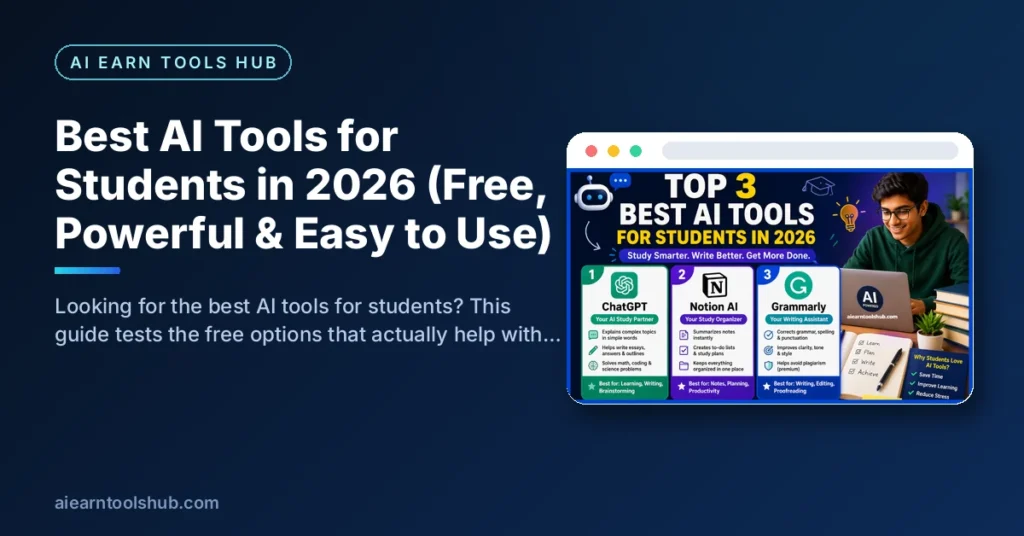
Best AI Tools for Students in 2026 (Free, Powerful & Easy to Use)
Looking for the best AI tools for students? This guide tests the free options that actually help with notes, essays, research and exam prep — the best AI tools for students are the ones that save time without doing the thinking for you.
Last checked: November 2026
Key Takeaways
This box sums up the best AI tools for students in this guide in under a minute.
- ChatGPT is, among the best AI tools for students, the best all-round pick for explaining topics, outlining essays, and brainstorming ideas — and its free Study Mode now acts like a patient tutor.
- Gemini Notebook (formerly NotebookLM) is, among the best AI tools for students, best for studying from your own notes, PDFs, and slides — it answers only from your materials.
- Perplexity is one of the best AI tools for students for research you can verify, because every answer comes with citations to its sources.
- Grammarly is one of the best AI tools for students for fixing grammar, clarity, and tone before you submit written work.
- Free plans are enough for most students; pay only when a paid feature solves a weekly problem.
- Use AI to understand and improve your work — never to copy and submit it as your own.
Introduction
The best AI tools for students in 2026 are ChatGPT for learning and writing, Gemini Notebook for studying from your own materials, Perplexity for research with citations, and Grammarly for polishing work. Each tool solves a different study problem, so the right choice depends on your task. Start free, learn one tool well, and add another only when you need it.
Student life in 2026 is more demanding than ever. From tight deadlines to complex subjects, keeping up can feel overwhelming. But there’s a smarter way to study today.
AI tools for students are transforming how learning works.
Instead of spending hours summarizing notes or struggling with writing assignments, students can now use AI to save time, improve accuracy, and learn faster.
In this guide, you’ll discover the best AI tools for students in 2026 that are free, easy to use, and highly effective.
Why Are AI Tools Important for Students in 2026?
The best AI tools for students are important in 2026 because they turn passive study into active learning and cut routine work such as summarizing and planning. They explain hard topics in simpler words, give quick feedback on writing, and help you revise on a schedule. They do not replace reading or practice, but they make both easier to stick with.
Traditional study methods are no longer enough.
Re-reading notes and highlighting textbooks often wastes time without improving understanding. AI tools solve this problem by making learning faster and more interactive.
Key Benefits of AI Tools for Students
The best AI tools for students give five clear benefits: saving time, understanding topics faster, writing more clearly, staying organized, and feeling less stressed before deadlines. The biggest gain is not speed alone — it is getting feedback while you study, when you can still fix mistakes. That is why small, daily use beats last-minute use the night before an exam.
- Save Time: Summarize long content in seconds
- Improve Writing: Fix grammar and clarity instantly
- Better Understanding: Get simple explanations for complex topics
- Stay Organized: Manage notes, tasks, and deadlines easily
- Reduce Stress: Handle academic pressure more efficiently
AI doesn’t replace learning — it makes it more effective. Used this way, the best AI tools for students deliver these benefits without doing the learning for you.
Student Deals Worth Claiming Before They Expire
Before the tool list, check these student offers — they are time-limited, and two of them are worth more than any free tier in this guide. All of them need a payment method at sign-up and renew at full price unless you cancel, so set a reminder before the free period ends.
- Google AI Pro free for a year (US) / Google AI Plus free for a year (140+ other markets): eligible college students aged 18 and over get 12 months free if they redeem by December 31, 2026. AI Pro includes higher Gemini limits, Gemini in Gmail and Docs, and 5 TB of storage; after the year it renews at $19.99 a month (Pro) or $4.99 a month (Plus). Student status is verified through SheerID. Check your country at gemini.google/students.
- GitHub Copilot free for students: verified students get the Copilot Student plan free through the GitHub Student Developer Pack — unlimited code completions plus an allowance of AI credits for chat and agent features. It lasts while your student status is verified.
- Perplexity Education Pro, about $10 a month: verified students get roughly half off Perplexity Pro, with unlimited Pro searches. Try the free tier first — it already answers with citations.
- Otter Pro, 20% off with a .edu email: lecture transcription at $13.59 a month instead of $16.99. The free plan already gives 300 transcription minutes a month.
One offer that has already ended: OpenAI’s four free months of ChatGPT Plus for US college students closed on October 31, 2026. If a guide still lists it, that guide is out of date. ChatGPT’s free plan itself — including Study Mode — is still free for everyone.
1. ChatGPT — Best AI Tool for Studying and Writing
Best for: Essay writing, explanations, brainstorming
ChatGPT is one of the most powerful AI tools for students. It can help you understand difficult topics, generate ideas, and even create structured essays.
Key Features:
- Explains complex concepts in simple language
- Generates essays, outlines, and summaries
- Helps with math, coding, and science problems
- Available 24/7 for instant help
Why students love it: It acts like a personal tutor that is always available.
New in 2026 — Study Mode: ChatGPT now has a free Study Mode that teaches instead of just answering. Turn it on by typing @study in a new chat or going to chatgpt.com/studymode, and it asks you questions, gives hints, and quizzes you as you go — the Socratic approach, instead of handing over a finished answer. Study Mode is free on every plan, including the free plan, and it works with every ChatGPT model. It can still make mistakes, so double-check anything important. If you want better prompts for it, our AI Prompt Generator turns a rough idea into a structured prompt, and our guide to writing AI prompts shows how to ask well.
2. Gemini Notebook — Your Smartest Study Partner (Formerly NotebookLM)
Best for: Studying from your own notes, PDFs, and slides
Gemini Notebook is one of the best free AI tools for students because it works only from the materials you upload — your notes, slides, and textbooks — instead of guessing from the open web. Its summaries, mind maps, and practice questions therefore match your actual course, which is why it sits near the top of any list of the best free AI tools for students for exam revision.
The name changed in July 2026: Google renamed NotebookLM to Gemini Notebook. It is the same standalone product — your notebooks, sources, and shared links carried over unchanged, and the old notebooklm.google address now redirects to notebook.google.com. Most students still search for “NotebookLM”, so this guide uses both names.
Here is how it works. You upload your notes, lecture slides, research papers, or PDF textbooks. Gemini Notebook reads them and turns them into an interactive study assistant that only answers from your uploaded material. You ask questions, and it gives you answers with source citations — so you know exactly where the information came from.
The practical value of this is huge. Imagine you are revising for a history exam and you have notes from twelve different lectures. Instead of scrolling through everything looking for a specific date or event, you just ask Gemini Notebook. It finds it instantly, explains it in context, and tells you which document it came from.
For students in Pakistan and South Asia, who often study from PDF textbooks rather than physical books — because digital copies are more accessible — this tool is particularly powerful. It works beautifully with text-based PDFs and handles Urdu-mixed English reasonably well for questions asked in English.
One important caveat: it works best with clean, text-based files. Scanned handwritten notes with low image quality will frustrate it. Typed notes and digital PDFs are where it shines. The free plan covers 100 notebooks with up to 50 sources each, plus chat, audio overviews, flashcards, and quizzes.
3. Perplexity — Best for Research You Can Actually Verify
Best for: Research, citations, checking facts before you cite them
Perplexity is the research assistant this list of the best AI tools for students was missing. You ask a question and it searches the live web, then answers with numbered citations to the sources it used — so you can click through and check every claim before it goes into your assignment. That one difference makes it more useful than a standard chatbot for anything you need to verify.
Key Features:
- Every answer carries inline citations to real sources
- Searches the live web, so answers reflect current information
- Follow-up questions that narrow a topic down step by step
- File uploads on paid tiers for questioning your own documents
Why students love it: It ends the worst student habit — copying a confident-sounding AI answer that turns out to be invented. If Perplexity cannot cite it, you know not to trust it.
The catch: the free tier gives standard cited answers plus a small daily allowance of the more powerful Pro searches. Verified students can get Education Pro for about $10 a month — roughly half the $20 standard Pro price — with unlimited Pro searches. Try the free tier for a month first; for most coursework, it is enough.
4. Claude — Best for Long Readings and Careful Writing
Best for: Dense readings, long documents, nuanced essay writing
Claude is the quiet heavyweight of the best AI tools for students. It handles long documents well — paste in a dense reading or a full problem set and it works through it carefully, explaining as it goes. Its writing is more measured than most chatbots, which makes it a strong second opinion when you are drafting something that needs to sound like you, not like a template.
Key Features:
- Strong with long documents and multi-step reasoning
- Clear, careful explanations that suit academic writing
- File uploads and web search on the free tier
- Learning Mode, which guides you with questions instead of giving answers away
Why students love it: When ChatGPT gives you a fast answer and you are not sure it is right, Claude is the tool to check it against. Two different models agreeing is a much better sign than one model sounding confident.
The catch: the free tier has a daily message limit, so it is a checker and a drafter, not an all-day chat window. There is no official student discount; Claude Pro is $20 a month.
5. Grammarly — Best AI Writing Assistant
Best for: Grammar correction and writing improvement
Grammarly is one of the best AI tools for students who want error-free and professional writing. It goes beyond spell-checking and improves tone, clarity, and structure.
Key Features:
- Real-time grammar and spelling correction
- Tone and clarity suggestions
- Improves sentence structure
- Plagiarism checker (premium)
Why students love it: It helps them write confidently and score better.
Run your draft through Grammarly at the end, not the start: write the essay yourself first, then let it catch the grammar and unclear sentences. Read every suggestion before you accept it — the ideas and wording must stay yours. If you are counting words or characters for an assignment limit, our free Word Counter and Character Counter check the length in seconds.
6. Notion AI — Best for Notes and Organization
Best for: Note-taking, productivity, study planning
Notion AI is one of the best AI tools for students for organizing their academic life in one place. From managing assignments to summarizing lecture notes, it keeps everything structured.
Key Features:
- Auto-summarizes notes
- Creates to-do lists and study plans
- Organizes projects and deadlines
- Improves writing inside notes
Why students love it: It turns chaos into a clear system.
Notion AI works best when you keep all your notes in one place — that is the deal. If your notes live in five different apps, fix that first; no AI feature rescues a scattered system.
7. Google Gemini — AI Built Into the Tools You Already Use
Best for: Help inside Google Docs, Slides, and Gmail
Google Gemini is one of the best free AI tools for students who already live in Google Docs, Slides, and Gmail, because the help appears inside the apps you already use every day. You can draft, improve, and organize work where it already lives, without copying text between separate tools or learning a new platform.
Most students already use Google Docs, Google Slides, and Gmail. Google Gemini is AI built directly into those tools — which means no learning curve, no new account, and no switching between platforms.
Inside Google Docs, Gemini can help you draft sections, suggest improvements to existing paragraphs, change the tone of your writing, summarize long documents, and generate outlines. Inside Google Slides, it can create presentation structures from a brief description. In Gmail, it drafts professional emails to professors or scholarship committees in seconds.
For students in countries where Google’s ecosystem is the dominant productivity platform — which includes much of South Asia, Africa, and the Middle East — this integration has real practical value. You are not adding a new tool to your workflow. You are adding intelligence to the workflow you already have.
The free access to Gemini within Google Workspace is generous for standard student use. Some advanced features shift to paid tiers, and availability of specific capabilities varies by region. However, for core writing and research assistance, the free integration is genuinely useful. Gemini also has its own Guided Learning mode, which — like ChatGPT’s Study Mode and Claude’s Learning Mode — walks you through a topic with questions instead of handing over the answer.
Don’t miss the student offer: eligible college students can get a full year of Google AI Pro (or Google AI Plus outside the US) free if they redeem by December 31, 2026 — see the deals section above before you pay for anything.
8. QuillBot — For When You Need to Rewrite, Not Just Edit
Best for: Rewriting and condensing text you already understand
QuillBot is one of the best AI tools for students for rewriting and condensing text you already understand, helping you say the same idea in clearer words of your own. Its free paraphrasing, summarizing, and citation tools work best after you have drafted something yourself and need to polish or shorten it.
QuillBot solves a specific problem that most students face regularly: you understand something, and you have read the source material, but when you try to write it in your own words, it still sounds too close to the original. QuillBot paraphrases text intelligently. You paste in a passage, and it rewrites it while preserving the meaning — in multiple different styles, including formal, simple, creative, and academic.
It also has a summarizer that condenses long passages into shorter versions and a citation generator that formats references automatically.
The free tier limits you to a set number of words per paraphrase session, which is genuinely a constraint. However, for most standard essay paragraphs and research summaries, the free limit is sufficient if you use it strategically rather than running entire papers through it at once.
One important warning that applies globally but matters especially in academic settings: QuillBot is a tool for helping you express ideas in your own voice, not for disguising plagiarized content. Universities have plagiarism detection tools that can identify AI-paraphrased text. Use QuillBot to improve your own drafts, not to repackage someone else’s work.
9. ChatPDF — Talk to Your Textbooks
Best for: Questioning PDF textbooks and long readings
ChatPDF is one of the best AI tools for students for getting through long PDFs, because you upload a textbook chapter or research paper and ask it questions in plain language. Instead of re-reading hundreds of pages, you get answers drawn from the document itself — exactly why students rate it among the best free AI tools for students for heavy reading weeks.
This one sounds almost too good to be true, but it works exactly as advertised.
ChatPDF lets you upload any PDF — a textbook chapter, a research paper, a set of lecture notes — and then have a conversation with it. You ask questions. It answers from the document. It tells you which page the answer came from.
For a student preparing for an exam on a 300-page textbook they have not fully read, ChatPDF is transformative. You ask it what the most important concepts are. You ask it to explain the theory on page 47 in simpler terms. You ask it to generate five practice questions based on chapter three. It does all of this in seconds.
In Pakistan and South Asia, where many students rely on digital PDF textbooks rather than physical books — partly because physical textbooks can be expensive or hard to access in certain cities — ChatPDF is one of the most practically useful free AI tools for students available right now.
The free plan has file size limits and a cap on the number of PDFs you can upload per day. For most regular study sessions, these limits are manageable. For heavy research use, you may hit the ceiling and need to be strategic about which documents you prioritize. Note that Gemini Notebook does the same grounded-from-your-documents job with a bigger free allowance — if you hit ChatPDF’s limits, try it there first.
10. Gamma AI — Presentations Without the Pain
Best for: Presentations and slide decks
Gamma AI is one of the best AI tools for students for presentations, because it turns a topic, outline, or block of text into a structured, professionally designed deck in minutes. You spend your preparation time on what you will actually say, not on aligning text boxes and hunting for templates.
Every student has spent more time making a presentation look good than actually preparing the content. Gamma AI solves the design problem so you can focus on the substance.
You give Gamma a topic, a rough outline, or a block of text, and it generates a complete, visually polished presentation. The design is handled automatically — layouts, colors, fonts, and image suggestions all appear without manual effort. You then edit the content to match exactly what you want to say.
For students who dread presentation assignments not because of the content but because of the design work — and that is most students — Gamma is a genuine relief. The free tier allows a meaningful number of AI-generated presentations per month.
One realistic caution: Gamma presentations have a recognizable visual style. If your entire class is using Gamma and the professor notices that several submissions look nearly identical, it may create an awkward conversation. Use it as a starting point and customize the design enough that it reflects your own choices.
How Do Students Choose the Right AI Tool?
Choose the right AI tool by matching it to one clear task first, not by installing every app you see. If you struggle to understand a topic, start with a tutor-style tool; if your notes are messy, start with an organizer; if writing costs you marks, start with a writing assistant. Test the free plan on real coursework for a week before paying or adding another tool.
With so many AI tools available, choosing the right one can be confusing.
Ask Yourself:
- Do you struggle with writing, studying, or organization?
- Do you need a free tool?
- Do you prefer mobile apps or browser tools?
Best Starter Combination:
- ChatGPT → Learning and understanding
- Gemini Notebook → Studying from your own materials
- Grammarly → Writing improvement
- Notion AI → Organization
Start small and expand as needed — the best AI tools for students are the ones you still use after the first month.
How Should Students Use AI the Right Way?
Use AI as a tutor and editor, not as a ghostwriter: ask it to explain, quiz, outline, and give feedback, then write and check the final work yourself. That approach improves your learning and keeps your work honest and in your own voice. If your school’s rule on a graded assignment is unclear, ask your teacher first.
Using AI the wrong way can harm your learning.
Use AI Like This:
- To understand concepts
- To improve your writing
- To organize your study process
Avoid This:
- Copy-pasting assignments
- Submitting AI work without editing
Tip: Use AI as a helper, not a shortcut. Used honestly, the best AI tools for students improve your work without replacing it. The three learning modes in this guide — ChatGPT’s Study Mode, Claude’s Learning Mode, and Gemini’s Guided Learning — are built for exactly this: they question you instead of doing the work for you.
Which AI Tool Is Best for Each Student Task?
There is no single winner among the best AI tools for students, because the right pick depends on the task in front of you. Match one tool to one job, and your study system stays simple and free to start. Used together, the best AI tools for students cover the whole study week, from first lesson to final test.
For Essays and Assignments
Best pick: ChatGPT for planning, with Grammarly for the final polish. Ask ChatGPT for an outline, examples, and counter-arguments, then draft each paragraph yourself from your course material. Run the draft through Grammarly at the end to fix grammar and unclear sentences, and read every suggestion before you accept it — the ideas and wording must stay yours. For most coursework, that pairing of the best AI tools for students is the place to start.
For Research and Citations
Best pick: Perplexity for finding sources, with Gemini Notebook for studying your own documents. Use Perplexity when you need facts you can verify — every answer comes with citations you can click. Use Gemini Notebook when the answer must come from your course readings, not the open web. Cross-check anything important in both.
For Math and Science Problems
Best picks: Photomath for checking a problem you have already attempted, and ChatGPT for understanding it. Compare your steps, then ask ChatGPT to explain why each step works instead of only giving the final answer. Then close the chat and solve a similar problem alone; if you cannot, you have found the exact gap to revise. Better still, use ChatGPT’s Study Mode — it will quiz you on the steps instead of handing you the solution.
For Language Learning
Best picks: Duolingo for short structured daily lessons, and ChatGPT for conversation and writing practice. Ask ChatGPT to hold a short conversation at your level, correct your sentences, and explain each correction in simple words. Short daily practice works better than one long session, and writing your own sentences builds real fluency.
For Exam Prep and Revision
Best picks: Quizlet for flashcards and practice questions made from your own notes, and Notion AI to organize your revision. Turn each topic into questions, test yourself without looking at the answers first, and note every topic you got wrong. Keep that weak-topic list in Notion AI and revise it again a few days later, when spaced practice helps most. Gemini Notebook’s practice questions and audio overviews, made from your own notes, are the strongest free option here.
For Lectures You Missed
Best pick: Otter for turning a recorded lecture into searchable notes. Its free plan gives 300 transcription minutes a month with a 30-minute cap per recording, and every transcript is searchable — so you can find the one minute of a two-hour lecture that matters. Check your university’s policy before recording a lecture; many institutions require the lecturer’s permission.
For Learning to Code
Best pick: GitHub Copilot, free for verified students. Copilot Student gives you unlimited code completions plus chat and agent help inside VS Code and other editors — it explains error messages in plain language and suggests the next line of code while you learn. Sign up through the GitHub Student Developer Pack. AskCodi-style assistants still exist, but none of them matches a free Copilot plan that is verified through your student status.
For Presentations and Group Projects
Best picks: Canva for clean, simple slides, ChatGPT for structure and wording, and Notion AI for group planning. Use ChatGPT to turn your research into a clear slide outline — one main point per slide — and to draft speaker notes in plain language. Use Notion AI to share tasks and deadlines with your group. Gamma turns that outline into a finished deck if design is the bottleneck.
How Do the Best Free AI Tools for Students Compare at a Glance?
The table below compares the best free AI tools for students side by side, so you can choose by study job instead of by hype. Every row is one of the best free AI tools for students for that job, and every tool in the table can be started on a free tier today.
| Tool | Best For | Standout Free Use |
|---|---|---|
| ChatGPT | Explaining difficult concepts | Step-by-step explanations, Study Mode, practice questions, and study plans |
| Gemini Notebook | Studying from your own materials | Summaries, mind maps, audio overviews, and practice questions from your uploads |
| Perplexity | Research with citations | Live-web answers with sources you can click and verify |
| Claude | Long readings and careful writing | Deep document work, Learning Mode, and a strong second opinion |
| Grammarly | Grammar and clarity checks | Real-time grammar, spelling, and punctuation checks as you write |
| QuillBot | Paraphrasing and summarizing | Rewriting support plus a free summarizer and citation generator |
| Google Gemini | Help inside Google Workspace | Drafting and improving work inside Docs, Slides, and Gmail |
| ChatPDF | Questioning PDF textbooks | Chat answers grounded in the PDF you upload |
| Notion AI | Organizing notes and tasks | Summaries, task lists, and searchable study notes |
| Gamma AI | Presentations | Structured, designed decks from a topic, outline, or text |
| GitHub Copilot | Learning to code | Unlimited code completions free for verified students |
| Otter | Lecture transcription | 300 free transcription minutes a month, searchable transcripts |
If you remember only one row, remember this: the best free AI tools for students work best in combination — one tool to understand, one tool to organize, and one tool to check your work before you submit it. Start with the rows for your weakest subjects, and the best free AI tools for students will quickly narrow themselves down to a personal shortlist you can actually stick to.
The $0 Student Stack: One Free Tool for Each Study Job
A $0 student stack is a small set of free tools in which each tool has one clear job, so together they cover your whole study week for nothing. Built entirely from the best free AI tools for students above, a starter stack looks like this:
- Study your own materials: Gemini Notebook — summaries, mind maps, and practice questions from your uploads.
- Understand anything difficult: ChatGPT — step-by-step explanations and follow-up questions on any topic — the thinking partner at the heart of the best free AI tools for students.
- Research with proof: Perplexity — cited answers you can verify before you cite them.
- Question long readings: ChatPDF — direct answers from your PDF textbooks and papers.
- Write without easy errors: Grammarly — a real-time check on every essay and assignment.
- Organize everything: Notion AI — notes, deadlines, and revision material in one searchable system.
- Build presentations fast: Gamma AI — a finished deck from an outline, leaving you time to rehearse.
- Never miss a lecture: Otter — searchable transcripts of the lectures that matter most.
- Learn to code: GitHub Copilot — free for verified students, inside the editor you already use.
That is the whole point of collecting the best free AI tools for students into a stack: each tool earns its place by doing one job well. Add a tool only when a real study problem appears, remove any tool you have not opened in two weeks, and let the best free AI tools for students do the heavy lifting around your learning — never the learning itself.
Are Free AI Tools Enough for Students, or Should You Pay?
For most readers, the free versions of the best AI tools for students are enough for everyday study. Free plans cover explaining, summarizing, organizing notes, and basic grammar checks — the core help in this guide. Paid plans mainly add convenience, such as higher usage and more advanced features, rather than a completely different result.
Start free and keep a short note of what frustrates you. If you rarely hit a limit and your marks are improving, there is no reason to pay. If one paid feature — deeper writing checks before important submissions, or all your notes and AI help in one workspace — would save you time every week, it may be worth it during a busy term.
A simple rule for the best AI tools for students on a budget:
- Stay free while you are learning the tool and building the habit.
- Pay only for one tool, for the task that matters most to your grades.
- Cancel or pause when the busy period ends, and never pay because of a discount countdown.
Remember that a paid plan cannot fix a weak study routine. The students who gain most from these tools ask better questions, check the answers, and revise regularly — habits that cost nothing. Spend on study time and consistency first, and on software second. That is why this guide ranks the best AI tools for students by study value first, and by price second.
FAQs About AI Tools for Students
These short answers cover the questions students ask most about the best AI tools for students, from cost and cheating to exam prep and paying.
1: Are AI tools free for students?
Yes, most AI tools offer free plans with enough features for daily academic use.
2: Is using AI tools considered cheating?
No, if used correctly. AI should support learning, not replace your effort.
3: What is the best AI tool for writing essays?
ChatGPT is great for generating ideas, while Grammarly is best for improving and polishing writing.
4: Can AI help with math and science?
Yes, AI tools can solve problems, explain formulas, and guide you step by step.
5: What is the best AI tool for exam prep?
ChatGPT is a strong choice for exam prep because it can turn your notes into practice questions and explain the answers you got wrong. Pair it with Notion AI to keep your revision list and weak topics organized.
6: Do students need to pay for AI tools?
No. Most students can study well with the free plans of the best AI tools for students, which cover the core help in this guide. Pay only if a paid feature solves a problem you meet every week, and stop when it no longer does.
7: What are the best free AI tools for students in 2026?
The best free AI tools for students in 2026 include Gemini Notebook (formerly NotebookLM), ChatGPT, Perplexity, Claude, Grammarly, QuillBot, Google Gemini, ChatPDF, Notion AI, and Gamma AI. Each serves a different academic need — from writing and research to coding, presentations, and personalized tutoring.
8: Are AI tools safe to use for academic assignments?
Most universities have AI use policies that vary significantly. Some allow AI assistance with disclosure, some prohibit it entirely, and some have no policy yet. Always check your institution’s guidelines before using AI tools for graded work. Use AI to support your learning, not to replace your own thinking and writing.
9: Can students in Pakistan use these AI tools for free?
Yes. All ten tools on this list have free tiers accessible from Pakistan and South Asia. Some features may vary by region, and a few tools work better with faster internet connections. ChatGPT, Grammarly, QuillBot, and Gemini Notebook all work reliably in Pakistan on standard broadband or mobile data connections.
10: Will using AI tools make me a worse student?
Only if you use them passively – copying output without engaging or learning. Used correctly, AI tools make you a more efficient and capable student by handling mechanical tasks and helping you understand concepts more deeply. The key is to stay actively engaged rather than letting the tool do your thinking for you.
11: How many AI tools should a student actually use?
Two or three. Pick one of the best free AI tools for students for studying, one for writing, and one for organizing, then use them daily for a full week before adding anything else. A small stack you actually open beats ten forgotten accounts — and because every tool here is free, your whole setup can stay at $0 while it earns its place. Start with any three of the best free AI tools for students above, use them for a full week of classes, and keep only the ones that earn their place – that shortlist becomes your personal set of best free AI tools for students for the whole semester.
Conclusion
In short, start with one of the best AI tools for students above, use it daily, and keep your own thinking in charge.
AI tools are no longer optional for students in 2026 — they are essential.
From improving writing to saving time and reducing stress, the best AI tools for students — tools like ChatGPT, Gemini Notebook, Perplexity, and Grammarly — are changing how students learn.
The key is simple: Use AI to work smarter, not to avoid learning. Start with one tool, build your system, and you’ll see real results in your academic performance.
Final Takeaway
Students who use AI wisely will always have an advantage. 🚀
Your next step is simple: choose one task you struggle with, pick the matching tool from this guide, and use it in your next study session today. That balance — help from AI, effort from you — is the whole point.
Related Guides
- How to Write AI Prompts: A Practical Guide — write better prompts and get better answers from every tool in this guide.
- How to Make YouTube Scripts with AI — turn your study notes into video scripts and presentations.
- ChatGPT Upwork Proposals: Win More Freelance Work — use your AI skills to earn while you study.
- Best Online Earning Apps Using AI — real ways students can earn with AI tools.
- Typing Speed Test: 7 Best Free Tools to Check & Improve WPM (2026)
- AI Plagiarism Checker Free: 7 Best Tools for Students (2026)
- AI Citation Generator: Free APA & MLA Tools That Format It Right (2026)
- AI Quiz Generator Tools for Studying Smarter (2026)
- AI Homework Helper: 8 Best Tools That Explain (2026)




[…] get a separate free plan. If you are still sorting out coursework tools, see our guide to the best AI tools for students in 2026. And if you never write code, skip this one entirely, because it will do nothing for your Word […]
[…] who read a lot will get the most from it. See our list of the best AI tools for students in 2026 for more study […]
[…] to a 15-year-old, then give me three practice questions.” For schoolwork, our list of the best AI tools for students adds more […]
[…] Best Free AI Tools for Students 2026 — free tools anyone can use to create better content […]