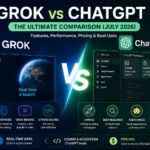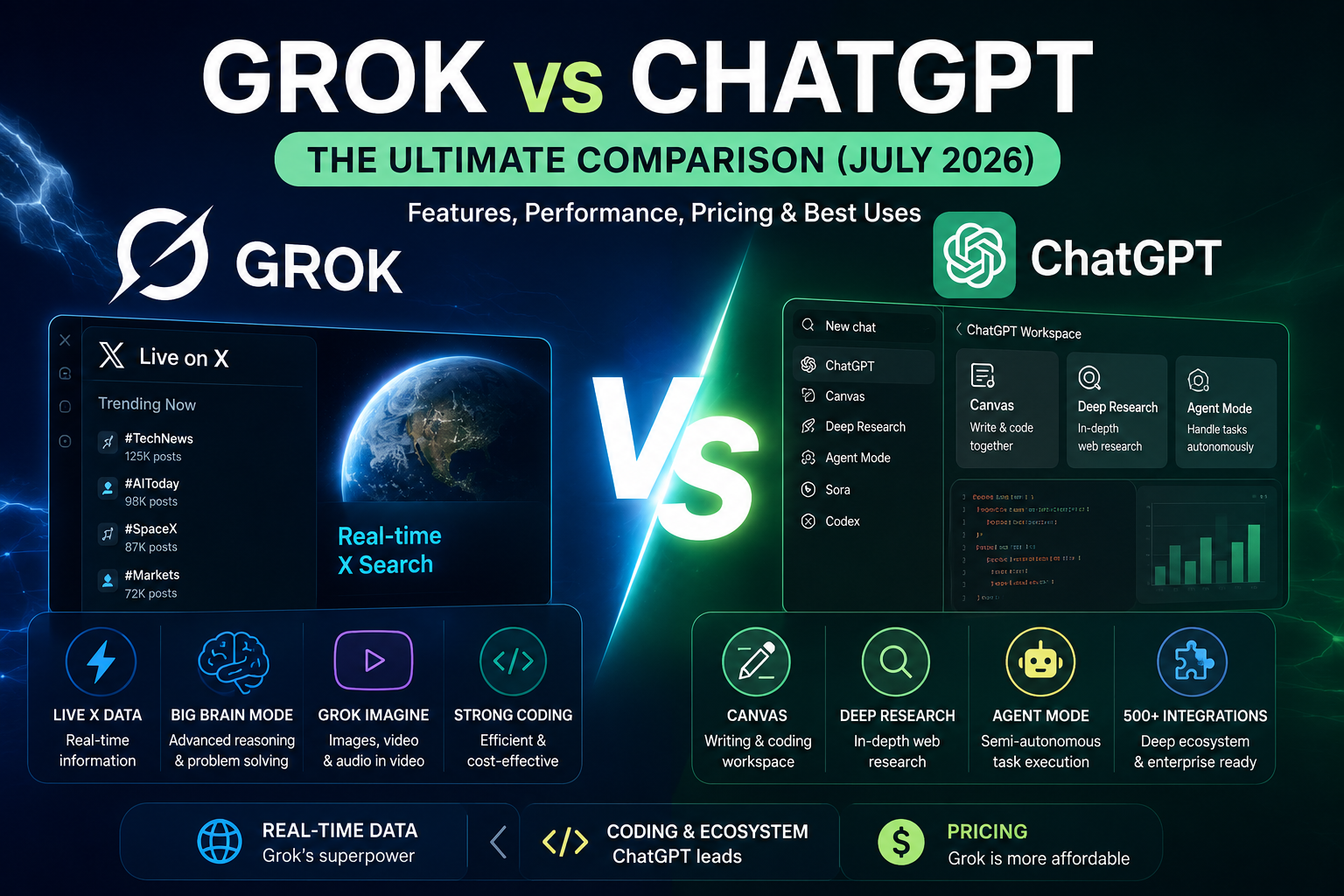
I asked a friend in the USA last week to settle the Grok vs ChatGPT question for me. He said ChatGPT for work and Grok for “seeing what’s actually happening on X.” That answer, it turns out, is basically the whole comparison.
Grok is xAI’s assistant built around live X data and math-heavy reasoning. ChatGPT is OpenAI’s assistant built around polish, breadth, and reliability. Neither one wins everything, and pretending otherwise is how you end up paying for the wrong subscription.
What Is Grok?
Grok is xAI’s AI assistant that pulls live data from X, reasons through math and code with its “Big Brain” thinking mode, and generates images and video through a feature called Grok Imagine—built for people who need fresh information, not last year’s training data.
It’s not a general writing assistant with a decade of plugins behind it. It’s the fast-orientation tool: the one you open when you want to know what’s trending right now, not the one you open to draft a client proposal.
The current flagship, Grok 4.5, rolled out on July 8, 2026, built on xAI’s V9 foundation model and trained on real developer activity from Cursor (which SpaceX acquired earlier in the year, after the SpaceX-xAI merger closed in February 2026). It’s a meaningful jump over Grok 4.3 in coding and reasoning, and it comes at a strikingly low API price: $2 per million input tokens and $6 per million output.
Grok’s one real superpower: live X search. Nothing else on the market reads real-time social sentiment and breaking posts the way Grok does.
What Is ChatGPT?
ChatGPT is OpenAI’s AI assistant that writes, codes, researches, and now runs semi-autonomous agent tasks through Canvas, Deep Research, and Agent Mode — the closest thing on the market to one tool that handles most knowledge work.
Not a chatbot that answers questions in isolation, but a workspace: Canvas turns a chat into a shared writing and coding surface, Sora generates video, and Codex handles repository-level programming. That breadth is the whole pitch.
GPT-5.6 (internally split into Sol, Terra, and Luna variants) went to general availability on July 9, 2026 — one day after Grok 4.5 — and is now the default model inside ChatGPT. It followed GPT-5.5, which reached the API in April 2026.
ChatGPT’s one real superpower: consistency. It’s what 92% of Fortune 500 companies were running some form of by mid-2026, and that adoption didn’t happen because it’s flashy. It happened because it rarely falls apart mid-task.
Grok vs ChatGPT: Key Differences
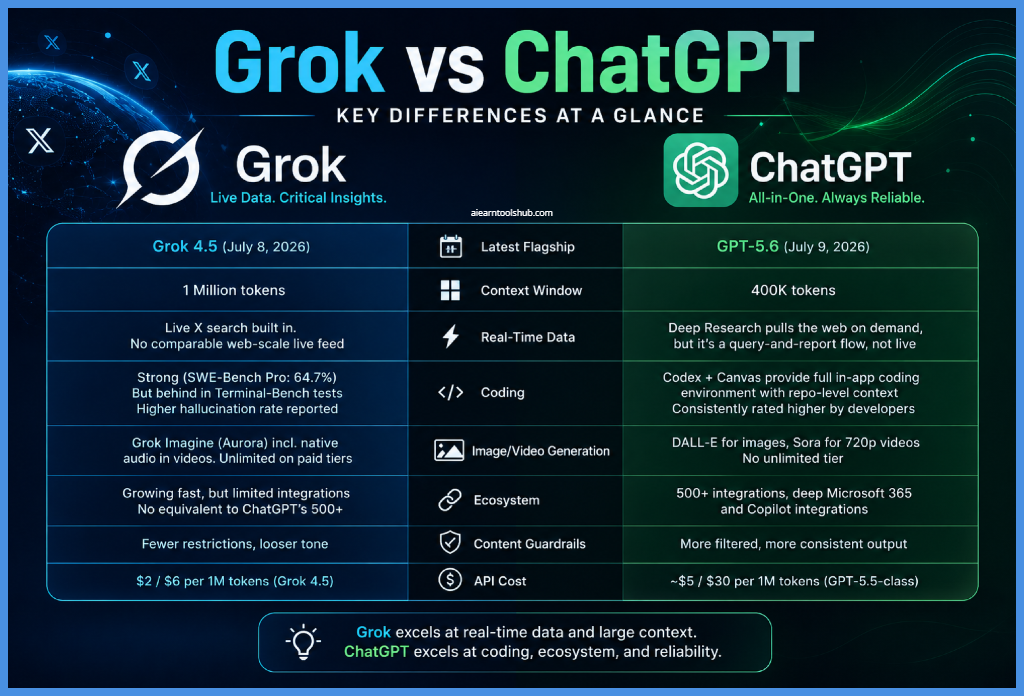
Specs only tell you half the story, but they’re the half worth starting with. Here’s where the two actually diverge, feature by feature.
| Feature | Grok | ChatGPT |
|---|---|---|
| Latest flagship | Grok 4.5 (July 8, 2026) | GPT-5.6 (July 9, 2026) |
| Context window | 1M tokens | 400K tokens |
| Real-time data | Live X search built in. No comparable web-scale live feed for ChatGPT’s free/Plus tiers without add-ons | Deep Research pulls the web on demand, but it’s a query-and-report flow, not a live feed |
| Coding | Strong and token-efficient (SWE-Bench Pro: 64.7%), but independent Terminal-Bench numbers put it behind Claude and GPT-5.5’s Codex harness | Codex and Canvas give a full in-app coding environment with repo-level context. Most developers still rate it higher day-to-day |
| Image/video generation | Grok Imagine (Aurora model), including native audio in video clips. Unlimited on paid tiers — in theory | DALL-E for images, Sora for 720p video clips. No unlimited tier |
| Ecosystem | Growing fast, but still thin — no equivalent to ChatGPT’s 500+ integrations | 500+ third-party integrations, deep Microsoft 365 and Copilot ties |
| Content guardrails | Fewer restrictions, looser tone | More filtered, more consistent output |
| API cost | $2 / $6 per 1M tokens (Grok 4.5) | Roughly $5 / $30 per 1M tokens (GPT-5.5-class pricing) |
A table like this rewards the tool with more checkmarks, so read the columns, not the row count. Grok wins on raw context size and live data. It does not win on coding reliability, ecosystem depth, or enterprise trust, and those three matter more for most day-to-day work.
Real-Time Data: Grok’s Actual Moat
This is the one category where the gap isn’t close. Grok reads X in real time; ChatGPT does not have an equivalent live social feed on its consumer tiers. If your job involves tracking breaking news, market sentiment, or what a niche community is saying about a product launch this hour, Grok gets there faster.
If you don’t use X professionally, this advantage matters a lot less than the marketing around it suggests.
Coding: Closer Than the Headlines Suggest
Grok 4.5 posted 64.7% on SWE-Bench Pro against 58.6% for GPT-5.5, using roughly a quarter of the tokens per task. That’s a genuinely good efficiency story. But independent Terminal-Bench 2.1 numbers tell a messier version: Grok 4.5 landed around 79.3% in real-world Cursor CLI testing, behind both Claude’s coding models and the GPT-5.5 Codex harness. Testers also flagged a rise in Grok’s hallucination rate on the new model. If coding is your main use case, see our Claude vs ChatGPT coding comparison for a deeper breakdown.
Verdict: cheaper per task, not necessarily better per task.
Pricing Compared
Money is where most people actually make this decision, so let’s put both ladders side by side.
| Tier | ChatGPT | Grok |
|---|---|---|
| Free | $0, ad-supported | ~10 prompts per 2-hour window on X |
| Budget | Go — $8/mo (98 countries) | SuperGrok Lite — $10/mo |
| Standard | Plus—$20/mo | SuperGrok — $30/mo |
| Premium | Pro — $100/mo (5x usage, Deep Research) | X Premium+ — $40/mo (Grok + ad-free X) |
| Top tier | Pro Max — $200/mo (20x usage, unlimited audio/video) | SuperGrok Heavy — $300/mo (16-agent parallel execution) |
At every rung where both companies compete directly, ChatGPT is cheaper. Plus, at $20, it undercuts SuperGrok at $30 by 50%. That premium buys you DeepSearch, Big Brain reasoning, and Grok Imagine—worth it only if you’ll actually use those specific features.
Flip to the API, and the story reverses completely. Grok 4.5 at $2/$6 per million tokens runs roughly a tenth of GPT-5.5-class API pricing. For developers building on top of these models rather than chatting inside the app, that’s not a small difference. It’s the difference between a side project staying free and one that doesn’t. For a wider breakdown across providers, see our guide on how to choose an AI model for your budget.
Benchmarks: Who’s Actually Smarter?
Numbers move fast in this market, so treat any benchmark table as a snapshot, not a verdict carved in stone. Artificial Analysis tracks these scores on a rolling basis if you want the current numbers rather than a July 2026 snapshot.
| Benchmark | Grok 4.5 | ChatGPT (GPT-5.5/5.6) | What it measures |
|---|---|---|---|
| SWE-Bench Pro | 64.7% | 58.6% | Real-world coding task completion |
| Terminal-Bench 2.1 (Cursor CLI) | ~79.3% | ~83.1% (Codex harness) | In-IDE coding reliability |
| AIME 2025 (math) | ~95% | ~86% | Competition-level math reasoning |
| Context window | 1M tokens | 400K tokens | How much text the model can hold at once |
| Inference speed | ~33% faster | Baseline | Response latency |
Grok wins math and raw speed by a wide margin. ChatGPT wins the benchmark that tracks closest to actual professional coding work. Split decision, not a sweep.
When to Use Grok vs ChatGPT
Reach for Grok when:
- You need to know what’s happening on X or in a fast-moving news cycle right now
- You’re doing math-heavy or token-cost-sensitive API work
- A looser, less-filtered tone fits what you’re building
- You want native image and video generation bundled into one subscription
Reach for ChatGPT when:
- You need consistent, structured output you can hand to a client or a boss
- Your workflow depends on integrations—Microsoft 365, a plugin ecosystem, a mature API
- You’re coding inside a repo and need Canvas or Codex-level context
- Reliability matters more than novelty
I run a blog out of Karachi that leans on both, honestly. Grok for scanning a niche AI-tools community is buzzing about it before I write. ChatGPT for actually writing the piece, because it doesn’t wander off-structure halfway through a draft. If you’re stacking a full toolkit rather than picking one assistant, our best free AI tools for students roundup covers where each one fits.
Challenges and Limitations
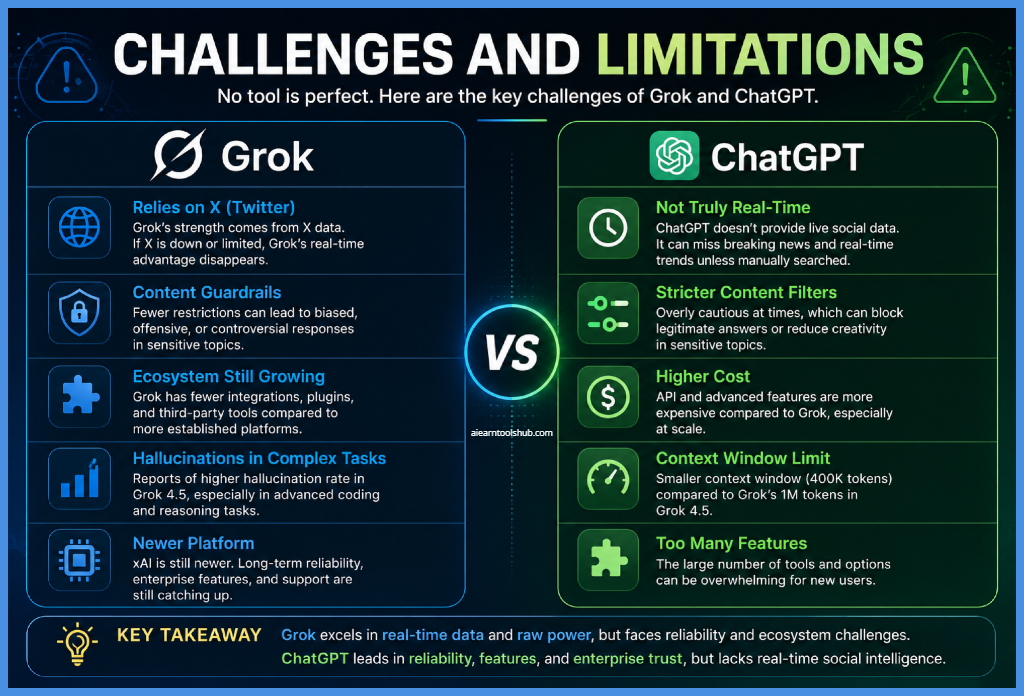
Neither tool is the finished product the marketing pages suggest.
Grok’s reliability problem is real. In May 2026, xAI cut image and video generation limits for paid SuperGrok subscribers by up to 80% without advance notice—daily image caps dropped from roughly 100 down to 20 or 25, and failed generation attempts still counted against the reduced limit. Musk promised the caps would rise again. For anyone paying for “unlimited” media generation, that’s a warning worth remembering before you build a workflow around it.
Grok’s hallucination rate is climbing, not falling. Independent testers flagged a noticeable increase with the 4.5 release, even as coding and reasoning scores improved. Faster and cheaper doesn’t automatically mean more trustworthy.
ChatGPT’s limitation is cost and pace. GPT-5.5-class API pricing runs roughly ten times what Grok charges for comparable throughput, and OpenAI’s message-cap system on Plus (160 messages per 3-hour window) can feel restrictive during a heavy work session.
Neither tool has solved the EU access gap cleanly. Grok 4.5’s rollout in the EU has been partial, with the API console still closed under the EU AI Act’s systemic-risk rules as of mid-July 2026 — worth checking before you commit a business workflow to it if you operate in Europe. If you’re comparing tools for a small team, our AI tools for startups buying guide covers the compliance angle in more depth.
FAQ
Is Grok better than ChatGPT in 2026?
Depends on the task. Grok wins on live X data, math reasoning, and API cost. ChatGPT wins on coding reliability, ecosystem integrations, and enterprise trust. Neither has a clean overall lead.
Is Grok cheaper than ChatGPT?
On consumer subscriptions, no — SuperGrok at $30/mo costs 50% more than ChatGPT Plus at $20/mo. On the API, yes — Grok 4.5 runs roughly a tenth of GPT-5.5-class pricing.
Which is better for coding, Grok or ChatGPT?
ChatGPT, for most developers. Grok 4.5 is genuinely competitive and far more token-efficient, but independent Terminal-Bench testing still puts it behind GPT-5.5’s Codex harness and Claude’s coding models on real-world reliability.
Does Grok have real-time information?
Yes, and it’s Grok’s strongest feature. It searches and reasons over live X posts, making it the fastest option for breaking news and social sentiment tracking. ChatGPT’s Deep Research pulls from the web on demand but isn’t a live feed.
Can ChatGPT generate images and video?
Yes, through DALL-E for images and Sora for 720p video clips on paid tiers. Grok’s Imagine feature (built on the Aurora model) also generates both, including native audio in video, and markets itself as unlimited on SuperGrok—though xAI has cut those limits without warning before.
Which has a bigger context window?
Grok, at 1 million tokens versus roughly 400,000 for ChatGPT. That matters most if you’re feeding in very large documents or codebases in a single pass.
Is Grok safe for business use?
With caveats, xAI has changed subscriber limits abruptly before, and Grok 4.5’s hallucination rate rose with the latest release. ChatGPT’s Microsoft integrations and admin controls make it the steadier enterprise pick as of mid-2026.
Do I have to choose just one?
No, and most power users don’t. A common pattern in 2026 is routing tasks: Grok for real-time research and cost-sensitive API calls and ChatGPT for structured writing, coding, and anything client-facing.
What’s the newest model from each company?
Grok 4.5, released July 8, 2026. GPT-5.6 (Sol/Terra/Luna), released July 9, 2026, and now the default model inside ChatGPT.
Is SuperGrok Heavy worth $300 a month?
Only if you need its 16-agent parallel execution for genuinely hard, high-volume problems. For everyday chat or writing, it’s overkill — even xAI positions it that way.

Welcome to aiearntoolshub ! I am Ehteshaam, an AI-powered SEO and content writer with over 2 years of experience in the AI and digital content space. I created this platform to help everyday people explore AI tools, learn practical online earning strategies, and stay ahead in the world of technology. My content is research-based, honest, and written to make AI simple for everyone.