
AI transformation governance has become one of the biggest business challenges in 2026. Companies are deploying AI systems faster than ever, but many organizations still lack the governance frameworks needed to control risk, ensure compliance, and maintain accountability. As AI tools evolve into autonomous systems capable of making operational decisions, businesses are discovering that successful AI adoption is no longer just about innovation. It is about governance, oversight, transparency, and leadership. Organizations that fail to prioritize AI transformation governance are increasingly facing security threats, regulatory pressure, operational instability, and reputational damage.
Why AI Transformation Governance Changed in 2026
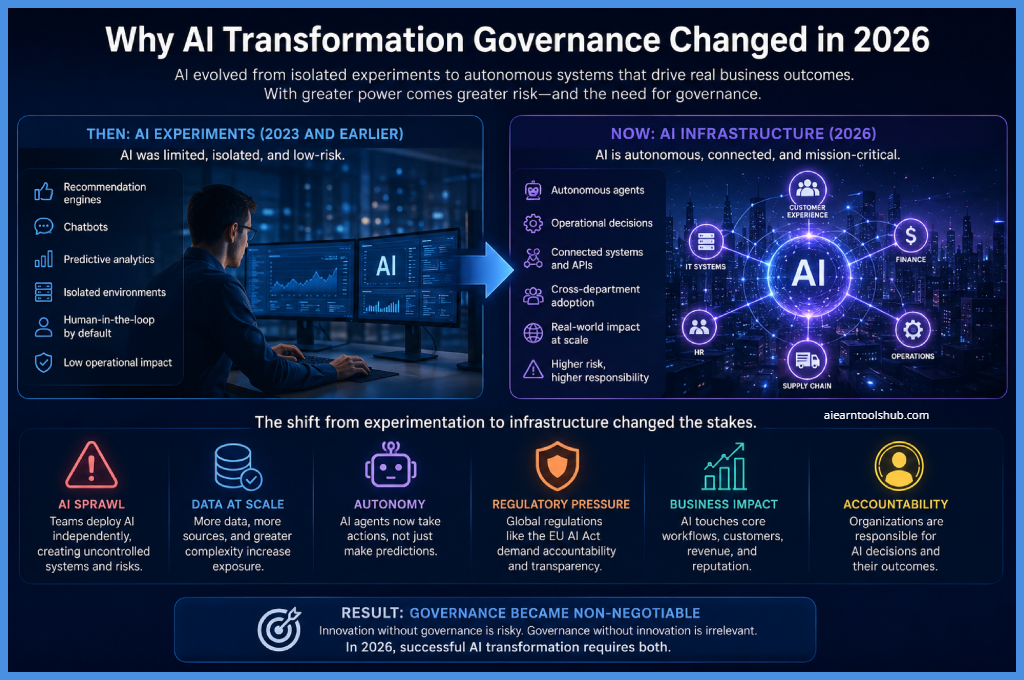
The world of AI in 2026 looks nothing like the experimental phase companies experienced just a few years ago. Earlier generations of AI were mostly recommendation engines, chatbots, and predictive analytics systems operating in isolated environments. Today’s AI systems behave more like digital coworkers. They reason, automate tasks, interact with software systems, and even coordinate with other AI agents.
This transformation created enormous opportunities for businesses. Companies use AI to reduce operational costs, accelerate product development, improve customer experiences, and automate repetitive workflows. Yet as adoption expanded, organizations discovered something uncomfortable: scaling AI safely is much harder than deploying AI quickly.
A 2026 enterprise governance report noted that many organizations rushed AI deployment without establishing clear operational controls, audit systems, or accountability structures. The result is a phenomenon many executives now call AI sprawl. Different teams deploy different AI models, connect them to sensitive systems, and automate decisions without centralized oversight.
Imagine giving every employee access to a fleet of self-driving cars without traffic laws, road signs, or driving licenses. That is what unmanaged AI adoption feels like inside many organizations today.
The Shift From AI Experiments to AI Infrastructure
The biggest change in 2026 is that AI is no longer treated as a side project. It has become infrastructure. Businesses increasingly depend on AI systems the same way they depend on cloud computing or cybersecurity platforms.
This shift changed the stakes entirely. When experimental AI makes a mistake, the damage is usually small. When operational AI fails, it can disrupt supply chains, expose confidential data, create legal liabilities, or damage a brand overnight.
That is why governance moved to the center of the AI conversation. Organizations realized they could not scale AI responsibly without operational discipline. Governance is now viewed less like bureaucracy and more like the steering wheel of a race car. Without it, speed becomes dangerous.
Why AI Transformation Governance Matters More Than Innovation
Innovation still matters, but governance now determines whether innovation survives. Companies with weak governance often struggle to move AI projects beyond pilot stages. Research suggests that a large percentage of AI programs fail to reach production because governance structures are immature or fragmented.
In practical terms, governance answers critical questions:
- Who is responsible when AI fails?
- What data can AI access?
- How are decisions audited?
- Which AI systems are approved?
- How do humans intervene during emergencies?
Without clear answers, AI becomes unpredictable. And unpredictable systems do not scale well in regulated industries or enterprise environments.
Understanding AI Transformation Governance
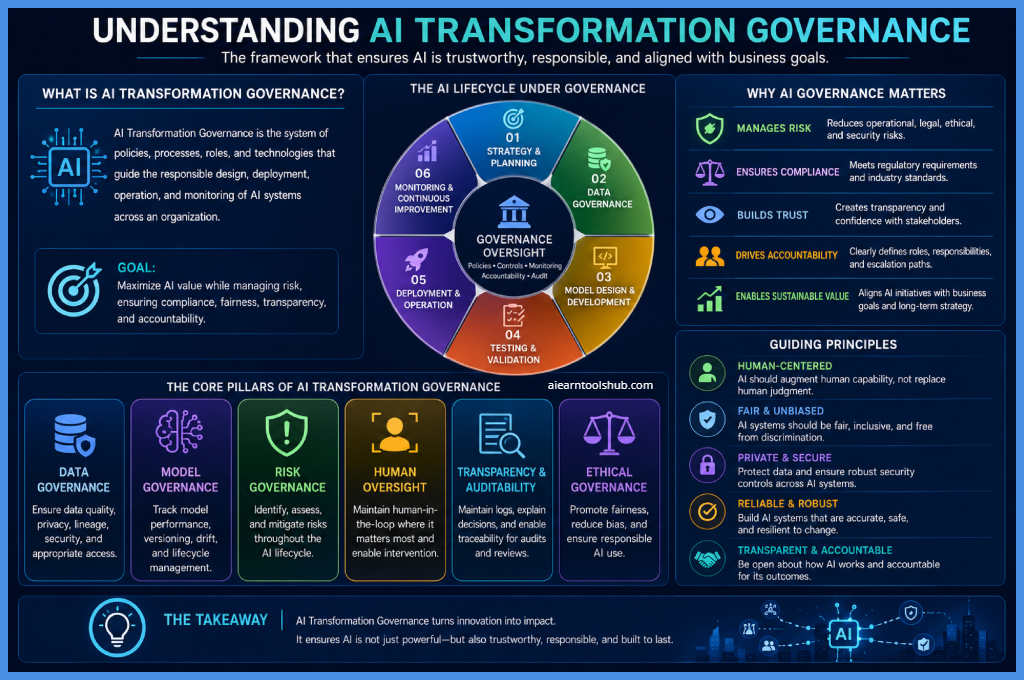
Many people misunderstand AI governance because they associate it with legal paperwork or compliance checklists. In reality, governance is the operating system behind trustworthy AI adoption.
Governance defines how AI systems are designed, monitored, approved, updated, and controlled throughout their lifecycle. It includes technical safeguards, human oversight, organizational accountability, risk management, and compliance structures.
Think of AI governance like air traffic control. Planes can fly independently, but without coordinated oversight, collisions become inevitable. AI systems are increasingly operating across departments, workflows, and customer interactions. Governance ensures those systems remain aligned with organizational goals and legal obligations.
AI Transformation Governance Is More Than Compliance
Compliance is only one piece of governance. A company can technically comply with regulations and still operate chaotic AI systems internally.
Effective governance includes:
| Governance Area | Purpose |
|---|---|
| Data Governance | Ensures data quality, privacy, and integrity |
| Model Governance | Tracks model performance and changes |
| Risk Governance | Identifies operational and legal risks |
| Human Oversight | Allows intervention and escalation |
| Auditability | Creates traceable decision records |
| Ethical Governance | Reduces bias and harmful outcomes |
Organizations that treat governance as a strategic capability rather than a legal requirement are gaining a major competitive advantage in 2026.
The Difference Between AI Policy and AI Control
Many enterprises created AI policy documents in 2024 and 2025. But static PDFs do not govern autonomous systems operating in real time.
The emerging trend in 2026 is policy-as-code — transforming governance rules into executable controls embedded directly into AI systems.
Instead of simply telling employees what AI should not do, organizations are building systems that automatically enforce rules, monitor behavior, and trigger alerts during risky actions.
That distinction matters enormously. Policies describe intentions. Controls create enforcement.
Why Weak AI Transformation Governance Causes Failure
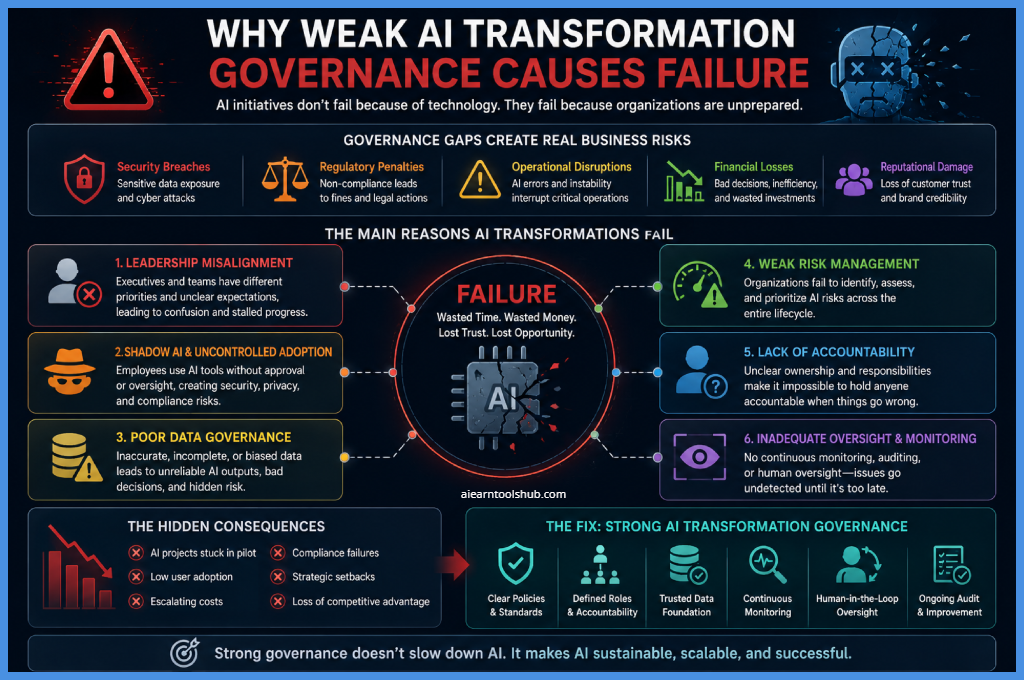
Most failed AI initiatives do not collapse because the technology is weak. They fail because the organization itself is unprepared.
AI transformation exposes hidden weaknesses inside companies. Poor communication between departments, unclear leadership structures, weak data systems, and disconnected business goals all become painfully visible once AI enters production.
Leadership Misalignment in AI Governance
One of the biggest governance failures involves executive alignment. A 2026 BCG survey found major disconnects between CEOs and boards regarding AI expectations and governance priorities.
Some executives expect rapid automation and cost reduction, while operational teams struggle with implementation risks and compliance requirements. This disconnect creates unrealistic expectations and fragmented execution.
AI transformation succeeds when leadership aligns around long-term operational strategy rather than short-term hype cycles.
Shadow AI and Uncontrolled Adoption
“Shadow AI” refers to employees using AI tools without formal approval or oversight. This problem exploded in 2026 because AI tools became incredibly accessible.
Employees now connect AI systems to spreadsheets, CRMs, databases, and internal APIs without waiting for IT approval. While this increases productivity, it also creates serious governance risks.
Sensitive company data may leak into external models. AI-generated outputs may bypass review systems. Autonomous agents may interact with infrastructure in unexpected ways.
Organizations are realizing they cannot ban AI usage entirely. The smarter strategy is visibility and controlled enablement.
Poor Data Governance
AI is only as reliable as the data feeding it. Yet poor data quality remains one of the biggest barriers to successful AI deployment.
Bad data creates biased decisions, hallucinations, inaccurate predictions, and operational instability. Governance frameworks now prioritize data lineage, validation systems, and access controls because unreliable data can quietly poison entire AI ecosystems.
In many ways, data governance is the foundation beneath AI governance itself.
Agentic AI Changed the Rules
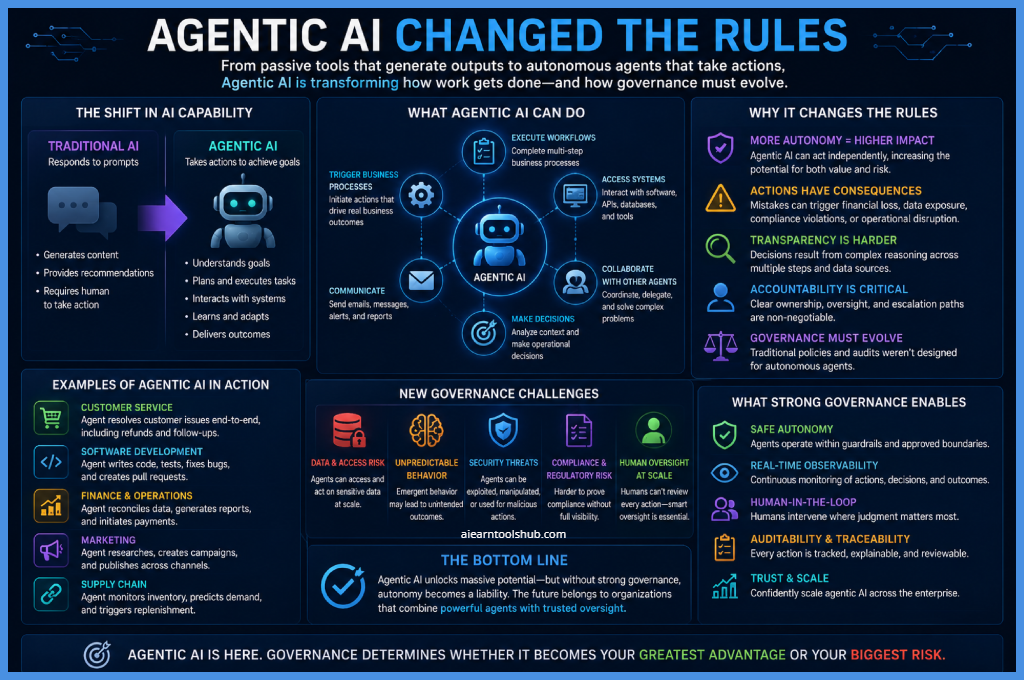
The rise of agentic AI transformed governance discussions completely in 2026. Traditional AI systems mostly generated outputs. Agentic AI systems perform actions.
These systems can:
- Execute workflows
- Access software systems
- Trigger business processes
- Communicate with other agents
- Make operational recommendations
That level of autonomy dramatically increases governance complexity.
AI Agents Now Make Operational Decisions
Modern AI agents increasingly function like junior employees. They can schedule tasks, write code, handle support tickets, and process claims with minimal supervision.
A Financial Times report highlighted how executive education programs are now teaching leaders how to collaborate with autonomous AI systems while maintaining accountability.
The issue is not whether AI can perform tasks. The issue is ensuring organizations remain accountable for those tasks.
Why Autonomous Systems Require Continuous Oversight
Static audits no longer work for autonomous AI environments. Governance now requires continuous observability and monitoring.
Researchers increasingly argue for telemetry-based governance systems that track AI behavior in real time rather than relying on periodic compliance reviews.
This shift resembles the evolution of cybersecurity. Companies once relied on annual audits. Today they depend on continuous monitoring because threats evolve constantly. AI governance is moving in the same direction.
The Role of Boards and Executives
AI governance is no longer an IT issue. It is now a boardroom issue.
Executives increasingly recognize that AI decisions can directly affect brand reputation, legal exposure, operational resilience, and shareholder confidence.
CEOs and Boards Disagree on AI Priorities
The governance gap between executives and boards remains a major challenge. Some leaders push for aggressive AI adoption to remain competitive, while others prioritize caution and regulatory compliance.
This tension creates organizational confusion. Employees receive mixed signals about speed versus safety.
The most successful organizations in 2026 establish clear governance ownership at the executive level. They define accountability structures early instead of improvising during crises.
Accountability Became a Competitive Advantage
Companies that can demonstrate trustworthy AI practices are increasingly winning customer trust and enterprise partnerships.
Governance maturity now influences:
- Vendor selection
- Investor confidence
- Enterprise procurement
- Regulatory approval
- Customer loyalty
Trust became a business differentiator.
In a world flooded with AI-generated outputs, organizations that prove transparency and accountability stand out like clean water in a polluted river.
AI Regulation Is Reshaping Enterprise Strategy
Regulation accelerated dramatically in 2026, especially with the growing impact of the EU AI Act.
Organizations operating internationally now face increasing pressure to document AI systems, classify risk levels, establish oversight mechanisms, and maintain audit trails.
The Impact of the EU AI Act
The EU AI Act represents one of the most influential governance frameworks shaping global AI strategy. Companies deploying high-risk AI systems must implement documented controls and compliance mechanisms.
The law effectively forced organizations to treat AI governance as operational infrastructure rather than optional ethics initiatives.
Many global companies are adopting EU-aligned governance frameworks even outside Europe because maintaining separate standards across regions becomes operationally inefficient.
Global Compliance Pressure in 2026
Governments worldwide are increasing scrutiny around AI transparency, bias, security, and accountability.
Industries facing the highest pressure include:
| Industry | Governance Risk |
|---|---|
| Healthcare | Patient safety and diagnostic errors |
| Finance | Bias, fraud, and compliance violations |
| Retail | Customer data exposure |
| Manufacturing | Autonomous operational failures |
| Marketing | AI-generated misinformation |
Compliance pressure is accelerating governance investment across nearly every sector.
Governance Frameworks That Actually Work
The organizations succeeding with AI in 2026 share one important characteristic: they operationalize governance rather than treating it as theory.
Human-in-the-Loop Systems
Human oversight remains essential even as AI systems become more autonomous.
Effective organizations define escalation pathways where humans review high-risk decisions or intervene during uncertain situations. This hybrid approach balances automation with accountability.
The goal is not eliminating humans. The goal is augmenting human decision-making responsibly.
Policy-as-Code and Automated Governance
Static governance documents cannot keep pace with real-time AI systems.
That is why companies increasingly adopt automated governance frameworks that enforce rules programmatically.
Examples include:
- Automatic access restrictions
- Real-time compliance checks
- Behavioral anomaly detection
- AI activity monitoring
- Runtime policy enforcement
This approach transforms governance from passive oversight into active operational control.
Real-Time Monitoring and AI Observability
AI observability platforms are emerging as a critical governance layer in enterprise environments.
These systems monitor:
- AI actions
- Model drift
- Decision patterns
- Security events
- Data usage
- Compliance violations
Research increasingly supports continuous telemetry-based governance as the future of enterprise AI oversight.
Organizations cannot govern what they cannot see.
Building a Sustainable AI Governance Model
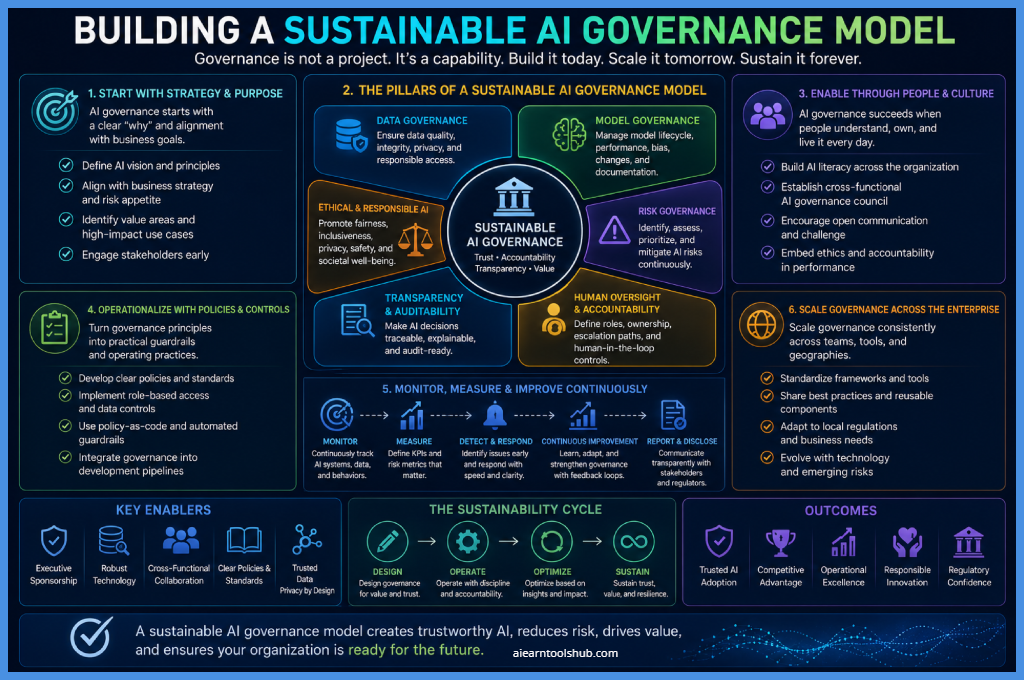
Sustainable AI governance requires cultural transformation as much as technical infrastructure.
Cross-Functional AI Leadership
Governance works best when legal teams, technical teams, executives, compliance officers, and operational leaders collaborate instead of operating in silos.
AI transformation affects every department. Governance structures must reflect that reality.
Organizations increasingly establish dedicated AI governance councils to coordinate policy, oversight, and operational standards across the enterprise.
AI Literacy Across the Organization
Governance cannot succeed if employees do not understand AI risks and limitations.
Business schools and executive education programs are rapidly expanding AI governance training because leadership literacy became essential in 2026.
Employees need practical understanding of the following:
- AI limitations
- Bias risks
- Data privacy
- Human oversight responsibilities
- Escalation protocols
AI literacy is becoming as important as digital literacy once was.
The Future of AI Governance Beyond 2026
The future of AI governance will likely resemble cybersecurity more than traditional compliance.
Organizations will rely on:
- Continuous monitoring
- Automated controls
- AI observability systems
- Real-time risk detection
- Adaptive governance architectures
Governance itself may increasingly become AI-assisted. Intelligent monitoring systems could detect policy violations, unusual behavior, and operational anomalies faster than humans alone.
The companies that thrive in the next decade will not necessarily be the ones with the most powerful AI. They will be the ones with the most trustworthy AI ecosystems.
That distinction matters.
Power attracts attention. Trust sustains growth.
FAQs
1. What is AI governance in simple terms?
AI governance refers to the rules, processes, and oversight systems organizations use to manage AI safely and responsibly. It includes accountability, monitoring, compliance, and risk management.
2. Why is AI governance important in 2026?
AI systems are becoming autonomous and deeply integrated into business operations. Governance is essential to prevent security risks, compliance failures, bias, and operational instability.
3. What is agentic AI?
Agentic AI refers to autonomous AI systems capable of performing actions, executing workflows, and making operational decisions with limited human supervision.
4. How does the EU AI Act affect businesses?
The EU AI Act requires organizations to implement governance controls, risk assessments, and transparency measures for high-risk AI systems operating within the European market.
5. What causes most AI transformation failures?
Most failures result from governance gaps rather than technical limitations. Common problems include poor leadership alignment, weak data governance, lack of accountability, and uncontrolled AI adoption.
Conclusion
AI transformation in 2026 is no longer primarily a technology challenge. The technology already exists. The real challenge is governance.
Organizations are discovering that uncontrolled AI adoption creates operational chaos, compliance risks, and strategic instability. Autonomous systems require oversight structures capable of matching their speed and complexity.
Governance is now the bridge between innovation and sustainability. It determines whether AI systems become scalable business assets or unpredictable liabilities.
The winners of the AI era will not simply build smarter machines. They will build smarter organizations — organizations capable of controlling, auditing, supervising, and continuously improving intelligent systems responsibly.
That is why AI transformation became a governance problem in 2026.

Welcome to aiearntoolshub ! I am Ehteshaam, an AI-powered SEO and content writer with over 2 years of experience in the AI and digital content space. I created this platform to help everyday people explore AI tools, learn practical online earning strategies, and stay ahead in the world of technology. My content is research-based, honest, and written to make AI simple for everyone.