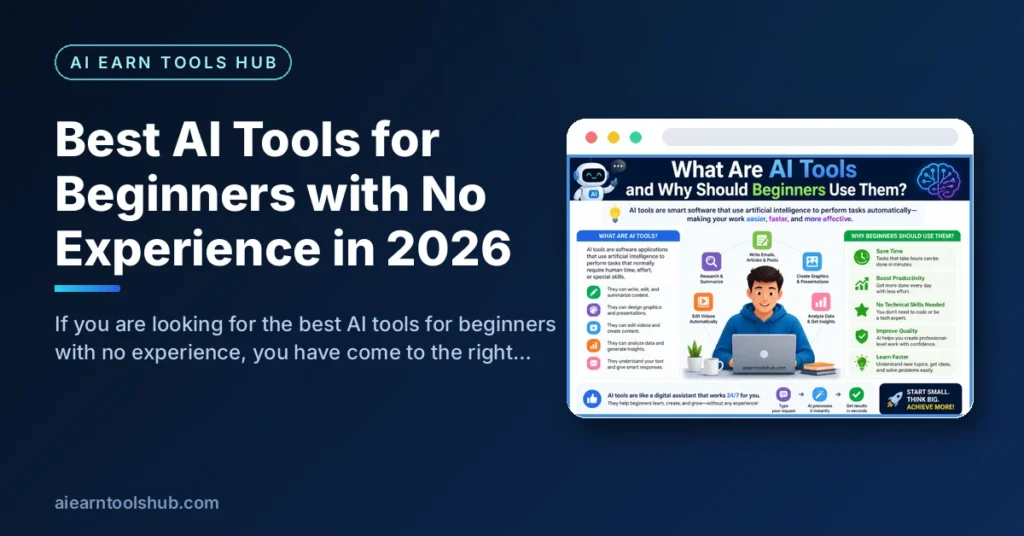
Best AI Tools for Beginners with No Experience in 2026
Last checked: October 2026
If you are looking for the best AI tools for beginners with no experience, you have come to the right place. In 2026, artificial intelligence tools for beginners have become more accessible, more powerful, and easier to use than ever before. Whether you are a student, a freelancer, or a working professional, you can now start using AI tools today — without any technical background, coding skills, or prior experience.
Furthermore, the good news is that most of these tools are either free or very affordable. So, in this guide, we will walk you through the top beginner-friendly AI apps of 2026, explain what they do, and show you exactly how to get started step by step.
Key Takeaways
AI tools for beginners with no experience let you write, design, check and create by typing plain requests — no coding needed.
- Start with one tool: ChatGPT is the easiest first pick.
- Most AI tools for beginners with no experience offer a free plan, so practise before paying.
- A good prompt names the task, audience, format and tone.
- Follow the 7-day plan below and finish the week with real work done.
- Free ChatGPT alternatives worth trying: Perplexity AI for research with sources, Claude for long writing, and HuggingChat for open-source models — all covered below.
What Are AI Tools and Why Should Beginners Use Them?
AI tools are software that uses artificial intelligence to do tasks like writing, designing, checking grammar and making videos. Beginners should use them because AI tools for beginners with no experience need no coding — you type words and get results in seconds.

First of all, it is important to understand what AI tools actually are. AI tools are software applications that use artificial intelligence to perform tasks automatically — tasks that would otherwise require significant human time, effort, or skill. For example, they can write content, design graphics, edit videos, check grammar, and analyze data in seconds.
Moreover, the biggest advantage of modern AI tools is their simplicity. You do not need to understand how AI works on a technical level. Instead, you simply open the tool, type your request in plain English, and get instant results. As a result, even complete beginners can produce professional-quality output from day one.
In addition, AI tools save enormous amounts of time. Tasks that previously took hours — such as writing a blog post, creating a presentation, or editing a video — now take just a few minutes. Therefore, whether you want to grow a business, improve your studies, or simply get more done each day, AI tools give you a real competitive advantage.
Why Are ChatGPT Alternatives Growing So Fast in 2026?

ChatGPT alternatives are growing fast because free users keep hitting message caps, login walls, and paid upgrades on ChatGPT itself. As AI becomes part of daily study, writing, and work, people want free AI tools like ChatGPT that let them keep going without interruption. The tools below meet that demand with generous free access and fewer restrictions for everyday tasks.
AI tools are no longer optional—they’ve become essential. From writing assignments to creating content and automating tasks, tools like ChatGPT have changed how we work.
However, limitations can slow you down:
- Daily message caps
- Login requirements
- Paid upgrades for full features
That’s why users are actively searching for free AI tools without limits—tools that offer:
- Unlimited prompts
- No login barriers
- Fast responses
- Reliable outputs
Having access to such tools means more productivity, zero interruptions, and better workflow.
What Are the Best AI Tools for Beginners With No Experience in 2026?
Start with ChatGPT for writing, Canva AI for design, Grammarly for clear writing, Google Gemini for productivity and Pictory AI for video. These five AI tools for beginners with no experience cover most tasks new users ask for.

Below, you will find the most recommended AI tools for beginners in 2026. Each tool is chosen specifically for its ease of use, reliability, and practical value for everyday tasks.
1. ChatGPT — Best AI Tool for Writing and Research
To begin with, ChatGPT by OpenAI is the most popular AI tool for beginners with no experience worldwide. It works like a smart conversation — you simply type your question or request, and ChatGPT instantly gives you a clear, helpful response. For instance, you can ask it to write an email, summarize a long article, create a business plan, or even explain a complex topic in simple language.
Additionally, ChatGPT requires absolutely no technical skills to use. As long as you can type, you can use ChatGPT effectively from day one.
- Skill required: None — simply type your request naturally
- Price: Free plan available; ChatGPT Plus at $20/month
- Best for: Writing, research, brainstorming, learning new topics
2. Canva AI — Best for Design Without Any Design Skills
Next on our list is Canva AI—arguably the most beginner-friendly design tool available today. Canva combines a simple drag-and-drop interface with powerful AI features such as Magic Write, Text-to-Image, and AI Presentation Maker. Consequently, even someone with zero design experience can create stunning graphics, social media posts, and professional presentations within minutes.
Furthermore, Canva offers thousands of ready-made templates. So, instead of starting from scratch, you simply choose a template, add your content, and let AI handle the rest.
- Skill required: None — choose a template and customise with AI
- Price: Free plan available; Pro at $12.99/month
- Best for: Social media posts, presentations, marketing materials
3. Grammarly — Best AI Writing Assistant for Clear Communication
Another excellent option for beginners is Grammarly—one of the most trusted AI writing assistants in the world. Grammarly works quietly in the background as you type, checking your grammar, spelling, tone, and clarity in real time. Moreover, its AI-powered rewrite suggestions help you sound more confident, professional, and polished — even if you have no writing experience at all.
In particular, Grammarly integrates directly with Gmail, Google Docs, Microsoft Word, and LinkedIn. Therefore, you do not need to copy and paste your text anywhere — it checks your writing wherever you already work.
- Skill required: None—install the browser extension and it works automatically
- Price: Free plan available; Premium at $12/month
- Best for: Emails, reports, job applications, professional writing
4. Google Gemini — Best Free AI Assistant for Everyday Productivity
Google Gemini is Google’s powerful AI assistant, and it integrates directly into Gmail, Google Docs, Google Drive, and Google Search. As a result, if you already use Google tools in your daily life, you can access AI features immediately — without learning any new platform. For example, Gemini can summarize long emails, draft documents for you, and answer questions directly inside your search results.
Best of all, Google Gemini offers a completely free plan. Consequently, it ranks as one of the most accessible free AI tools for beginners available today.
- Skill required: None — works inside tools you already use daily
- Price: Free; Gemini Advanced at $19.99/month with Google One
- Best for: Productivity, email management, document drafting
5. Pictory AI — Best for Creating Videos Without Editing Experience
Finally, if you want to create video content but have no editing experience, Pictory AI is the perfect solution. Pictory converts your written text — such as a blog post or script — into a professional video complete with stock footage, captions, and background music. In other words, you write the content, and Pictory handles all the video production automatically.
Therefore, bloggers, educators, and content creators use Pictory to repurpose their existing content into engaging videos—without spending hours in a video editor.
- Skill required: None—paste your text and Pictory creates the video
- Price: Starts at $19/month
- Best for: Content creators, bloggers, educators, online marketers
Quick Comparison of AI Tools for Beginners With No Experience
This table compares AI tools for beginners with no experience by strength, price and skill needed.
| Tool | Best for | Price | Skill needed |
|---|---|---|---|
| ChatGPT | Writing and research | Free plan; Plus $20/month | None |
| Canva AI | Design and presentations | Free plan; Pro $12.99/month | None |
| Grammarly | Grammar and clear writing | Free plan; Premium $12/month | None |
| Google Gemini | Everyday productivity | Free; Advanced $19.99/month | None |
| Pictory AI | Turning text into video | From $19/month | None |
How Can Beginners Use AI Tools Step by Step?
Choose one tool for a task you already do, explore it briefly, then use it on real work. That turns AI tools for beginners with no experience into a daily habit — the five steps below show you how.

Now that you know the best tools, here is a simple step-by-step plan to help you get started with AI tools for beginners confidently and effectively:
- First, choose one tool that matches a task you already do daily.
- Then, spend just 15 minutes exploring it—there is no pressure to be perfect.
- Next, apply it to a real task — for example, write an email or create a graphic.
- After that, explore one new feature each week as your confidence grows.
- Finally, publish or share your result—because consistency builds real skill over time.
What Should Your First 7 Days With AI Tools Look Like?
Build one small win per day instead of learning every tool at once. By day seven, you will have used AI tools for beginners with no experience to write, design, check and create.
- Day 1 — ChatGPT: Ask it to explain a topic in simple words, then ask a follow-up.
- Day 2 — ChatGPT: Draft a real email, then rewrite it in your own words.
- Day 3 — Canva AI: Make one social post or slide from a ready-made template.
- Day 4 — Grammarly: Check an email as you type with the browser extension.
- Day 5 — Google Gemini: Summarise a long email or document into an action list.
- Day 6 — Pictory AI: Turn a short paragraph into a simple video draft.
- Day 7 — Review: Repeat the task that saved you most time; save your best prompt.
Small daily tasks are all AI tools for beginners with no experience need to become useful.
What Mistakes Do Beginners Make With AI Tools?
The common mistakes are expecting perfect results from a vague prompt, trying too many tools at once, and copying output without checking it. Avoid those habits and AI tools for beginners with no experience become reliable, not frustrating.
- Expecting perfection first time: Treat the first answer as a draft, then ask for it shorter or clearer.
- Writing vague prompts: Say what you want, who it is for and the format you need.
- Trying every tool at once: Pick one tool, one task and one week before adding another.
- Copying without checking: Verify facts, names and numbers — AI can sound confident and still be wrong.
- Sharing private information: Never paste passwords, bank details or personal data into an AI tool.
How Do You Write a Good First Prompt?
A good prompt tells the tool what you want, who it is for, and what format and tone you need. It is the skill that makes AI tools for beginners with no experience work well, because a tool can use just the details you give it.
Use this pattern: task + topic + audience + format + tone — say what the content must do and how it should sound.
Worked example:
Write a short email to my manager asking to move Friday’s meeting to Monday morning. Keep it polite and professional, and use fewer than 80 words.
It works because it names the task, reader, new time, tone and length, so the first draft is close to sendable.
Are Free AI Tools for Beginners Actually Effective?
Yes — free AI tools for beginners with no experience are effective for most everyday tasks.
Absolutely — and this is one of the most common questions beginners ask. In fact, many of the best AI tools 2026 offers come with generous free plans that fully serve the needs of everyday users. For instance, ChatGPT, Grammarly, Canva AI, and Google Gemini all provide free tiers with enough features to handle a wide range of daily tasks.
However, as your needs grow and your skills develop, upgrading to a paid plan becomes a worthwhile investment. Nevertheless, starting free is always the smartest approach for anyone who wants to learn how to get started with AI without any financial risk.
Free ChatGPT Alternatives: Perplexity, Claude, Gemini & HuggingChat
Short answer: The best free ChatGPT alternatives right now are Perplexity AI for research, Claude for writing, Google Gemini for everyday help, and HuggingChat for open-source flexibility. Each one is free to start, and each suits a different job — match the tool to your task, and use the comparison table below to see the differences at a glance.
| Tool | Best for | Standout strength | Limits reality |
|---|---|---|---|
| Perplexity AI | Research and fact-checking | Answers with sources you can open and verify | Free use is generous, but advanced features sit behind paid plans |
| Claude | Writing and long documents | Natural, human-like writing and careful tone | Free use is capped by fair-use rules that vary with demand |
| Google Gemini | Everyday questions and productivity | Fast help linked to Google search and tools | Free access continues under Google account and usage policies |
| HuggingChat | Developers and model testing | Open-source models you can switch in one place | Availability depends on the model and service load |
Perplexity AI — Free Research With Sources
Perplexity AI is one of the most powerful AI tools for research and real-time answers. Unlike traditional chatbots, it provides accurate responses with sources, making it ideal for students and professionals.
Key Features:
- Real-time web results
- Free access with generous limits
- Clean, simple interface
- Great for research and learning
Best For: Students, researchers, bloggers
Claude AI — Best ChatGPT Alternative for Writing
Claude AI is known for its natural writing style and long-form content generation. It feels more human-like compared to many AI tools.
Key Features:
- High-quality writing output
- Handles long documents easily
- Safer and more context-aware responses
Best For: Writers, freelancers, long-form content creators
HuggingChat — Open-Source AI Without Limits
HuggingChat is a free open-source AI chatbot by Hugging Face that provides access to multiple AI models in one platform.
Key Features:
- Fully open-source and transparent AI
- Access to multiple models (Llama, Mistral, Qwen, etc.)
- Free to use with flexible usage
- Developer-friendly and customizable
- Simple web interface
Best For: Developers, AI learners, researchers
What Does “Without Limits” Really Mean for Free AI Tools?
“Without limits” is a promise no free service can keep in full. Every free chatbot runs on expensive computing power, so providers protect that power with rate limits, fair-use caps, and queues at busy times. The honest meaning is narrower: generous free use for ordinary tasks, without paying, as long as your use stays reasonable.
Rate limits usually control how much you can ask in a set period, even when that period is not shown on screen. Fair-use rules go further and can slow replies, pause access, or offer a smaller model when demand is high. You may also meet limits on file size, conversation length, or advanced features that stay reserved for paying users.
You can often spot a limit before it stops you. Watch for slower replies, shorter answers, upgrade prompts, or messages asking you to try again later. Those signals mean you are close to a cap, so finish the important part of your task first.
None of this makes free AI tools like ChatGPT a bad deal. It just means you should plan for it: save important work as you go, split very long jobs into smaller prompts, and keep a second tool ready for busy moments. Readers who understand those rules get far more from free AI tools like ChatGPT than readers who expect endless, priority access for free.
How Private Are Free AI Tools Like ChatGPT, Really?
Free AI tools like ChatGPT are generally safe for ordinary questions, study help, and drafting, but they are not private notebooks. Providers may store prompts, review conversations to improve their services, or keep data under their own policies. The safe rule is simple: if you would not post it publicly, think twice before you paste it into a free chatbot.
- Never share passwords, payment details, or personal identification.
- Remove client names, addresses, and private details from text before you paste it.
- Check each tool’s privacy settings and policy, and use opt-out controls where the provider offers them.
- Verify important facts and figures, because even confident answers can be wrong.
Limits deserve the same reality check as privacy. Free plans change, features move behind paywalls, and busy services can slow down without warning. Recheck your favourite tool’s free offer from time to time, and never build a critical deadline around a single free account.
Frequently Asked Questions About AI Tools for Beginners With No Experience
What is the easiest AI tool for a complete beginner to start with?
ChatGPT is the easiest starting point because you type a request in plain words and get an answer. It is the most versatile of the AI tools for beginners with no experience in this guide.
Do I need coding skills to use AI tools?
No — none of the tools in this guide needs coding or technical knowledge. If you can type and browse the web, you can use them from day one, which is why AI tools for beginners with no experience suit students, freelancers and professionals alike.
Are free AI tools enough, or do I need a paid plan?
Free plans are enough for everyday tasks like writing, design and grammar checking. Start free with AI tools for beginners with no experience, and pay only when you use a tool daily or need advanced features.
How long does it take a beginner to learn AI tools?
Most beginners finish a useful first task within an hour and feel comfortable within a week of short daily practice. The 7-day starter plan in this guide builds that confidence one task at a time.
Is it safe to share information with AI tools?
The well-known tools in this guide are safe for everyday tasks with basic precautions. Never paste passwords, bank details or private information into an AI tool, and check important facts before using its output.
Are there truly unlimited AI tools?
Most tools have fair usage policies, but many offer high enough limits that feel unlimited for regular users.
Which AI tool is closest to ChatGPT?
Claude AI is often considered the closest in terms of writing quality and conversation style.
Can I use free AI tools like ChatGPT without signing up?
Some tools let you try a chat as a guest, while others ask you to create a free account before you can keep going. A free account usually saves your history and settings, but always check what sign-in requires before you share any personal details.
Conclusion: AI tools for beginners with no experience make it easy to start immediately
In summary, the world of artificial intelligence is vast—but your entry point does not have to be complicated. The AI tools for beginners with no experience listed in this guide are intuitive, accessible, and genuinely useful from the very first day you use them.
Therefore, start with one tool, use it consistently, and explore new features gradually. Within just a few weeks, you will find that AI tools save you time, improve the quality of your work, and open opportunities you did not know were possible.
Ultimately, the only thing you need to begin is the decision to start.
Every option above was chosen as one of the AI tools for beginners with no experience can start using today, for free, without a credit card.
- AI Note Taker: 7 Best Free Tools for Notes & Summaries (2026)
- AI Book Generator: 7 Best Free Tools to Write a Full Book (2026)
- AI Prompt Generator: 7 Best Free Tools That Work (2026)
- How to Remove Background from Video Free: AI Tools That Do It in Seconds (2026)
- Tip Calculator Guide: How to Calculate a Tip and Split Bills