Tag: SEO for bloggers

  • How to Rank on Google With AI Content (2026)

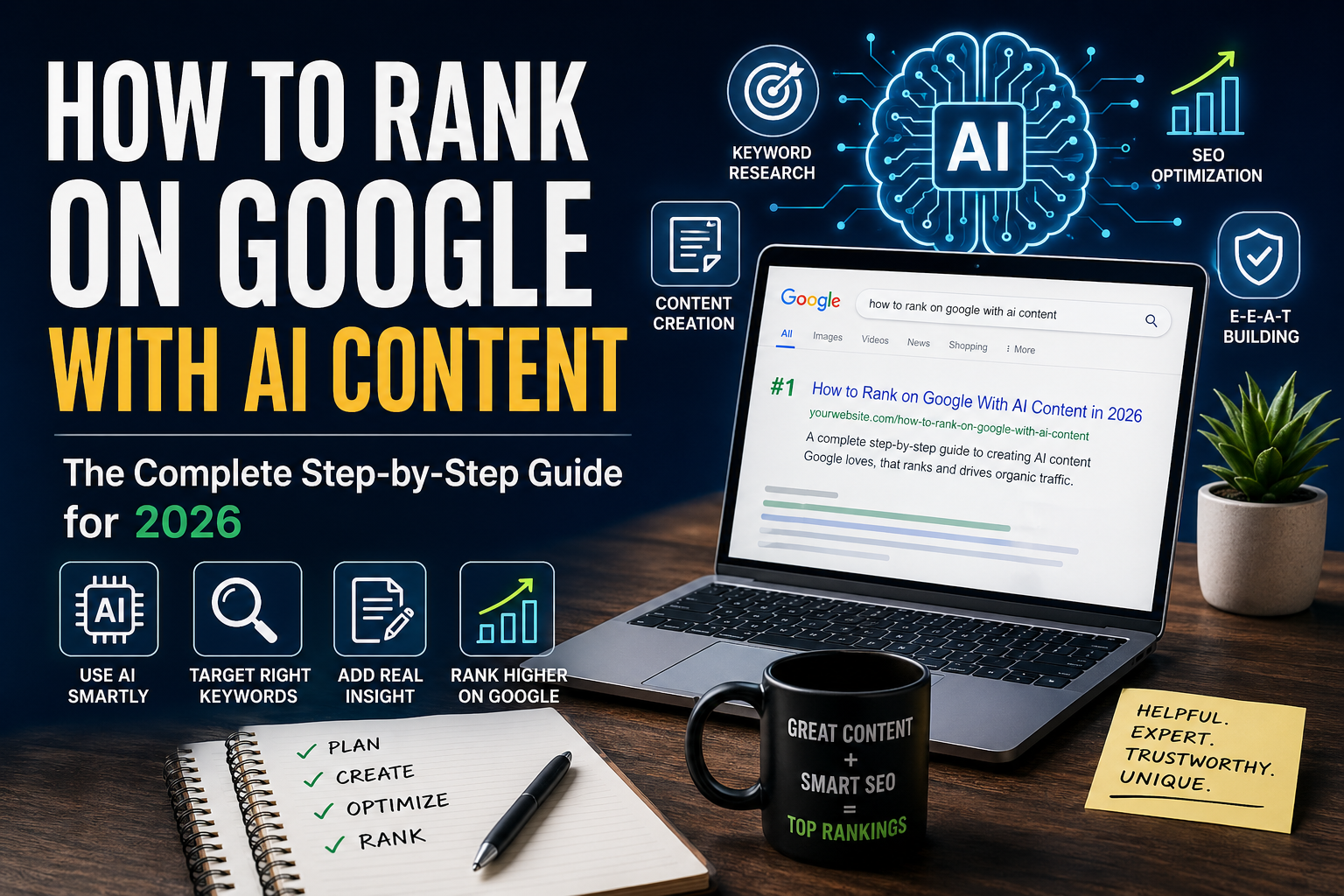
    How to Rank on Google With AI Content (2026)

    Introduction

    Learning how to rank on Google with AI content is one of the most searched topics among bloggers and content marketers right now — and for good reason. Google does not penalize AI content. It penalizes thin, low-value, and unhelpful content. That is a critical distinction most people miss entirely.

    Sites using AI the right way are growing organic traffic faster than ever. Sites dumping raw AI output without editing or optimization are getting ignored — or worse, manually demoted. The difference is not the tool. The difference is the process behind the tool.

    This guide covers exactly how to rank on Google with AI content in 2026 — from choosing the right keywords to publishing content that passes Google’s helpful content standard and keeps readers on the page long enough to matter.

    Why AI Content Is Now a Mainstream SEO Strategy

    Why AI content is a mainstream SEO strategy in 2026 showing benefits like faster content creation, scalability, cost efficiency, and improved search rankings

    Two years ago, using AI for content felt risky. Today it is standard practice across industries. A 2025 BrightEdge study found that over 68% of enterprise marketing teams use AI in some part of their content workflow. That number is even higher among independent bloggers and small business owners who cannot afford large content teams.

    The reason is simple. AI removes the blank page problem. It compresses research time. It helps non-writers produce structured, readable drafts quickly. When those drafts are edited, fact-checked, and optimized properly, Google treats them exactly the same as manually written content.

    The playing field has shifted. AI is no longer a shortcut. It is a standard tool — and knowing how to use it well is now a competitive advantage.

    Why Most AI Content Fails to Rank on Google

    Why most AI content fails to rank on Google showing issues like lack of originality, missing E-E-A-T signals, and poor on-page SEO optimization

    Before getting into what works, it is worth being honest about why most AI content underperforms in search results.

    The Sameness Problem

    AI models trained on the same internet produce similar outputs. When ten websites publish AI-generated articles targeting the same keyword, they all sound nearly identical — same structure, same talking points, same generic conclusions. Google has no clear reason to rank any one of them above the others, so none of them rank well.

    This is the single biggest reason AI content fails. It is not that Google detects AI. It is that the content is indistinguishable from every other page covering the same topic, which means it adds nothing new to the conversation.

    Missing E-E-A-T Signals

    Google’s E-E-A-T framework—Experience, Expertise, Authoritativeness, Trustworthiness — rewards content that demonstrates real knowledge. A purely AI-generated article that references no real experience, no named sources, and no original opinion scores poorly on every one of those dimensions.

    Google cannot always tell how content was written. But it can measure whether content earns clicks, holds attention, earns backlinks, and gets cited elsewhere. Raw AI content rarely does any of those things well enough to sustain rankings.

    Weak On-Page Optimization

    Most people publish AI drafts without proper SEO optimization. The focus keyword is missing from the introduction. Subheadings do not reflect the target topic. Internal links are absent. Meta descriptions are auto-generated or left blank. These are fixable problems — but they require a human step after the AI draft is done.

    How to Rank on Google With AI Content: Complete Step-by-Step Process

    Step-by-step process to rank on Google with AI content in 2026 including keyword research, content optimization, E-E-A-T, schema markup, and publishing strategy

    Step 1: Choose the Right Keywords for AI Content

    Not every keyword is equally winnable with AI content. The best targets share three characteristics: clear informational intent, low to medium competition, and a topic you can add genuine context to.

    Informational keywords — “how to,” “what is,” “best way to,” “why does” — give AI content the clearest path to ranking. The format is predictable, the reader wants a direct explanation, and Google rewards completeness over brand authority in these SERPs.

    Avoid targeting high-competition commercial keywords like “best project management software” or “top credit cards 2026” with raw AI content. Those results are dominated by sites with massive domain authority and real product testing. AI alone cannot compete there.

    Use free tools like Google Autocomplete, AlsoAsked, and ChatGPT itself to find long-tail keyword variations with clear intent and manageable competition. Learn more in our guide on [how to use AI for keyword research free →].

    Step 2: Use AI to Draft, Then Add What AI Cannot Produce

    This is the most important step. Treat every AI output as a first draft—never a final product.

    Let AI handle the structure, the outline, and the initial body copy. Then go back through the draft and add the following:

    • Real examples from your own experience or research
    • Specific data points with named, verifiable sources
    • A clear opinion or recommendation — not “it depends,” but an actual position
    • A contrarian angle the top-ranking articles are not covering
    • Personal observations that only someone with real experience in the topic could write

    One well-written paragraph of genuine insight does more for your rankings than five paragraphs of polished, generic AI copy. Google’s quality raters are trained to look for exactly this kind of differentiation. So are readers. [Best AI SEO Tools 2026 →]

    Step 3: Optimize On-Page SEO Thoroughly Before Publishing

    Raw AI drafts are almost never properly optimized for search. Before any AI-assisted article goes live, run through this full checklist:

    Title and headings:

    • Focus keyword in the H1 title
    • Focus keyword or close synonym in at least two H2 subheadings
    • Subheadings that reflect real search questions, not just topic labels

    Body content:

    • Focus keyword in the first paragraph — within the first 100 words
    • Keyword density between 1% and 1.5% — roughly 4 to 6 uses in a 1,500-word article
    • LSI and semantic keywords distributed naturally throughout
    • No keyword stuffing — every use must read naturally in context

    Meta and technical:

    • SEO title under 60 characters
    • Meta description between 130 and 155 characters with the focus keyword included
    • URL slug is short and keyword-inclusive—example:/how-to-rank-on-google-with-ai-content
    • At least two to three internal links to related posts on your site
    • At least one outbound link to a credible external source

    Media:

    • At least one featured image with keyword-inclusive alt text
    • Screenshots or supporting visuals where relevant
    • Image file names that include the focus keyword

    Step 4: Build E-E-A-T Signals Around Every AI Article

    Google does not evaluate a single page in isolation. It evaluates the page within the context of your entire site, your author credentials, your backlink profile, and your engagement data.

    To rank AI content on Google consistently, build trust signals at every level:

    Author signals: Add a real author bio to every post. Include the author’s name, relevant credentials, and links to their social profiles or other published work. Google’s quality raters check author credibility—especially for topics in health, finance, and legal categories.

    Site-wide signals: Keep overall content quality high across your entire site. One strong AI-assisted article on a site full of thin content still struggles. Every page on your site contributes to or detracts from your domain’s overall authority.

    Backlink signals: Earn links from relevant sites in your niche through guest posting, digital PR, or creating genuinely citable resources. AI content on a well-linked domain ranks far more easily than the same content on a brand new site with no external references.

    Engagement signals: Write introductions that keep readers on the page. Use clear subheadings so readers can navigate. Answer the search query directly and early — do not make readers scroll through three paragraphs of background before getting to the answer they came for.

    Step 5: Match Search Intent and Cover the Topic Completely

    Word count alone does not rank content. Topical completeness does. Google measures whether a page satisfies search intent well enough that the reader does not need to return to the search results for more information.

    Before publishing any AI-assisted article, check the top three to five ranking pages for your target keyword. Note every subtopic, question, and angle they cover. Then check what they miss. Your article should cover everything the top results cover — and add at least one section, angle, or level of depth they do not.

    AI is genuinely useful at this stage. Paste a competitor article into ChatGPT or Claude and ask it to identify every topic the article fails to address. That gap list becomes your content edge.

    This is exactly how to rank on Google with AI content at scale — not by producing more articles, but by producing more complete ones.

    Step 6: Add Schema Markup for Enhanced Search Visibility

    Schema markup tells Google exactly what type of content your page contains, which improves how it appears in search results. For AI-assisted articles, three schema types are most valuable:

    FAQ schema: Mark up your FAQ section so Google can display individual questions and answers directly in search results as rich snippets. This increases click-through rate without requiring a higher ranking position.

    Article schema: Signals to Google that the page is an editorial article with a named author, publication date, and clear topic focus. Supports E-E-A-T signals.

    How-To schema: If your article contains a step-by-step process, How-To schema can trigger rich results that show individual steps directly in the SERP—a significant visibility boost for instructional content.

    None of these require a developer. Yoast SEO, Rank Math, and Schema Pro all handle schema generation without writing code.

    Step 7: Publish, Index, and Update on a Regular Schedule

    Publishing is not the finish line. It is the starting point.

    After publishing, submit the URL in Google Search Console under URL Inspection → Request Indexing. This accelerates the crawl timeline from days to hours for most sites.

    Then set a content review schedule. AI content ages faster than manually written content because it often lacks specific dates, current statistics, and recent tool references. Google favors freshness for many informational keywords — especially in technology, marketing, and finance niches.

    Review fast-moving topics quarterly. Update evergreen content annually. When you update, change the published date, refresh any outdated statistics, and add a brief note at the top of the article indicating when it was last reviewed. These signals matter to both Google and readers.

    What Google’s Helpful Content Guidelines Actually Say

    What Google’s helpful content guidelines actually say in 2026

    Google’s helpful content system is designed to reward pages that provide genuine value to real readers. The official guidance is clear: content should demonstrate first-hand expertise, serve a specific audience, and leave the reader satisfied — not reaching back to the search results for a better answer.

    What it does not say is that AI content is disqualified. The method of production is irrelevant. The quality of the output is everything.

    The practical self-test before publishing any AI article:

    • Does this article help a real person solve a real problem?
    • Does it say something the top-ranking articles do not?
    • Does it reflect actual knowledge about this topic — not just surface-level summaries?
    • Would an experienced person in this field trust this article enough to share it?

    If you can answer yes to all four, the article is ready to publish. If not, it needs more editing before it goes live.

    Frequently Asked Questions

    Does Google penalize AI-written content?

    No. Google’s guidelines explicitly state that how content is produced is less important than whether it is helpful, accurate, and written for people. AI content that meets Google’s helpful content standard is treated the same as manually written content meeting the same standard.

    How do I make AI content rank on Google faster?

    Target low-competition informational keywords, add the focus keyword to your introduction and at least two subheadings, build internal links from existing pages, submit the URL in Google Search Console immediately after publishing, and add FAQ schema to increase rich snippet eligibility.

    Can AI content rank without backlinks?

    Yes, on low-competition keywords with thorough on-page optimization. For competitive terms, backlinks remain a significant ranking factor. AI content does not change the role of authority in SEO — it just changes how efficiently you can produce the content itself.

    How long should an AI SEO article be for Google ranking?

    For most informational keywords, 1,500 to 2,000 words is the minimum for competitive ranking. For pillar pages and high-competition topics, 2,500 to 3,500 words is more appropriate. Match the depth of the top-ranking results — not just the word count.

    What is the biggest mistake people make with AI content SEO?

    Publishing raw AI output without editing, adding original insight, or checking on-page optimization. AI produces a starting draft. The editing, fact-checking, keyword optimization, and human insight added after the draft is generated are what actually determine whether the article ranks.

    Is AI content good enough for AdSense approval?

    Yes — if the content is original, well-edited, genuinely useful, and published on a site with a clear niche, proper navigation, and an About page. AdSense reviewers look for content quality and site legitimacy, not the method of production.

    conclusion

    Ranking on Google with AI content is a repeatable system, not a shortcut. AI handles speed and structure. You handle insight, accuracy, and optimization. Google rewards the result — and in 2026, the sites winning organic traffic are not the ones generating the most AI articles. They are the ones editing carefully, targeting smart keywords, and building real authority behind every page they publish.

    Pick one keyword today. Draft with AI. Add what only you can add. Optimize every element before hitting publish. Submit to Search Console. Update it quarterly.

    That process works. And unlike tricks that collapse with every algorithm update, it only gets stronger over time.

  • Best AI SEO Tools 2026: 7 Reviewed and Ranked

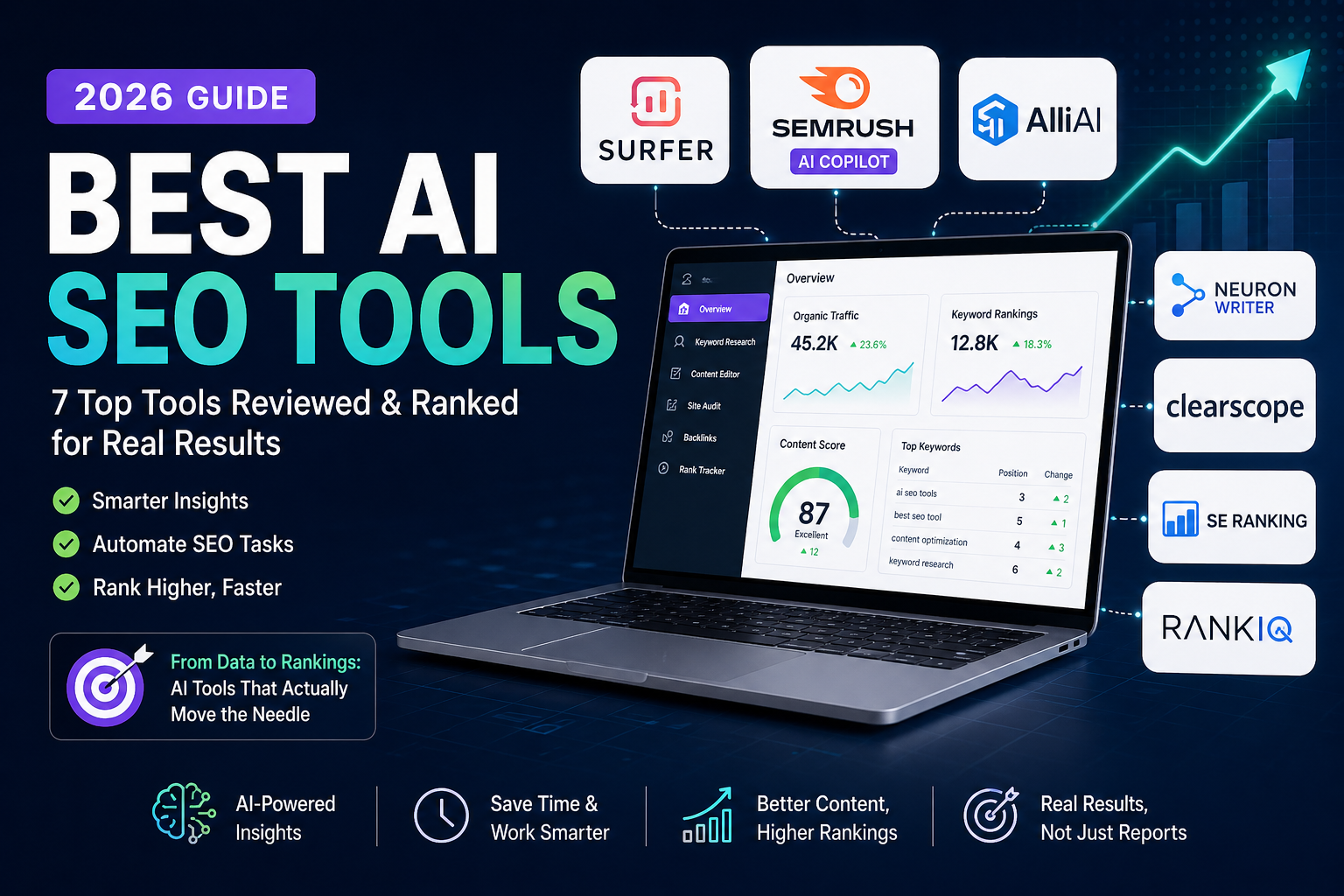
    Best AI SEO Tools 2026: 7 Reviewed and Ranked

    Most SEO tools sell you a dashboard. Only a few actually change where you rank. With AI baked into almost every platform now, the gap between hype and results has never been harder to read—and the best AI SEO tools 2026 are not those who spent the most on ads.

    Bloggers, content marketers, and small business owners face the same trap: dozens of tools all claiming to automate SEO, none of them telling you what they actually can’t do. You either overpay for features you don’t use or underpay for something that underdelivers. This review fixes that.

    After testing each tool on real sites, here’s an honest breakdown—what works, what doesn’t, and which one earns a spot in your stack.

    Why AI SEO Tools Are Different in 2026

    Infographic explaining why AI SEO tools are different in 2026

    The 2022-era SEO tools ran keyword databases and content scoring. That’s not what the best AI SEO tools 2026 do. The shift is from reporting what happened to predicting what should happen next.

    According to a 2025 BrightEdge report, 68% of enterprise marketers now use AI-assisted SEO tools for some part of their content workflow — up from 29% in 2023. The tooling has caught up to that demand in meaningful ways.

    Predictive intent modeling

    Older tools matched keywords to search volume. Current platforms model search intent in context—they distinguish between someone researching a purchase and someone ready to make it, then adjust content recommendations accordingly. That’s not a feature upgrade. It’s a different category of tool.

    Real-time SERP feedback loops

    2026’s tools pull live SERP data and reweight recommendations as rankings shift. If a competitor’s page moves up for a term you’re targeting, the tool flags it and suggests a countermove—without you refreshing a report manually. That kind of active monitoring used to cost enterprise contracts. It’s now available at mid-market pricing.

    Best AI SEO Tools in 2026

    Best AI SEO tools in 2026 infographic featuring Surfer SEO, Semrush Copilot, Alli AI, NeuronWriter, Clearscope, SE Ranking, and RankIQ with dashboard analytics, keyword rankings, and SEO performance growth visualization


    These are ranked by overall usefulness for independent publishers and small teams, not by feature count.

    1. Surfer SEO  — Best overall

    Surfer connects directly to Google Search Console and scores your content against the top 10 results for a given keyword in real time. Its content editor gives clear NLP-based term recommendations—not vague “add more keywords” advice, but specific phrases ranked by impact.

    Best for: Content-heavy blogs and agency teams   |   Pricing: From $99/mo (Essential plan)   |   Standout: Real-time SERP scoring in the editor

    Limitation: Surfer’s AI writing output is generic. Use the optimization layer, not the auto-write feature

    2. Semrush (AI Copilot)  — Best all-in-one

    Semrush added an AI Copilot layer on top of its existing keyword and backlink database in 2025—and it actually changes how the platform works. Instead of hunting through reports, Copilot surfaces priority actions. It’s the closest thing to AI tools for SEO that replaces the need for a dedicated analyst.

    Best for: Small businesses that want one platform | Pricing: From $139.95/mo (Pro)   |   Standout: Copilot prioritizes actions across all reports

    Limitation: Steep learning curve. Plan for 2–3 weeks before you’re using it efficiently.

    3. Alli AIBest for on-page automation

    Alli AI focuses entirely on on-page SEO automation — it generates and deploys meta tags, schema markup, and internal links across your site without touching your CMS directly. For site owners managing 50+ pages, it’s the only tool that makes bulk on-page work practical.

    Best for: E-commerce and content sites with large page counts | Pricing: From $299/mo (Small Business)   |   Standout: Live editor deploys changes without a developer

    Limitation: Expensive at a small scale. Only makes financial sense above ~100 pages

    4. NeuronWriter — Best value pick

    NeuronWriter does what Surfer does at roughly half the price, with a better internal linking suggestion module. Its AI keyword research tools pull semantic keyword clusters that surface opportunities Surfer misses on lower-volume terms. The UI is less polished, but the output quality holds up.

    Best for: Solo bloggers and budget-conscious teams | Pricing: From $23/mo (Bronze, billed annually) | Standout: Semantic NLP scoring + internal link map

    Limitation: No live GSC integration. You’re working from crawled data, not real-time signals

    5. Clearscope — Best for editorial teams

    Clearscope is the cleanest tool on this list. No bloat, no bundled features you won’t use—just a content grading system that tells writers exactly what to cover and at what depth. Enterprise editorial teams choose it because the reports are easy to hand off to writers without training.

    Best for: Editorial teams with multiple writers | Pricing: From $199/mo (Essentials) | Standout: Clean, writer-friendly report format

    Limitation: No keyword research, no technical SEO. It’s an optimization layer only—you need another tool upstream

    6 SE Ranking AI Content Tool  — Best newcomer

    SE Ranking added a full AI content module in late 2024, and it’s improved faster than most legacy platforms. It pulls keyword data, generates a content brief, and runs an on-page audit in one flow—something most tools still force you to do in three separate steps

    Best for: Teams switching off Semrush for cost reasons | Pricing: From $65/mo (Essential) | Standout: End-to-end content workflow in one platform.

    Limitation: Backlink data still lags behind Ahrefs and Semrush in depth.

    7. RankIQ — Best for bloggers

    RankIQ is purpose-built for bloggers in specific niches. It maintains a curated keyword library sorted by low-competition, high-traffic opportunities and tells you exactly how long a post needs to be to rank—based on what’s actually working in that niche category, not generic benchmarks.

    Best for: Niche bloggers, food/lifestyle/personal finance | Pricing: $99/mo (flat rate) | Standout: Niche-specific keyword library with real competition data.

    Limitation: Narrow niche coverage. If your blog straddles multiple categories, you’ll hit gaps in the keyword library.

    What Most AI SEO Tool Reviews Get Wrong

    Infographic explaining what most AI SEO tool reviews get wrong, comparing common mistakes like focusing on features, confusing AI writing with SEO

    The standard review formula: list the tools, describe their features, call them all “great for beginners and experts alike,” and move on. That’s not a review — it’s a brochure. Here’s what actually trips people up when choosing SEO automation tools.

    Buying a tool for features, not for workflow fit

    Surfer and Clearscope both optimize content. But if your team writes first and optimizes second, Surfer’s real-time editor fits that workflow. If you brief writers upfront and optimize after.

    publication, Clearscope makes more sense. Most buyers never ask which workflow they actually run—they buy whichever tool ranks higher in the comparison article they found.

    Confusing AI content generation with AI SEO

    A lot of tools now bundle AI writing features with SEO tooling and charge for both. The writing is almost always weak. The SEO features are almost always solid. Paying for an “AI SEO platform” that you mostly use as a ChatGPT wrapper is a waste. Separate your tool from your SEO tool, at least until one platform demonstrably does both well.

    Ignoring the data freshness question

    Some tools update keyword and SERP data weekly. Others update monthly or less. For fast-moving niches—finance, tech, and health—stale data means stale recommendations. Always check the crawl and update frequency before committing to an annual plan.

    Frequently Asked Questions About AI SEO Tools

    What is the best AI tool for SEO in 2026?

    Surfer SEO is the best overall choice for most users — it combines real-time SERP data with practical, actionable content recommendations. For all-in-one keyword research, technical auditing, and content optimization in a single dashboard, Semrush with Copilot is the stronger option for growing teams willing to invest more.

    Can AI tools replace SEO experts?

    No. AI SEO tools automate the repetitive analytical work — keyword clustering, content scoring, technical audits — but they can’t replace strategic judgment. Deciding which pages to prioritize, how to build topical authority, or how to respond to a core algorithm update still requires human expertise. The tools make experts faster, not redundant.

    Which AI SEO tool is best for beginners?

    RankIQ for bloggers, or NeuronWriter if your site covers multiple topics. Both give clear, direct guidance without requiring you to understand the underlying SEO mechanics. Avoid enterprise tools like Semrush as a starting point—the learning curve will eat the time savings you’re expecting to gain.

    Are AI SEO tools worth the money?

    Yes — if you publish content consistently. For sites producing four or more pieces per month, the time saved on research, brief creation, and optimization analysis pays for mid-tier tool costs within the first two months. For occasional publishers, a lower-tier plan or a usage-based model is the smarter call.

    What is the difference between AI SEO tools and traditional SEO tools?

    Traditional SEO tools report on data—rankings, backlinks, and crawl errors. AI SEO tools interpret that data and generate recommendations or content guidance. The practical difference: traditional tools tell you what’s happening; AI tools suggest what to do about it. Most platforms now blend both, but the AI layer is what separates active guidance from passive reporting.

    conclusion

    If you’re a blogger after low-competition wins, RankIQ or NeuronWriter is your entry point. If you run a content operation and need a full audit-to-publish workflow, Semrush or SE Ranking gives you that in one place. The best AI SEO tools 2026 are not the ones with the most features—they’re the ones that fit how you actually work.

    Don’t buy based on a feature checklist. Buy based on which phase of your content process costs you the most time. That’s where the tool pays off.

    Using one of these tools already? Drop which one in the comments, or read the full breakdown to see how the keyword layer alone can change what you target.