
Best AI SEO Tools 2026: 7 Tools Compared by Workflow, Price and Limits
Looking for the best AI SEO tools 2026 has to offer? Surfer SEO is the best overall pick for content-led sites, Semrush is the best all-in-one platform, and NeuronWriter is the best value for bloggers. The seven tools below are ranked by workflow fit, with starting prices, free plans, and honest limits for each.
Key Takeaways
- Best overall: Surfer SEO — live content scoring against the pages that already rank, from $49/mo.
- Best all-in-one: Semrush — keyword research, audits, backlinks, and AI visibility in one login, from $139/mo.
- Best value: NeuronWriter — real SERP-based scoring from $23/mo, the cheapest tool on this list.
- Best for bloggers: RankIQ — a hand-picked library of low-competition keywords, from $49/mo.
- Best for large sites: Alli AI — it deploys on-page fixes across hundreds of pages, from $299/mo.
- Cheapest way in: Semrush's free plan covers basic research at no cost; the rest offer free trials instead.
- Watch the add-ons: AI visibility tracking is often a separate charge — Semrush's AI Visibility toolkit is $99/mo per domain.
How We Picked These 7 Tools
This guide is research-based. We did not run paid hands-on trials of all seven tools, and this article does not claim otherwise. Each of these AI tools for SEO was assessed from its official pricing page and product documentation, checked on 13 November 2026, and cross-checked against independent roundups from October 2026. Where a price or limit could not be read directly from the vendor's own page, this guide says so instead of guessing.
This ranking of the best AI SEO tools 2026 is by workflow fit for independent publishers, bloggers, and small teams — not by feature count. A tool earns its place by answering one question well: which job does it do, for whom, at what price, and what does it not do? That is why a narrow tool like RankIQ sits next to a platform like Semrush. They solve different problems, and the right pick depends on which problem is costing you the most time.
Three rules shaped the list. First, every tool must publish its starting price — tools that hide pricing behind a sales call did not make the ranked seven. Second, every tool must do real SEO work with live search data, not just generate text. Third, every entry names its main limitation.
Best AI SEO Tools 2026 at a Glance
| Tool | Best for | Starting price | Free plan | AI visibility tracking |
|---|---|---|---|---|
| Surfer SEO | Content-heavy blogs and agency teams | $49/mo billed annually | No | Separate plan |
| Semrush | Small businesses that want one platform | $139/mo | Yes (limited) | Separate toolkit, $99/mo per domain |
| Alli AI | E-commerce and content sites with many pages | $299/mo | No — 10-day trial | Yes |
| NeuronWriter | Solo bloggers and budget-conscious teams | $23/mo | No — free trial | Yes, on paid plans |
| Clearscope | Editorial teams with multiple writers | $129/mo | No — 14-day trial | Yes, query tracking |
| SE Ranking | Teams switching from Semrush for cost reasons | $103.20/mo billed annually | No — 14-day trial | Separate add-on |
| RankIQ | Niche bloggers (food, lifestyle, personal finance) | $49/mo | No | No |
Prices checked 13 November 2026 on each vendor's official pricing page (Alli AI and Profound: see their sections). Monthly billing costs more than the annual prices shown here.
Quick picks: best for bloggers — RankIQ. Best free option — Semrush. Best for agencies — Surfer SEO. Best value — NeuronWriter.
The 7 Best AI SEO Tools in 2026
1. Surfer SEO — Best Overall
Surfer connects to Google Search Console and scores your content against the top-ranking pages for a keyword while you write. The Content Editor gives specific, NLP-based term recommendations — the exact phrases the pages above you cover, ranked by impact — not vague advice to "add more keywords." That live feedback loop is why Surfer leads this list.
Best for: Content-heavy blogs and agency teams. Starting price: $49/mo for Discovery, billed annually ($59/mo billed monthly); Standard is $99/mo billed annually. Free plan: No. Check the pricing page for the current trial or money-back terms before you buy. Standout: Real-time SERP scoring in the Content Editor. Key limit: Not a keyword-research or backlink platform on its own. Its AI writing output is generic — use the optimization layer, not the auto-write feature.
Surfer renamed its plans in 2026. The old Essential and Scale tiers are gone, replaced by Discovery, Standard, Pro, and Peace of Mind — so older reviews quoting Essential at $99/mo describe a plan that no longer exists. AI visibility tracking is also separate: the AI Search Analytics plan, which monitors whether ChatGPT and other AI engines mention your brand, is sold on its own from $82/mo billed annually.

2. Semrush — Best All-in-One
Semrush is the closest thing to a single subscription that covers the whole SEO job: keyword research, site audits, rank tracking, backlink analysis, and — since its 2026 rebrand — AI visibility tracking. Its AI Copilot layer sits on top of the existing reports and surfaces priority actions, so instead of hunting through dashboards you get a short list of what to fix first.
Best for: Small businesses that want one platform. Starting price: $139/mo for the SEO plan billed monthly ($117.33/mo billed annually); Starter (SEO plus AI search) is $199/mo. Free plan: Yes — a limited free plan at $0/mo, plus a 7-day free trial on paid plans. Standout: Copilot prioritizes actions across every report. Key limit: Plan on two to three weeks before you are using it efficiently, and the bill grows fast once you add seats (from $45/mo each) and toolkits.
Two costs catch buyers out. The AI Visibility toolkit, which tracks brand mentions across ChatGPT, Gemini, and Perplexity, is a separate $99/mo per domain, and the Content Toolkit is another $60/mo — so price the toolkits you actually need before you commit. Semrush also renamed its plans in 2026, retiring the old Pro, Guru, and Business tiers in May 2026, so older reviews quoting Pro at $139.95/mo describe the same entry tier under its new SEO-plan name.

3. Alli AI — Best for On-Page Automation
Alli AI does one job no other tool on this list does: it deploys on-page fixes — meta tags, schema markup, internal links — across your whole site without a developer and without touching your CMS directly. It installs through a WordPress plugin, a JavaScript snippet, or tag manager, and its live editor pushes changes live.
Best for: E-commerce and content sites with large page counts. Starting price: $299/mo for the Business plan ($249/mo billed annually; $299/mo on monthly billing, 10-day free trial — verified 13 November 2026). Free plan: No — a 10-day free trial, confirmed on the official pricing page. Standout: The live editor deploys changes without a developer. Key limit: The price only makes sense at scale — below roughly 100 pages, a scoring tool and a few hours of manual work cost far less.
Alli AI also sells AI-search features as part of the platform, including an AI Search Visibility Engine and pre-rendering for AI crawlers, plus a live monitor for AI bot traffic. One caution: changes injected by script should still be visible to search crawlers, so test the rendered HTML of a changed page before you roll a fix out site-wide.

4. NeuronWriter — Best Value Pick
NeuronWriter does most of what Surfer does at roughly half the price, with a better internal-linking suggestion module. Its AI keyword research pulls semantic keyword clusters that surface opportunities on lower-volume terms, and its NLP scoring grades drafts against the pages that rank. The interface is less polished than Surfer's, but at $23/mo it is the cheapest real content-scoring tool in this guide.
Best for: Solo bloggers and budget-conscious teams. Starting price: $23/mo for Bronze ($230/year, about $19/mo, billed annually); Silver is $45/mo, Gold $69/mo, Platinum $93/mo. Free plan: No permanent free plan — a 7-day free trial under Gold plan terms, no card required (verified 13 November 2026). Standout: Semantic NLP scoring plus an internal link map. Key limit: Bronze covers only 2 projects and 25 documents, and there is no live Google Search Console integration — you work from crawled data, not real-time signals.
NeuronWriter added AI monitoring for AI Overviews and chatbots in 2026, so even the entry plan now tracks a handful of AI-monitored questions (5 on Bronze). If you publish a few posts a month and want Surfer-style scoring without Surfer's price, this is the honest budget pick — just count your monthly documents against the plan caps before you buy.
5. Clearscope — Best for Editorial Teams
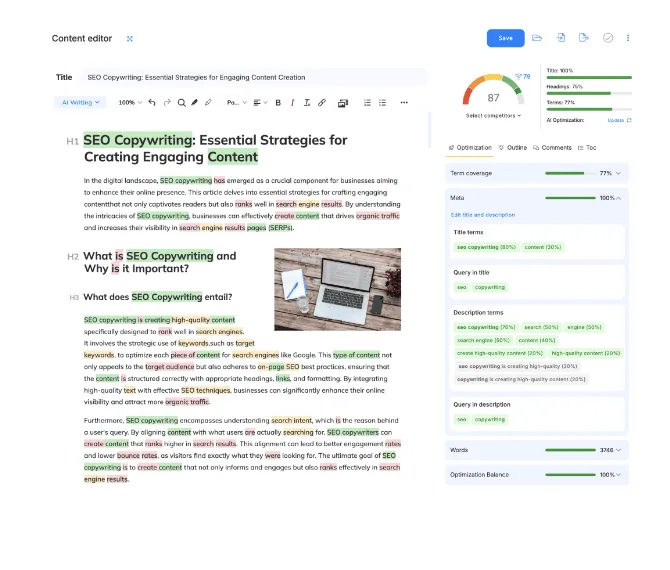
Clearscope is the cleanest tool on this list. No bloat, no bundled features you will not use — just a content grading system that tells writers exactly what to cover and how deeply. Enter a target query and it analyzes what ranks, then grades your draft with a letter score until the content covers the topic the way the winners do.
Best for: Editorial teams with multiple writers. Starting price: $129/mo for Essentials; Business is $399/mo. Free plan: No — a 14-day free trial. Standout: A clean, writer-friendly report format, with unlimited users and projects on every plan. Key limit: No keyword research and no technical SEO — it is an optimization layer only, so you need another tool upstream. Essentials caps drafts at 20 a month, with 50 tracked queries and 50 pages.
In 2026 Clearscope added query tracking across ChatGPT and Gemini, plus AI drafting and a feature that watches published pages for decay. Unlimited seats make it cost-effective for larger teams; a solo writer will find NeuronWriter far kinder to the wallet.

6. SE Ranking — Best Budget All-in-One
SE Ranking is the value alternative to Semrush: keyword research, rank tracking, site audits, backlink checks, and a full AI content module in one subscription, for less than the Semrush entry price. Its content workflow pulls keyword data, generates a brief, and runs an on-page audit in one flow — work most tools still split across three separate steps.
Best for: Teams switching from Semrush for cost reasons. Starting price: $103.20/mo for Core, billed annually ($129/mo billed monthly); Growth is $223.20/mo billed annually. Free plan: No — a 14-day free trial, no credit card required. Standout: An end-to-end content workflow in one platform. Key limit: Backlink data lags behind Ahrefs and Semrush, and Core covers only 10 projects with a single manager seat.
SE Ranking also tracks AI search visibility, but as a separate add-on: the AI Search (GEO) features are listed from $71/mo billed annually on the pricing page checked 13 November 2026. Add that to the Core price before you compare it with Semrush's bundled Starter tier.

7. RankIQ — Best for Bloggers
RankIQ is purpose-built for bloggers in specific niches. It keeps a curated library of low-competition keywords — hand-picked rather than scraped — and tells you exactly what to include and how long a post needs to be, based on what is actually working in that niche.
Best for: Niche bloggers in food, lifestyle, or personal finance. Starting price: $49/mo for the Blogger plan (16 SEO reports); Pro is $99/mo (36 reports) and Agency is $199/mo (80 reports). Free plan: No. Standout: A niche-specific keyword library with real competition data, plus the Aided bundle of AI apps for social posts and email promos. Key limit: Report allowances do not roll over, and no free trial is advertised. Niche coverage is narrow: blogs spanning many categories will hit gaps in the library.
Note the correction from the previous version of this guide, which listed RankIQ at a flat $99/mo with a free plan. Both were out of date: the Blogger tier now starts at $49/mo, and no free plan is offered.

How Much Do AI SEO Tools Cost in 2026?
Starting prices for the best AI SEO tools 2026 in this guide run from $23/mo (NeuronWriter) to $299/mo (Alli AI). Most land between $49 and $139/mo — but the headline price is rarely the price you end up paying.
First, annual billing changes the number. Surfer's Discovery is $49/mo billed annually but $59/mo billed monthly; Semrush's SEO plan is $139/mo monthly but $117.33/mo billed annually; SE Ranking's Core is $103.20/mo billed annually but $129/mo monthly. If you are not ready to commit for a year, price the monthly rate.
Second, AI visibility is usually an add-on. Semrush charges $99/mo per domain for its AI Visibility toolkit, SE Ranking's AI Search add-on starts at $71/mo billed annually, and Surfer's AI Search Analytics is a separate plan from $82/mo billed annually. Add that line to every quote before you compare tools.
Third, caps push you up a tier. RankIQ's report allowances do not roll over, Clearscope's Essentials plan caps drafts at 20 a month, and NeuronWriter's Bronze plan caps documents at 25. Match the plan to your publishing volume: paying for 500 tracked keywords when you publish twice a month is the fastest way to waste money.
AI Visibility (GEO) Tools Worth Adding in 2026
The seven tools above cover classic SEO. A separate category grew fast in 2026: AI visibility tools, also called GEO tools. They track how often your brand is mentioned or cited when ChatGPT, Perplexity, Gemini, or Google AI Overviews answer questions. A mention in an AI answer can now send more qualified visitors than a mid-page organic ranking, so for informational sites this tracking belongs in the stack alongside classic rank tracking. These three sit outside the ranked seven.
| Tool | Tracks | Starting price |
|---|---|---|
| Peec AI | ChatGPT, Perplexity, Gemini share of voice plus gap analysis | $95/mo |
| Otterly | ChatGPT, Google AI Overviews, Perplexity, Copilot plus GEO audit | $29/mo |
| Profound | ChatGPT, Perplexity, Google AI Mode, Gemini, Copilot, Claude, AI Overviews | $99/mo plus add-ons |
Peec AI ($95/mo, or $80/mo billed annually) is built for share-of-voice tracking: it runs the same prompts across AI engines and shows where your brand appears, where competitors appear instead, and which topics have gaps you can close with content.
Otterly (Lite from $29/mo — US pricing; the page shows €29 to EU visitors) is the cheapest entry point, tracking mentions across ChatGPT, Google AI Overviews, Perplexity, and Copilot, with a GEO audit that flags pages AI engines struggle to cite.
Profound (Agency Growth from $99/mo plus add-ons, per independent pricing checks in October 2026 — the official page shows no simple self-serve price, so confirm it with the vendor) covers the widest engine list, including Claude and Google AI Mode, and is aimed at teams needing agency-style reporting across many domains.
If you already use Semrush, check its AI Visibility toolkit ($99/mo per domain) before buying a second subscription.
What Changed in November 2026: AI Visibility Data Got Harder to Read
November brought two changes that affect how to read the numbers these tools report. First, Semrush added a Gemini filter to its AI Visibility Toolkit on 3 November, separating mentions, citations and cited pages for Gemini. Its Ghost Citations study found Gemini names brands in 83.7% of their appearances but cites them in only 21.4% — almost the reverse of ChatGPT, which cites brands in 87% of appearances and mentions them in 20.7%. A brand can therefore look visible in Gemini while earning almost no clickable links, so judge Gemini by mentions, not by referral traffic.
Second, Semrush stopped tracking Microsoft Copilot in its enterprise AI search product, Enterprise AIO, on 9 November, saying changes to Copilot’s access requirements prevent AI visibility platforms from collecting the data. Tracking on the other platforms Semrush covers is unaffected. Affected customers can either reclaim the Copilot prompts for other platforms or keep the historical data. The change applies to Enterprise AIO only, not the $99-per-domain AI Visibility Toolkit.
Finally, Google started its November 2026 core update on 10 November, with the rollout expected to take up to two weeks, and put Gemini 4 Hydrogen into Search globally on 12 November, saying its stronger query fan-out connects users to a broader range of links. Expect rank and AI-visibility readings to move during November, and do not judge any tool’s data until the rollout is complete.
What Most AI SEO Tool Reviews Get Wrong
Most roundups of the best AI SEO tools 2026 get three things wrong: they rank tools by features instead of workflow fit, they confuse AI writing with AI SEO, and they ignore how fresh the tool's data is. Fix those three blind spots and choosing the right tool becomes straightforward.
Buying a Tool for Features, Not for Workflow Fit
Surfer and Clearscope both optimize content. But if your team writes first and optimizes second, Surfer's real-time editor fits that workflow; if you brief writers upfront and optimize after publication, Clearscope makes more sense. Most buyers never ask which workflow they actually run. Start from your workflow, then shortlist the tools that fit it.
Confusing AI Content Generation with AI SEO
Many tools now bundle AI writing with SEO features and charge for both. The writing is almost always weak; the SEO features are almost always solid. Keep the two jobs separate: use a dedicated drafting assistant for the writing, and a scoring tool for the SEO. Our free AI writing tools roundup covers the best draft assistants, and our free AI article rewriter tools roundup covers reworking existing copy.
Ignoring the Data Freshness Question
Some tools update keyword and SERP data weekly; others update monthly or less. For fast-moving niches — finance, tech, and health — stale data means stale recommendations. Always check the crawl and update frequency before committing to an annual plan.
How Can You Check Whether AI Tools Mention Your Website?
Use an AI visibility tracker that runs the same prompts across ChatGPT, Perplexity, Gemini, and Google AI Overviews, then reports when your brand is mentioned or cited. Dedicated platforms like Profound do this automatically, and several tools in this guide — including SE Ranking and Surfer — bundle AI visibility tracking or sell it as an add-on. You can also check manually for free by asking each AI engine brand-related questions in a fresh session.
Why this matters: AI Overviews and chatbots now answer a large share of informational queries, so a mention there can drive more qualified traffic than a mid-page organic ranking. Tracking shows whether your content is being cited and which competitors appear instead of you.
Follow these steps to check your own AI visibility:
- List the questions your customers actually ask. Start with 10–20, for example "best AI SEO tools for bloggers."
- Ask each one in ChatGPT, Perplexity, and Google. Use a logged-out or fresh session so personalization does not skew results.
- Record mentions and citations. Note whether your brand is named, linked, or cited — and who gets mentioned instead.
- Automate ongoing monitoring. Profound and Otterly track brand mentions across AI engines, while SE Ranking's AI Search add-on and Surfer's AI Search Analytics fold the same data into dashboards you may already use.
- Close the gaps. Pages that AI engines cite tend to have clear definitions, comparison tables, and FAQ-style Q&A. Publish quotable, well-structured answers and the mentions follow.
Free option: repeat the manual prompt test once a month — it will not scale, but it catches the big shifts.
How Do You Choose the Right AI SEO Tool?
Choose in 30 seconds: blank page and need a draft fast? Start with Surfer or NeuronWriter. Thin drafts that need stronger term coverage? Surfer, Clearscope, or NeuronWriter. Want one platform for everything? Semrush. Tight budget? NeuronWriter at $23/mo. Large site with hundreds of pages? Alli AI. Worried about AI answers instead of classic rankings? Add a GEO tool from the section above.
Three tools to skip: mass AI article generators (Google's guidance is that what matters is helpful, people-first content, not how it was produced), AI link builders (bought links risk a penalty that outlasts any short-term gain), and any tool promising "AI rankings" (no tool controls Google's algorithm).
Match the tool to your situation, not to the longest feature list. If you are still learning the basics, our guide on how to use AI for SEO walks through the workflow first, and our AI tools for beginners roundup covers the gentlest starting points.
- Solo bloggers: start with RankIQ if you blog in one of its covered niches, or NeuronWriter for multi-topic sites. Both cost a fraction of enterprise tools and tell you exactly what to write.
- Small businesses: pick one all-in-one platform instead of three point tools. Semrush with AI Copilot or SE Ranking cover keyword research, audits, and content optimization in a single subscription, and both now track AI search visibility too. Our best AI tools for small business owners roundup covers the wider toolkit beyond SEO.
- Agencies and content teams: Surfer SEO fits write-then-optimize workflows with its real-time editor, while Clearscope fits brief-first editorial teams. Alli AI pays off when you are managing hundreds of pages and need bulk on-page deployment without developers.
Whatever you choose, match the plan to your publishing volume. Our AI productivity tools guide covers the daily workflow around these tools.
Frequently Asked Questions About AI SEO Tools
What is the best AI tool for SEO in 2026?
Surfer SEO is the best overall choice for most users — it combines real-time SERP data with practical, actionable content recommendations. For all-in-one keyword research, audits, and content optimization in a single dashboard, Semrush is the stronger option for growing teams willing to invest more.
Can AI tools replace SEO experts?
No. AI SEO tools automate the repetitive analytical work — keyword clustering, content scoring, technical audits — but they cannot replace strategic judgment. Deciding which pages to prioritize, how to build topical authority, or how to respond to an algorithm update still requires human expertise. The tools make experts faster, not redundant.
Which AI SEO tool is best for beginners?
RankIQ for bloggers, or NeuronWriter if your site covers multiple topics. Both give clear, direct guidance without requiring you to understand the underlying SEO mechanics. Avoid enterprise tools like Semrush as a starting point — the learning curve will eat the time savings you expect to gain.
Is there a free AI SEO tool?
Yes. Semrush offers a limited free plan at $0/mo, and Google Search Console is free for every site owner. The other tools here offer free trials instead — Clearscope and SE Ranking for 14 days, Alli AI for 10 days.
How much do AI SEO tools cost in 2026?
Starting prices in this guide range from $23/mo (NeuronWriter) to $299/mo (Alli AI); most land between $49 and $139/mo. Annual billing lowers most of those prices, but AI visibility tracking is often a separate add-on, so price the full stack — not just the headline number — before you compare tools.
Can AI SEO tools guarantee better rankings?
No. A content score measures how well your page covers the terms that ranking pages cover — it does not measure links, brand authority, or page experience, all of which also decide rankings. Treat AI SEO tools as analysts that show you what to fix, not as guarantees.
Did Semrush stop tracking Microsoft Copilot in November 2026?
Yes — but only in one product. Semrush discontinued Copilot tracking in its enterprise product, Enterprise AIO, on 9 November 2026, saying changes to Copilot’s access requirements prevent AI visibility platforms from collecting the data. Tracking on the other platforms Semrush covers was unaffected. The $99-per-domain AI Visibility Toolkit was not named in the notice, and other vendors’ Copilot coverage was not confirmed as changed.
Conclusion
If you are a blogger chasing low-competition wins, RankIQ or NeuronWriter is your entry point. If you run a content operation and need a full audit-to-publish workflow, Semrush or SE Ranking gives you that in one place.
Do not buy based on a feature checklist. The best AI tools for SEO are not the ones with the most features; they are the ones that fit how you work — buy for the phase of your content process that costs you the most time.
Your next step: pick the one tool that matches your workflow, run its free plan or trial on a real post, and measure whether the draft improves. If you want to compare the wider toolkit first, browse our free tools library.
Last checked: 16 November 2026 | Prices checked: 16 November 2026 on each vendor's official pricing page (see Sources). Prices change — confirm on the vendor site before you buy.
site before you buy.
Sources
- Surfer SEO pricing — surferseo.com/pricing/ (checked 13 November 2026)
- Semrush pricing — semrush.com/pricing/ (checked 13 November 2026)
- Alli AI pricing — alliai.com/pricing/ (checked 13 November 2026; price read via independent check, see Alli AI section)
- NeuronWriter pricing — neuronwriter.com/pricing/ (checked 13 November 2026)
- Clearscope pricing — clearscope.io/pricing (checked 13 November 2026)
- SE Ranking pricing — seranking.com/pricing.html (checked 13 November 2026)
- RankIQ pricing — rankiq.com/pricing (checked 13 November 2026)
- Peec AI pricing — peec.ai/pricing (checked 13 November 2026)
- Otterly pricing — otterly.ai/pricing (checked 13 November 2026)
- Profound pricing — tryprofound.com/pricing (checked 13 November 2026; price read via independent check, see GEO section)
- Google Search Central, "Google Search's guidance about AI-generated content" — developers.google.com/search/blog/2023/02/google-search-and-ai-content
- Google Search Central, "Creating helpful, reliable, people-first content" — developers.google.com/search/docs/fundamentals/creating-helpful-content
- Rank.ai, "AI SEO tools: 18 tools for research, content, technical SEO and AI visibility (2026)" — rank.ai/guides/seo/ai-seo-tools (prices read from vendor sites 16 October 2026; used as cross-check only)
- Rankite, "Best AI SEO Software in 2026: 9 Tools Compared" — rankite.com/blog/best-ai-seo-software-my-location-is-usa (checked October 2026; used as cross-check only)
- Rework, "Best AI SEO Tools in 2026: 15 Tools Ranked by Use Case" — resources.rework.com/tools/ai-tools/best-ai-seo-tools-2026 (updated July 2026; used as cross-check only)
- Semrush Gemini filter / Ghost Citations report — geoagencies.com/news/semrush-adds-gemini-filtering-to-ai-visibility-toolkit-as-mentions-out-20261103
- Semrush drops Copilot tracking (PPC Land) — ppc.land/semrush-drops-copilot-from-ai-visibility-tracking-on-november-9/
- Google Search Status Dashboard, November 2026 core update — status.search.google.com/incidents/WLxcJyC6jMWMfryxsKMc
- Google blog, Gemini 4 Hydrogen in Search — blog.google/products-and-platforms/products/search/gemini-4-hydrogen-search-upgrade/
- AI News November 2026: Anthropic’s $64B IPO, OpenAI Robotics & Gemini Glasses
- AI Note Taker: 7 Best Free Tools for Notes & Summaries (2026)
- Typing Speed Test: 7 Best Free Tools to Check & Improve WPM (2026)
- Gemini 4 Carbon: Google’s Strongest AI Model Yet (2026)
- AI Book Generator: 7 Best Free Tools to Write a Full Book (2026)




[…] quality raters are trained to look for exactly this kind of differentiation. So are readers. [Best AI SEO Tools 2026 […]