

Freelance digital marketing means running marketing for clients as an independent professional, usually in areas like SEO, paid ads, social media, email, and content, and charging by the hour, project, or monthly retainer. You can start with free training and no special equipment, but your first paying client takes real outreach, not just a certificate.
A teacher in Manchester planning a career change, a marketing graduate in Toronto who cannot find a junior role, a parent in Houston who wants flexible hours, and a designer in Sydney adding a new service all look at freelance digital marketing for the same reasons: low start-up cost, flexible work, and steady demand from small businesses that cannot afford an agency.
This guide covers the services you can sell, what they typically pay, how to price, where to find clients, what to learn, and a 7-step plan to start freelance digital marketing. Rates are ranges from recent guides checked on October 9, 2026. They are not promises, and most beginners earn less than the averages quoted below.
Key takeaways
- Freelance digital marketing covers SEO, paid ads, social media, email, and content, and specialists usually earn more than generalists.
- Hourly rates in recent guides run from about $25 to $50 for entry-level work to $120 to $250 for senior specialists.
- Monthly retainers give you steadier income than one-off projects.
- Free training from Google Skillshop and HubSpot Academy helps, but client results and a portfolio matter more than certificates.
- Your first client usually comes from direct outreach and referrals, not from waiting for inbound work.
What Freelance Digital Marketing Actually Involves
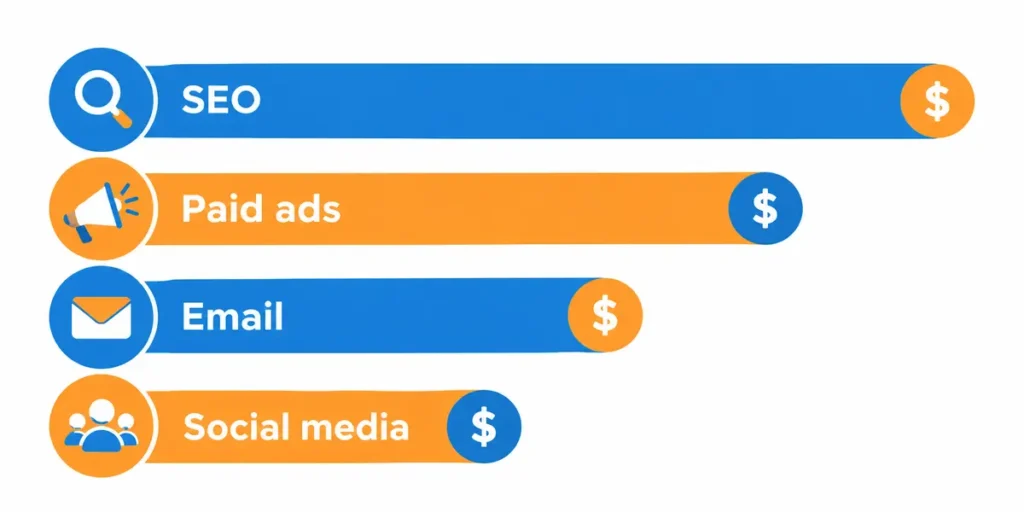
Digital marketing is a group of skills, not one job. Most freelancers pick one or two channels and go deep. The table below shows the main services and typical hourly ranges from Twine’s rate guide.
| Service | What you do | Typical hourly range |
|---|---|---|
| SEO | Audit sites, fix technical issues, and plan and optimize content. | $50 to $200+ |
| Paid ads (PPC) | Run Google, Meta, and LinkedIn ad campaigns and manage budgets | $75 to $250+ |
| Social media management | Plan posts, run accounts, engage with the community | $30 to $150+ |
| Email marketing | Build lifecycle flows, newsletters, and segments. | $50 to $200+ |
| Content marketing | Write articles, guides, and landing pages. | Varies widely by niche and experience |
Source for the ranges: Twine’s digital marketer hourly rate guide. Paid ads and technical SEO sit at the top because mistakes cost clients real money.
How Much Freelance Digital Marketing Pays
Pay depends on your experience, your specialty, your client’s region, and how you price. Twine’s guide breaks hourly rates down by experience: roughly $25 to $50 for entry-level work, $50 to $120 for mid-level, $120 to $250 for senior and $250 to $500+ for expert consultants. Another guide puts the average freelance marketer rate near $48 an hour, which hides a wide spread.
| Pricing model | How it works | Best for |
|---|---|---|
| Hourly | You bill for time spent. | Audits, consulting, and unclear scopes |
| Project | A fixed price for a defined deliverable, with guides citing ranges from about $1,500 to $50,000 or more depending on scope | SEO audits, landing pages, and email sequences |
| Monthly retainer | A fixed monthly fee for ongoing work, with social media retainers reported from around $300 for basic management to $7,000+ for premium work | Ongoing SEO, ads, social media, and content |
| Performance-based | A share of results or ad spend, often cited at 10 to 20 percent of spend | Experienced freelancers with predictable campaigns |
Do the math before you quit a job. At $40 an hour and 15 billable hours a week, you earn about $2,400 a month before tax and costs. Billable hours are only part of your week, because finding clients, admin, and reporting take time too.
How to Start Freelance Digital Marketing: 7 Steps
1. Pick a Service and a Niche
Specialists tend to earn more than generalists, because clients pay for focused expertise. Choose one service, such as SEO, email, or paid social, and one type of client you understand, such as local restaurants, online shops or software startups. A narrow offer is easier to explain and easier to sell.
2. Learn the Basics With Free Training
You do not need a degree. Google Skillshop offers free Google Ads training and certifications, and HubSpot Academy offers free courses and certificates on inbound, content, email, and social media marketing. Meta Blueprint has free courses for paid social, though its official exams cost extra, and Semrush Academy has free SEO courses.
Certificates help you learn and build credibility, but clients care about results. Do not stop at the course.
3. Build Proof Before You Have Clients
Run a small project where you can measure results: grow your own site, help a local charity or offer a discounted project to a small business in exchange for a testimonial and permission to publish a case study. Record real before-and-after numbers honestly. One credible case study beats ten certificates.
4. Package Your Offer
Create a simple one-page site or LinkedIn profile with two or three clearly packaged services, such as an SEO audit with an action plan, a welcome email sequence, or monthly social media management. Define what is included, how long it takes, and how you will report results. Clear packages are easier to price and harder to haggle over.
5. Find Your First Clients
Contact local small businesses directly with a specific, useful observation about their marketing, such as a missing Google Business profile or slow-loading landing page. Ask friends, past employers, and contacts for referrals. Platforms like Upwork and Fiverr can get you a first project faster but charge fees and have heavy competition. More on channels below.
6. Set Up Contracts, Invoicing and Tax
Use a written agreement with scope, payment terms, revision limits, and a deposit for new clients. Keep business money separate from personal money, track income and expenses, and learn the tax rules in your country. This is general information, not tax advice, so consider a local accountant.
7. Deliver, Report and Grow
Send a short monthly report with the few numbers that matter to the client’s business, such as leads, sales or qualified traffic. Good reporting turns a project into a retainer and a happy client into a referral. Raise your rates as your results and testimonials grow.

Where to Find Freelance Digital Marketing Clients
| Channel | Best for | Catch |
|---|---|---|
| Local outreach | Small businesses that need basic marketing help | Takes time and many messages |
| Referrals and past employers | Building trust quickly | Slow to start without a network |
| B2B services and consultants | Needs a clear profile and consistent posting | |
| Upwork and Fiverr | Landing a first project quickly | Fees, competition, and payout delays |
| Content and social media | Attracting inbound inquiries | Slow, so see our guide to TikTok content ideas |
Tools for Freelance Digital Marketing (Including AI)
You can start with a small toolkit: Google Analytics and Search Console for data, a spreadsheet for reporting, a simple project tool and an invoicing app. AI assistants can speed up research, outlines, and first drafts. Our guides to AI productivity tools and the best AI SEO tools cover the options.
A useful starter prompt for an SEO audit helper:
Act as a senior SEO consultant. Here is the text of a small business homepage: [paste]. List five quick-win improvements for title, headings, internal links and calls to action, and explain why each matters in one sentence.Prompt quality matters, so see our guide to how to write AI prompts. Two rules: edit AI output carefully before it reaches a client, and do not paste confidential client data into consumer AI accounts. Check your contract on whether you need to disclose AI use.
Contracts and Red Flags in Freelance Digital Marketing
- Never guarantee results. No honest marketer can guarantee a number one ranking or a specific sales figure. Promise a process and reporting, not an outcome.
- Beware of unpaid “test projects.” A small paid trial is fine. A request for free work that looks like real deliverables is not.
- Get a deposit. Start work after the first payment clears.
- Watch for fake-check scams. The FTC warns that no legitimate client sends you a check and asks you to send part of it back or buy gift cards. See the FTC’s guide to job scams.
- Agree on scope in writing. Unlimited revisions and vague deliverables lead to unpaid work.
Common Mistakes to Avoid
Most beginners in freelance digital marketing make the same few mistakes.
- Offering everything. Clients trust focused experts more than “I do all marketing.”
- Underpricing for months. Low rates attract difficult clients and make it hard to raise prices later.
- Skipping proof. Without a case study, prospects have no reason to choose you.
- Waiting for clients to find you. Direct outreach is what lands early work.
- Ignoring reporting. Clients cancel what they cannot see working.
- Relying on one client. Losing a single large client can wipe out your income.
Bottom Line: Is Freelance Digital Marketing Worth It?
It can be, if you treat it as a business and not a quick fix. Pick one service, learn it properly, build proof, package a clear offer, and keep contacting potential clients every week. Retainers and referrals make income steadier over time.
Freelance digital marketing rewards patience and results. The freelancers who last are the ones who report honestly, raise their rates as they improve and never promise what they cannot control.
Freelance Digital Marketing: Frequently Asked Questions
How do I start freelance digital marketing with no experience?
Pick one service, such as SEO or email, learn the basics through free courses like Google Skillshop and HubSpot Academy, and build proof with a small project for your own site or a local business. Then package a simple offer and contact local small businesses directly. Expect your first client to take weeks of outreach.
How much do freelance digital marketers earn?
Hourly rates in recent guides run from about $25 to $50 for entry-level work to $120 to $250 for senior specialists, with SEO and paid ads at the higher end. One guide puts the average freelance marketer rate near $48 an hour, but beginners usually start lower and earn less than billable-hour math suggests.
What skills do I need for freelance digital marketing?
You need at least one core channel, such as SEO, paid ads, email or social media, plus basic analytics, clear writing and client communication. Project management and honest reporting matter just as much. Specialists generally earn more than generalists, so go deep on one skill before adding others.
Do I need a degree or certification for freelance digital marketing?
No degree is required. Clients mostly care about results, so a portfolio with real case studies matters more than a certificate. Free certifications from Google Skillshop and HubSpot Academy can build knowledge and credibility, and platform badges can help when you manage ad budgets.
Where can I find freelance digital marketing clients?
Start with local small businesses, past employers and personal referrals, then add LinkedIn outreach and platforms such as Upwork or Fiverr. Platforms are faster for a first client but charge fees and have more competition. A direct message with a specific suggestion for the client’s marketing tends to stand out more than a generic pitch.




[…] If marketing is your skill, see our full guide to freelance digital marketing. […]