
How to Write AI Prompts: 7 Powerful Techniques & 2026 Guide
Last checked: October 2026
Artificial intelligence has fundamentally transformed content creation, programming, business strategy, and visual design. However, the quality of any artificial intelligence output depends entirely on the quality of its input. Learning how to write ai prompts effectively—a discipline formally known as prompt engineering—has become one of the most critical digital skills of the 21st century.
Whether you are using large language models like ChatGPT, Claude, and Gemini for business workflows or generative image engines like Midjourney and Adobe Firefly for design assets, mastering how to write ai prompts ensures you receive accurate, contextually rich, and production-ready outputs every time. To explore more technical guides on optimizing artificial intelligence workflows, visit AI Earn Tools Hub. For deeper technical insights into prompt architecture and machine learning research, developers frequently explore IBM’s Guide to Prompt Engineering Frameworks.
In this comprehensive 2026 guide, we break down core prompting frameworks, advanced step-by-step techniques, essential prompt elements, and practical examples to teach you how to write ai prompts that consistently yield exceptional results.
Key Takeaways
- A strong prompt has five parts: role, context, task, constraints, and format.
- Show one to three examples when tone or layout must match exactly.
- Work in turns: outline, draft, polish.
- For images: subject, setting, lighting, style, camera angle — in that order.
- Check facts, names, and numbers before publishing any AI answer.
- Practise how to write ai prompts with the templates and examples in this guide.
What is an AI Prompt & Why Does Prompt Structure Matter?
An AI prompt is a written instruction telling a model what to produce. Structure matters: role, context, task, rules, and format leave less to guess.
Before diving into advanced techniques, it is essential to understand what an AI prompt actually is. An AI prompt is a natural language instruction, question, or contextual text block provided to a generative machine learning model to guide its response.
When studying how to write ai prompts, many users make the mistake of treating language models like traditional search engines. Search engines index existing webpages based on simple keywords. In contrast, generative AI models construct novel statistical predictions token by token based on massive training datasets.
A vague prompt like “Write an email about a product launch” forces the model to make dozens of blind assumptions regarding target audience, tone, product benefits, email length, and call-to-action details. Conversely, understanding how to write ai prompts with clear structural guardrails allows you to direct the model’s vast reasoning capabilities toward your precise goals.
The 5 Core Elements of a Perfect AI Prompt:
- Persona (Role): Who should the AI act as? (e.g., “Act as a senior search engine optimization strategist…”)
- Context (Background): What background details does the model need to know? (e.g., “We are launching an enterprise B2B SaaS tool…”)
- Task (Action): What exact action should the AI perform? (e.g., “Draft a 300-word cold outreach email…”)
- Constraints (Rules): What limitations or rules must it follow? (e.g., “Avoid jargon, use a professional tone, limit paragraphs to 2 sentences…”)
- Format (Output): How should the response be styled? (e.g., “Format using Markdown with bullet points and bold key terms.”)
7 Powerful Techniques on How to Write AI Prompts
Use seven techniques together: set a role, reason step by step, show examples, add constraints, refine in turns, separate context, and control format.
Mastering how to write ai prompts requires moving beyond trial-and-error typing. Professional prompt engineers rely on battle-tested algorithmic frameworks to manipulate probability distributions in their favor.
1. Role-Based Prompting (Assigning a Persona)
Generative language models possess vast knowledge spanning thousands of domains. Assigning a specific expert persona forces the model to filter its response through that specialized domain knowledge, adopting appropriate industry terminology and professional standards. When learning how to write ai prompts, always start by defining the AI’s role.
Weak Prompt: “How do I improve my website’s conversion rate?”
Optimized Prompt: “Act as a world-class Conversion Rate Optimization (CRO) expert with 15 years of e-commerce experience. Audit the following landing page copy and identify three psychological friction points reducing our checkout conversions…”
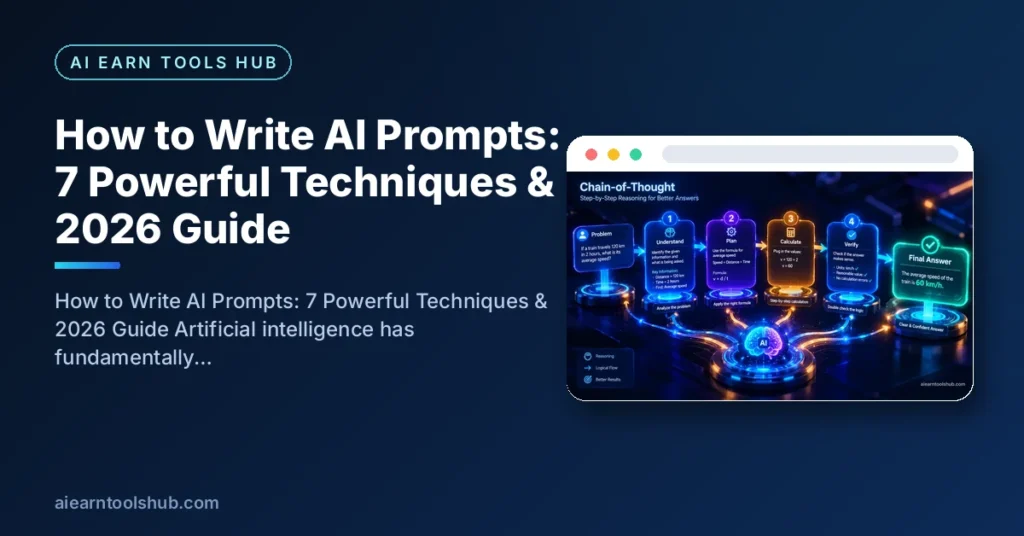
2. Chain-of-Thought (CoT) Prompting
Complex mathematical, analytical, or multi-step logic queries often fail when models jump straight to a final answer. Chain-of-Thought prompting forces the AI to simulate sequential reasoning, drastically reducing logical hallucinations.
To implement this when mastering how to write ai prompts, simply add instructions like “Think step by step before providing your answer” or “Break down your analytical logic into sequential numbered stages before reaching a recommendation.”

3. Few-Shot Prompting (Providing Exemplars)
Models learn rapidly from pattern recognition. Instead of merely describing how you want something done, show the model 1 to 3 examples of perfect execution. This technique is known as Few-Shot Prompting.
Task: Convert customer feedback into a sentiment label and tag.
Example 1:
Input: "The delivery took two weeks and the box was crushed."
Output: [Sentiment: Negative | Category: Logistics]
Example 2:
Input: "Sublime quality! The customer service team resolved my issue in 5 minutes."
Output: [Sentiment: Positive | Category: Customer Support]
Now analyze this input:
Input: "The app crashes every time I tap the checkout button."
Output:
4. Constraint-Driven & Negative Guardrails
Equally as important as telling an AI what to do is instructing it on what NOT to do. Negative constraints prevent generic, robotic phrasing and bloated formatting.
When applying how to write ai prompts for business content, include negative guardrails such as “Do not use buzzwords like ‘delve,’ ‘tapestry,’ ‘game-changer,’ or ‘testament.'” “Do not summarize conclusions at the end of every section.”
5. Multi-Turn Conversational Refinement
Never expect a single prompt to produce a flawless 2,000-word deliverable on the first try. Professional prompt engineers utilize multi-turn workflows, systematically guiding the model through incremental stages:
- Turn 1: Request an initial high-level outline or strategic framework.
- Turn 2: Review the outline, request structural edits, and approve section headings.
- Turn 3: Command the model to generate one detailed section at a time.
- Turn 4: Request polish, tone adjustments, and final formatting passes.
6. Context Delimiters (Using XML or Markdown Tags)
When feeding long reference documents, articles, or code snippets into a prompt, use clear visual delimiters (such as XML-style <context> tags or triple backticks) to separate your commands from raw data. This prevents the model from confusing your reference materials with its active instructions.
7. Output Formatting Control
Ensure the model presents its output in a structure ready for immediate use. Instruct the system to output raw Markdown tables, valid JSON objects, bulleted executive summaries, or clean HTML code blocks based on your downstream application requirements.
Text AI Prompts vs. Visual AI Prompts: Key Differences
Text prompts control reasoning, tone, and structure. Visual prompts control subject, lighting, style, and framing.
Understanding how to write ai prompts varies depending on whether you are working with Text Large Language Models (LLMs) or Visual Generative models. While the core philosophy remains similar, syntax rules differ significantly:
| Prompt Aspect | Text AI Prompts (ChatGPT / Claude) | Visual AI Prompts (Midjourney / DALL-E) |
|---|---|---|
| Primary Objective | Logic, tone, context retention, and reasoning | Lighting, composition, art style, and framing |
| Structure Focus | Persona + Context + Task + Rules + Formatting | Subject + Environment + Lighting + Camera + Aspect Ratio |
| Key Parameters | Temperature, Max Tokens, System Messages | Aspect ratio (--ar 16:9), stylize, seed, model version |
| Ideal Syntax | Full conversational sentences and detailed instructions | Comma-separated descriptive keywords and visual modifiers |
How Do You Write AI Prompts for Image Generators Like Midjourney and DALL-E?
Name the subject, setting, lighting, and style first. Add the camera angle and aspect ratio last.

Creating photorealistic imagery or digital artwork requires a specialized visual framework. When learning how to write ai prompts for image generation tools, follow this 5-part visual formula:
[Core Subject] + [Environment & Setting] + [Lighting & Color Palette] + [Style & Medium] + [Camera Angle & Technical Specs]Example Visual Prompt:
“A photorealistic portrait of an elderly craftsman sculpting wood in an authentic workshop, dramatic chiaroscuro lighting with warm golden hour sunlight coming through a dusty window, shot on 35mm film, ultra-detailed skin textures, shallow depth of field –ar 16:9”
What Are the Most Common Mistakes to Avoid When Writing AI Prompts?
The most common mistakes are being vague, overloading one prompt, expecting facts you never gave, and skipping verification. Avoid those four, and you already know how to write ai prompts better than most beginners.
To consistently get top-tier results, avoid these frequent prompt engineering mistakes:
- Being Overly Vague: Asking, “Make this sound better,” without specifying the target audience, tone, or context.
- Information Overload in One Turn: Cramming 20 complex tasks into a single prompt instead of breaking them into logical steps.
- Ignoring System Limitations: Expecting models to know live private facts without supplying reference documents via Retrieval-Augmented Generation (RAG) principles.
- Skipping Verification: Blindly publishing AI output without verifying quotes, statistics, or code logic.
What Are Some Copyable Prompt Templates You Can Use Right Away?
Copy a template, replace the bracketed words, and keep its role, task, and format lines.
Template 1: Blog Post Introduction
Act as a blogger for [AUDIENCE]. Write a [NUMBER]-word intro on [TOPIC]: open with a problem, explain why it matters, and promise practical tips.Template 2: Product Description
Act as a copywriter. Write a [NUMBER]-word description of [PRODUCT] for [BUYER] using only: [FEATURES AND PRICE]. Lead with the main benefit; end with a call to action.Template 3: Study Notes
Act as a tutor. Make study notes on [TOPIC] for a [LEVEL] student from this text: headings, bullets, one example per key idea, five test questions. Text: [PASTE TEXT]Change one part at a time when reusing a template — that is how to write ai prompts in practice. Keep a small library of them, and learning how to write ai prompts becomes a habit, not a chore.
What Does a Weak Prompt Look Like Compared With a Strong Prompt?
A weak prompt leaves audience, purpose, and format unstated, so the model guesses. A strong prompt states all three, plus facts to use and length wanted.
Weak prompt: “Write something about our new headphones.”
Strong prompt: “Act as a copywriter. Write a 120-word description of wireless headphones with 30 hours of battery life, priced at $79, for commuters. Lead with the battery benefit and end with ‘Order today for free delivery.’ Add no other features.”
Why the strong version works:
- Role and audience are named, so tone and level are set.
- Length, price, and the lead fact are specified.
- The closing line is given word for word.
- It shows, in miniature, how to write ai prompts for any task.
How Can You Fix Vague Answers, the Wrong Tone, and Made-Up Facts?
Most poor answers can be fixed in the prompt: add detail, show the tone you want, and limit the model to facts you supply. That routine is the practical core of how to write ai prompts well.
Problem 1: The Answer Is Vague
Add the audience, purpose, and format, then ask for three specific examples, or for steps you can follow today.
Problem 2: The Tone Is Wrong
Name the tone — friendly, formal, or plain — and paste a paragraph written that way. Ask the model to match it and avoid phrases you dislike.
Problem 3: The Answer Contains Made-Up Facts
Tell the model to use only facts you provide, and to write “I do not know” otherwise. Check names, dates, and numbers yourself before publishing.
What Is the Future of Prompting With Autonomous Agents and Meta-Prompting?
Prompting is moving from step-by-step instructions toward clear goals. Meta-prompting improves prompts automatically, and agents run multi-step tasks from one instruction. That is why learning how to write ai prompts still matters in 2026.
As artificial intelligence evolves, the skill of how to write ai prompts is expanding into Meta-Prompting—using AI systems to draft, test, and optimize prompts for other AI agents automatically. Furthermore, multi-agent autonomous workflows orchestrate teams of specialized AI personas collaborating synchronously to complete end-to-end enterprise projects.
Developing strong prompt engineering skills today ensures you remain at the forefront of digital efficiency, business innovation, and creative automation throughout the next decade.
Frequently Asked Questions (People Also Ask)
These short answers cover the questions readers ask most about how to write ai prompts.
How to write AI prompts effectively in simple terms?
To write effective AI prompts, assign a specific expert role to the model, provide detailed background context, define clear action steps, specify desired output formats, and include examples whenever possible.
What is the best prompt structure for ChatGPT and Claude?
The most effective structure follows the CARE or CREATE framework: Persona (Role) + Context (Background) + Task (Action) + Constraints (Format & Style Rules) + Examples.
What is the difference between text prompts and visual AI prompts?
Text prompts focus on logical reasoning, tone, structure, and domain expertise for language models. Visual AI prompts (for Midjourney or DALL-E) focus on camera angles, lighting conditions, artistic mediums, subject framing, and aspect ratios.
Why does AI hallucinate or provide incorrect answers to prompts?
AI models predict statistically likely token sequences rather than searching a live database unless grounded. Ambiguous or overly broad prompts lead to assumptions, resulting in factual errors or hallucinations.
How do few-shot prompts improve AI response quality?
Few-shot prompting provides the AI with 1 to 3 concrete input-output examples inside your prompt. This conditions the neural network to replicate the exact structure, tone, and formatting you require.
What should you do when an AI answer is vague or off-topic?
Restate the audience, purpose, and format, ask for examples or steps, and tell the model to use only facts you supplied.




[…] quality matters, so our guide to how to write AI prompts will help. If you want a voiceover without recording yourself, see our guide to AI text to speech, […]
[…] alternatives,” and “what could be wrong with this answer?” Our full guide on how to write AI prompts has more […]
[…] 138 words—specific, proof-backed, ending with a question. To sharpen the prompting skill behind it, see our guide to writing AI prompts. […]
[…] help: our AI prompts guide and YouTube automation […]