Gemini 4 Carbon: Google’s Strongest AI Model Yet (2026)
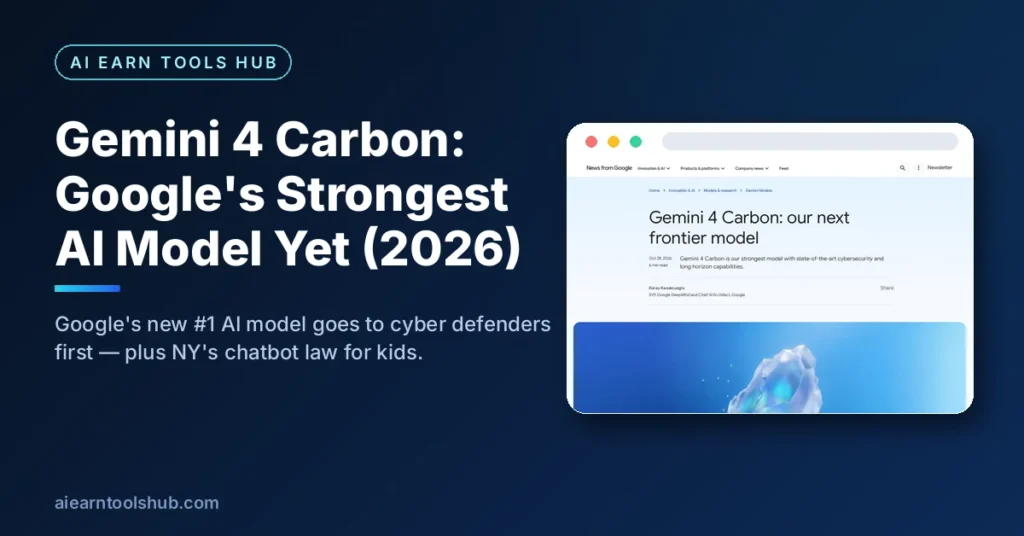
Gemini 4 Carbon is Google DeepMind’s new frontier AI model, announced on October 28, 2026, and it is the strongest model Google has released — but almost nobody can use it yet. Carbon ranks #1 on the updated Artificial Analysis Intelligence Index with a score of 59, leads three cybersecurity benchmarks for finding, exploiting and patching software flaws, and costs the same introductory price as its predecessor.
Google is giving it first to a small group of cyber defenders through its Fairwind Program, with wider access promised only after feedback and guardrail testing.
Key takeaways
- Lead story: Gemini 4 Carbon, announced October 28, is Google’s strongest model yet — #1 on the Artificial Analysis Intelligence Index v5.0 (59), ahead of Claude Opus 5.5 (58) and GPT-6 Astra (57).
- Security story: Carbon scores 88.2% on SEC-bench Pro (finding vulnerabilities), 54.8% on ExploitGym (exploiting them) and 71.0% on CWE-bench (patching) — but those tests were run without guardrails, and independent verification is pending.
- Access story: only a subset of cyber defenders gets Carbon this week; developers, businesses and consumers wait for an unannounced later date.
- Law story: New York signed a chatbot safety law on October 28 that bans 12 “unsafe” chatbot features for users under 18 from January 1, 2027, with fines up to $25,000 per violation.
- Cyber week: the same week, Anthropic’s red team showed an unreleased Claude chaining real software flaws into working attacks, and the three big labs confirmed weeks of joint safety coordination.
Table of Contents
- What is Gemini 4 Carbon, and why does it lead the benchmarks?
- Why is Gemini 4 Carbon only available to cyber defenders?
- How much will Gemini 4 Carbon cost?
- What has New York actually banned in AI chatbots for kids?
- What else happened in AI’s cybersecurity week?
- Also in brief: Anthropic’s science expansion
- What to watch next
- FAQs
- Bottom line
What is Gemini 4 Carbon, and why does it lead the benchmarks?
Gemini 4 Carbon is Google DeepMind’s next frontier model, announced on October 28, 2026, just two weeks after its predecessor Gemini 4 Argon. Google describes Carbon as its strongest model with state-of-the-art cybersecurity and long-horizon capabilities — meaning it can sustain multi-step engineering work for days rather than minutes.
The benchmark case is genuinely strong: Carbon ranks #1 on the recently updated v5.0 of the Artificial Analysis Intelligence Index at 59, a composite of independent evaluations, ahead of Claude Opus 5.5 at 58, GPT-6 Astra at 57 and Argon at 50. It also posts the top result in 15 of the 17 benchmark rows in Google’s own announcement.
The cybersecurity numbers explain why Google is pitching Carbon as a defender’s tool first. SEC-bench Pro, which tests finding vulnerabilities in real software, comes in at 88.2%; ExploitGym, which tests turning a disclosed flaw into a working exploit, at 54.8%; and CWE-bench, which grades patching to root cause, at 71.0%.
Google also reports that Carbon more than doubles Argon’s success rate at generating secure code, that its Chrome team saw Carbon produce high-quality patches more than 10 times better than another lab’s frontier model, and that it cuts unsupported claims by about half versus Argon. Two honest caveats belong with those figures: the security benchmarks were run without safety guardrails, and Google has not yet published a Carbon-specific technical report or model card — the safety report linked from the announcement covers Argon. Independent developers cannot yet run Carbon themselves to check any of this.
| Benchmark | Gemini 4 Carbon | Closest rival | What it measures |
|---|---|---|---|
| Artificial Analysis Intelligence Index v5.0 | 59 (#1) | Claude Opus 5.5 (58) | Overall frontier capability |
| SEC-bench Pro | 88.2% | Previous record | Finding real software vulnerabilities |
| ExploitGym | 54.8% | — | Turning flaws into working exploits |
| CWE-bench | 71.0% | — | Patching to root cause |
| Coding Agent Index | 59 (#2) | Claude Code + Opus 5.5 (62) | Agentic coding |
Why is Gemini 4 Carbon only available to cyber defenders?
Gemini 4 Carbon is only available to cyber defenders first because Google is taking what it calls a deliberate approach to rollout, and is engaged in the US government’s voluntary process for pre-release model testing. Starting this week, a subset of cyber defenders gets access, with staged expansion to additional trusted partners through Google’s Fairwind Program, which counts more than 650 partners worldwide.
Developers, businesses and consumers will get Carbon through Google’s product surfaces “as soon as possible” after Google gathers feedback and iterates on guardrails — but no date has been set.
This is the second time in a month Google has used this pattern: Gemini 4 Argon went to defenders on September 30 and opened more broadly on October 13, a 13-day head start for defense. The logic is straightforward for a model this good at finding and exploiting flaws: give the people who fix software a head start before the capability spreads.
The risk, which Google’s own cautious rollout acknowledges, is that the same skills that patch systems can also attack them — which is why Carbon’s benchmarks were run without guardrails but its release is wrapped in them.
How much will Gemini 4 Carbon cost?
Gemini 4 Carbon will launch at the same introductory price as Argon: $2 per million input tokens and $10 per million output tokens, with cached input tokens priced at 95% off the input rate. After the introductory period ends — Google has not said when — the price rises to $4 per million input tokens and $20 per million output tokens, matching Claude Opus 5.5’s pricing tier.
Since Carbon is not yet broadly available through the public API, that price is a stated launch price for restricted access, not a price you can pay today. If you need a frontier model right now, Argon remains the model customers can actually evaluate through Google’s existing public offering.
What has New York actually banned in AI chatbots for kids?
New York has banned 12 “unsafe AI companion features” for users under 18, under a law Governor Kathy Hochul signed on October 28, 2026. The law — S.9051B/A.10379C, enacted as Article 48 of New York’s General Business Law — takes effect on January 1, 2027, giving companies about two months to comply.
Sponsored by State Senator Kristen Gonzalez and Assemblymember Alex Bores and enforced by Attorney General Letitia James, it is described by supporters as the strongest kids’ chatbot safety law in the United States.
The banned features for minors include chatbots pretending to be human, alive or feeling human emotions; claiming a romantic, personal or professional relationship with a child; using flattery or sycophancy to keep a young user engaged; asking unprompted emotional questions; recalling a child’s private health or personal details from earlier conversations; encouraging self-harm, eating disorders or drug use; urging children to keep secrets from parents or trusted adults; and producing sexually explicit content.
Crucially, the law does not just apply to users a company knows are minors: a company may not offer these features to any user until it has confirmed the user is not a minor. Companies must offer more than one age-verification method, including at least one that does not rely only on a government ID, and must delete age data after using it.
Violations can draw civil penalties of up to $25,000 each, plus damages, restitution and even court-ordered deletion of unlawfully collected data or models trained on it.
One scope question is still open and worth watching: the law’s definition of a covered system — a generative-AI system with a natural-language interface providing ongoing, adaptive responses — is written broadly enough that legal analysts argue it could reach general-purpose assistants like ChatGPT, Claude and Gemini, not just companion apps.
The governor’s office cited a Common Sense Media survey finding that 72% of teens have used an AI companion. A second bill signed the same day sets security standards for internet-connected baby monitors, effective 90 days after signing. For readers following this space, our earlier coverage of the week’s other major AI stories is in Google Genie 4: AI Worlds That Talk Back.

What else happened in AI’s cybersecurity week?
AI’s cybersecurity week was bigger than one model launch — it was the week the frontier labs stopped treating cyber capability as a side topic. On October 27, Anthropic’s Frontier Red Team published research showing an unreleased internal Claude model finding vulnerabilities across Chrome, Safari, Android, Windows and Linux and chaining them into five working proof-of-concept attacks, reaching root in one case in 53 minutes.
Google assigned 62 CVEs to the wider findings, all critical or high, patched as of Chrome 156. And on October 29, OpenAI, Anthropic and Google DeepMind confirmed they had spent several weeks coordinating on AI safety measures, jointly unveiling cyber-focused models, safeguards and access programs — a notable shift after years of largely public competition.
OpenAI also described the monitoring system it uses to watch its own models at work, reportedly detecting problems within 15 minutes.
Read together, the pattern is clear: the same week produced a model built for defense (Carbon), a demonstration of offense (Anthropic’s red team) and a joint statement that the labs are coordinating on the boundary between the two. That is why defenders-first access is the story, not just a footnote.
Also in brief: Anthropic’s science expansion
Anthropic announced an expansion of its AI for Science program, offering free Claude credits to eligible researchers and highlighting partnerships with 20 scientific foundations, institutions and research groups working across biology, medicine, physics and climate science.
Separately, Anthropic extended a 40% discount on Claude to every level of US government. Both moves land as Anthropic’s IPO filing continues to draw scrutiny over its pre-IPO risk disclosures — the commercial and political tracks of the AI race are now running in parallel.
What to watch next
Three follow-ups matter more than this week’s headlines. First, who actually gets Gemini 4 Carbon access beyond the first defender group, and what do those users report about its real-world patching quality — that will test whether the benchmark lead survives contact with real codebases.
Second, whether New York’s chatbot law draws a legal challenge over its broad definition, and how general-purpose chatbot operators redesign age checks before January 1. Third, whether the three labs’ safety coordination continues into a standing arrangement or stays a one-off tied to cybersecurity week. Watch those three, and ignore the hype cycle in between.
FAQs
What is Gemini 4 Carbon in simple terms?
Gemini 4 Carbon is Google DeepMind’s newest and strongest AI model, announced October 28, 2026, built for long engineering tasks and cybersecurity — finding, proving and fixing software flaws. It tops the Artificial Analysis Intelligence Index but is not yet available to the public.
Can I use Gemini 4 Carbon for free today?
No. Gemini 4 Carbon is rolling out first to a subset of cyber defenders through Google’s Fairwind Program. Developers, businesses and consumers will get access later, on a date Google has not announced.
How much does Gemini 4 Carbon cost?
The introductory price is $2 per million input tokens and $10 per million output tokens, with cached inputs at 95% off. After the introductory period, the price rises to $4 and $20 per million tokens respectively.
What does New York’s new chatbot law ban?
From January 1, 2027, chatbots in New York may not offer 12 “unsafe” features to users under 18 — including pretending to be human, claiming a personal relationship, flattery, encouraging self-harm, or producing sexually explicit content — and companies must verify age before offering those features to anyone.
Is Gemini 4 Carbon better than Claude Opus 5.5 and GPT-6 Astra?
On the updated Artificial Analysis Intelligence Index v5.0, Carbon leads at 59, ahead of Claude Opus 5.5 (58) and GPT-6 Astra (57). On the separate Coding Agent Index, Claude Code with Opus 5.5 still leads. Independent verification of Carbon is pending because public access has not opened yet.
Bottom line
Gemini 4 Carbon is a real benchmark leader with a deliberately limited release: Google wants defenders to have it before attackers do, and the rest of us will wait. New York’s chatbot law is the week’s other durable story — a January 1 deadline that will force every chatbot operator to rethink age checks and companion-style features. Both stories continue in the next few weeks; the announcements are just the starting gun.
Last checked: October 2026. Carbon’s access status and pricing may change as Google expands the Fairwind rollout; this article will be updated when broad access opens.
Further reading: Google DeepMind for the official Gemini 4 Carbon announcement.
- AI News November 2026: Anthropic’s $64B IPO, OpenAI Robotics & Gemini Glasses
- OpenAI LifeVal: AI Now Graded on Everyday Life (Nov 2026)
- ChatGPT and Codex Will Share One Usage Limit in December — Plus DeepSeek’s Super-Agent and Apple Intelligence in China
- AI News November 2026: Claude Memory, OpenAI’s $11B Round & the Shared AI Training Opt-Out
- AI Training Opt-Out: One robots.txt Rule Now Backed by OpenAI, Google, Microsoft and Anthropic