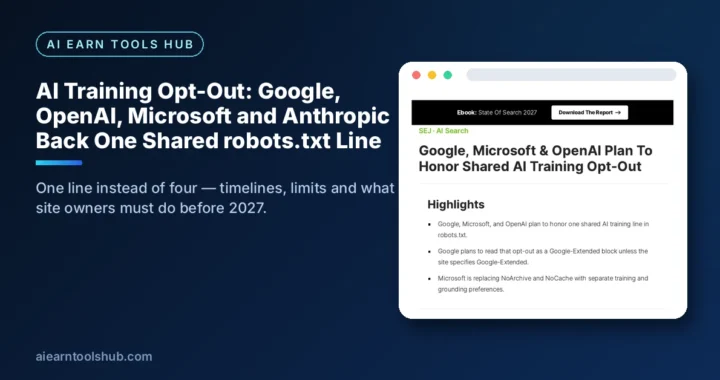

AI news November 2026 starts with a change that matters to every website owner, writer, photographer and publisher: Google, Microsoft and OpenAI will honour one shared robots.txt token to opt out of AI training. Instead of adding a different rule for every crawler, publishers can add one line to robots.txt and expect the three companies to respect it for AI training. It is the simplest opt-out story of the year, and it arrives alongside two other big developments: Apple Intelligence in China with Qwen, and fresh momentum for Gemini and OpenAI funding.
For years, opting out of AI training meant keeping track of a growing list of crawler names, each with its own documentation and quirks. Some publishers gave up, some blocked everything and lost search traffic, and some never realised their work was being used to train models at all. A single shared token changes that calculation. One line, in one familiar file, now carries the same meaning across three of the largest AI developers. That is why this story leads AI news November 2026, even though the file itself is only a few lines long.
AI News November 2026: What the Shared Opt-Out Token Means
Robots.txt is a small text file that sits at the root of a website and tells automated crawlers which parts of the site they may visit. Search engines have used it for decades. AI companies later added their own crawlers for training data, and publishers asked for a way to say no to training without saying no to search. The shared token answers that request: it is a single, agreed signal that means do not use this site’s content for AI training.
The practical effect is straightforward. A publisher adds the shared token to robots.txt, the participating companies read it, and their AI training crawlers skip the site. Search indexing is a separate question, and publishers should keep their existing search rules intact unless they also want to change search visibility. In other words, opting out of AI training no longer has to mean disappearing from search results, and opting into search no longer has to mean opting into training.
For small publishers, the benefit is time and confidence. There is no new dashboard to learn, no per-company form to submit, and no need to hire a developer to maintain a dozen different rules. For large publishers, the benefit is consistency: one policy, written once, applied across the major training crawlers. That consistency is also what makes the announcement credible, because a token only works if the companies that read it actually agree on what it means.
Who Is Backing the AI Training Opt-Out, and Why It Matters Now
Google, Microsoft and OpenAI are the three names in the headline, and that combination is what gives the token its weight. Each company operates large AI models and large crawlers, and each has faced questions from publishers about how training data is collected. By agreeing on one token, they reduce confusion and make it easier for publishers to give a clear answer, instead of navigating three different opt-out systems that may change at different times.
Publishers should still check each company’s documentation for the exact implementation, because a shared meaning does not remove every technical detail. Some sites use a content management system that manages robots.txt automatically, some use a plugin, and some edit the file by hand. In each case, the principle is the same: add the shared token, test that the file is reachable, and keep a copy of the previous version so you can roll back if something looks wrong. A mistake in robots.txt can affect search visibility, so changes should be made carefully, not rushed.
How to Add the AI Training Opt-Out to Robots.txt
First, find your robots.txt file. For most WordPress sites, it is available at your domain followed by /robots.txt. Second, add the shared AI training opt-out token as a new line, following the format published by the participating companies. Third, save the file and check that it loads in a browser. Fourth, use a robots.txt tester, if your search console or hosting tools offer one, to confirm that search crawlers can still reach the pages you want indexed. Fifth, record the date you made the change, so you can track when training crawlers should start respecting it.
It is also worth telling your team what the change does and does not do. It does not delete content that was already used for training, it does not block AI search answers that quote publicly available pages under a separate system, and it does not replace copyright law or licensing agreements. What it does is give publishers a clear, machine-readable way to say no to future AI training use by the companies that honour the token. That distinction matters, because readers and creators often overestimate what a single file can do.
For more background on how robots.txt works, see the robots.txt explainer. For more free tools and guides on this site, visit AI Earn Tools Hub.
Apple Intelligence in China With Qwen: What It Means for iPhone Users
The second major item in AI news November 2026 is Apple Intelligence in China with Qwen. Apple has long faced a different regulatory and technical landscape in China, where its usual AI partners and models cannot simply be used in the same way as in other regions. Working with Alibaba’s Qwen models gives Apple a local foundation for AI features on iPhones sold in China, while keeping the familiar Apple Intelligence experience of writing help, summarisation, image tools and smarter Siri-style assistance.
For users in China, the practical question is which features arrive first and how well they work in Chinese, because language quality matters more than a feature list. Qwen is a strong Chinese-language model family, and that strength is likely to shape the rollout, from text understanding to local app integration. For Apple, the move also shows how AI is becoming regional: the same phone may use different model partners in different markets, even when the user interface looks the same.
For developers and publishers, the lesson is similar to the robots.txt story: AI is no longer one global system with one set of rules. Different regions, different partners and different data rules all affect what an AI feature can do. If you create content for a Chinese audience, or you sell apps and services there, keep an eye on which Apple Intelligence features are available, which languages they support well, and how they handle local content and privacy requirements.
Gemini and OpenAI Funding: The Wider AI News November 2026 Picture
Beyond the opt-out token and Apple in China, AI news November 2026 also includes continued momentum for Gemini and for OpenAI funding. Gemini remains Google’s flagship AI family, appearing across Search, Workspace, Android and developer tools, and each update tends to focus on longer context, better reasoning and tighter integration with everyday apps. For users, that means AI help is less of a separate chatbot and more of a layer inside tools they already use.
OpenAI funding news matters for a different reason: building frontier models is expensive, and funding determines how fast a company can train new models, hire researchers and expand infrastructure. Continued investment in OpenAI signals that investors still expect AI to become a larger part of work, education and software, even as questions about regulation, copyright and profitability continue. For readers, the takeaway is not the funding itself, but what it enables: more capable models, more competition, and more pressure on publishers to decide how their content should be used.
Together, these stories paint a clear picture. AI companies are competing on capability, cooperating on basic publisher controls, and adapting to local rules in large markets. That combination — competition, cooperation and localisation — is likely to define AI news for the rest of 2026, not just November.
What AI News November 2026 Means for Creators and Small Publishers
If you run a blog, a portfolio, a news site or a small business website, the opt-out token gives you a decision to make, not just a file to edit. Do you want your content used for AI training, in exchange for visibility and possible traffic from AI tools, or do you want to opt out and keep your work for your own audience and licensing deals? There is no single right answer. Some creators welcome AI discovery, some sell licences and want to protect that income, and some simply want control over where their work appears.
Whatever you decide, make the decision explicit. Write it into your content policy, tell contributors and photographers what you have chosen, and review it every few months, because AI companies change their crawlers, their documentation and their partnerships. A shared token makes the technical step easier, but it does not replace the editorial decision behind it. If you use AI tools yourself, the same logic applies in reverse: check whether the tools you use respect opt-outs, and whether they train on your inputs by default.
AI News November 2026 Frequently Asked Questions
Does the shared robots.txt token block Google Search?
No, not on its own. The token is for AI training. Search indexing uses separate rules, so you should keep your search settings as they are unless you also want to change search visibility. Always test robots.txt after editing it, because a broad block can accidentally hide pages from search.
Will the opt-out remove my content from models already trained?
No. An opt-out in robots.txt is a forward-looking signal. It does not delete data already used for training, and it does not change past model versions. It is still useful, because it affects future training runs by the companies that honour it.
Is Apple Intelligence in China the same as Apple Intelligence elsewhere?
The user experience is meant to feel familiar, but the underlying models and partners differ by region. In China, Apple Intelligence works with Qwen, which reflects local language, regulatory and partnership requirements. Features and availability may therefore differ from other markets.
What should I do first after reading AI news November 2026?
Decide your AI training policy, update robots.txt if you want to opt out, check that search still works, and note the change for your team. Then keep following AI news, because shared tokens, local partnerships and funding all point to a fast-moving landscape where today’s simple rule may be updated tomorrow.
Final Takeaway: One Line, Big Signal
AI news November 2026 will be remembered for a small file with a large meaning. One shared robots.txt token, honoured by Google, Microsoft and OpenAI, gives publishers a clearer way to opt out of AI training. Apple Intelligence in China with Qwen shows how AI adapts to local markets, while Gemini and OpenAI funding show how fast the field keeps moving. For creators, the message is simple: decide what you want, write it down in a form machines can read, and keep checking that the machines are listening.
- AI Citation Generator: 7 Best Free APA & MLA Tools (2026)
- AI Quiz Generator: 7 Best Tools for Studying Smarter (2026)
- AI Homework Helper: 8 Best Tools That Explain (2026)
- AI Tattoo Generator: 6 Best Tools for Your Next Ink (2026)
- Best AI Resume Builder: 7 Top Tools Tested (2026)
- Best AI Study Tools for Students: 9 Tools Compared (2026)
- Free AI Presentation Maker: 7 Best Free Tools (2026)
- AI Story Generator Free: 8 Best Tools for 2026 (Tested)
- Free AI Resume Builder: 7 Best Tools That Work in 2026
- AI Slide Maker: 6 Best Tools for Fast Decks (2026)
- OpenAI LifeVal: AI Now Graded on Everyday Life (Nov 2026)
- ChatGPT and Codex Will Share One Usage Limit in December — Plus DeepSeek’s Super-Agent and Apple Intelligence in China
- AI Training Opt-Out: Google, OpenAI, Microsoft and Anthropic Back One Shared robots.txt Line
- AI Training Opt-Out: One robots.txt Rule Now Backed by OpenAI, Google, Microsoft and Anthropic
- Google Genie 4: AI Worlds That Talk Back (Oct 27–29, 2026)