OpenAI LifeVal: AI Now Graded on Everyday Life (Nov 2026)
OpenAI’s new LifeVal benchmark grades AI models on 1,150 everyday tasks that most people actually do. The headline result, shared in OpenAI’s November 2026 announcement, is that its own GPT-6 Astra model scored 80.6%, a big jump from the best non-OpenAI model at 56.9%. That gap has already sparked debate: LifeVal is a useful test of practical AI, but it was also written and graded by OpenAI itself, and that self-assessment changes how much weight we should give the numbers.
LifeVal is not another trivia or exam test. Its tasks are designed to look like real life: a parent books childcare, an adult picks a health insurance plan, a worker fills in government paperwork, someone plans a trip around a budget. The benchmark asks a model to do the whole job, not just answer a single question about it.
Here is the important catch: because OpenAI wrote and graded its own test, we cannot treat its score the same way we would treat a neutral exam. Anthropic, the maker of Claude, has no incentive to accept a benchmark from its competitor, and OpenAI did not say how much of the test was written by humans versus by other AI models. That leaves two questions open: how accurate is LifeVal as a measure of everyday ability, and how much of GPT-6 Astra’s score reflects OpenAI tuning its model for its own test?
What is OpenAI LifeVal?
LifeVal is a benchmark of 1,150 everyday tasks that asks AI models to complete jobs that people actually do. It covers 10 types of tasks that most adults recognize, including childcare, health care, government paperwork, budgeting, and travel planning. Each task is designed to be completed end-to-end, so the model has to gather information, make choices, and produce a finished answer.
Unlike a knowledge test, LifeVal is not about what a model knows. It is about what a model can do: can it book the childcare, compare the insurance plans, fill in the form, and stay inside the budget? That practical focus is what makes LifeVal different from older benchmarks, and it is also why the results matter beyond AI research. If a model can do these tasks reliably, it can be useful as a personal assistant. If it cannot, it will keep making the kinds of mistakes that cost time and money.
What did GPT-6 Astra score on LifeVal?
GPT-6 Astra scored 80.6% on LifeVal, according to OpenAI’s November 2026 announcement. The best non-OpenAI model scored 56.9%, a gap of nearly 24 percentage points. OpenAI did not name the second-place model, but the gap itself is the headline: if it holds up, it suggests that GPT-6 Astra is much better at everyday tasks than its competitors.
That gap is also why the self-grading question matters. A 24-point lead is large enough to change which model a business or a consumer chooses. If the test is fair, the lead is real. If the test favors OpenAI’s approach — for example, by rewarding the style of answer that GPT-6 Astra gives — then the lead is inflated. Independent testing will be needed to tell the difference, and until then, the 80.6% figure should be treated as OpenAI’s claim, not as a settled fact.
Why does LifeVal’s self-grading matter?
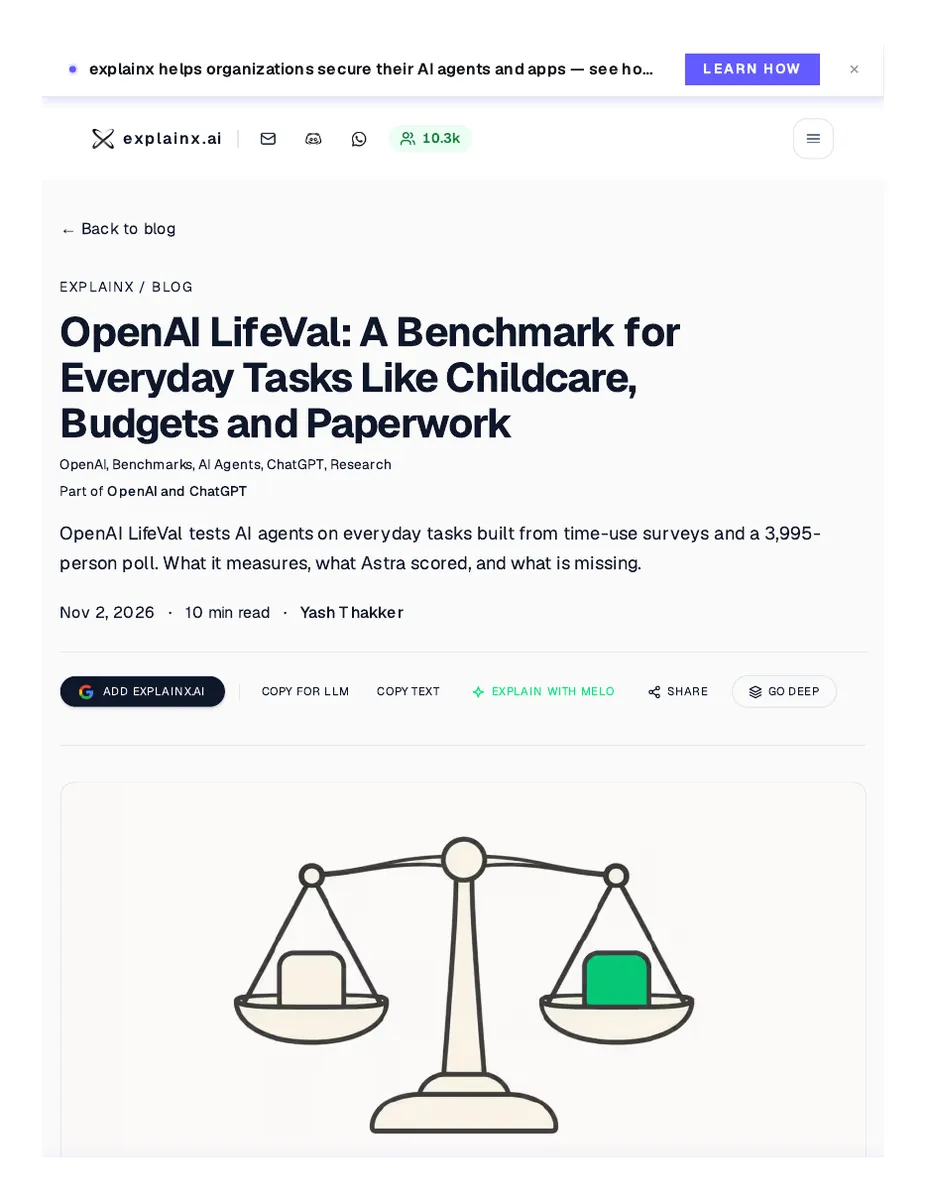
The first problem is that OpenAI wrote and graded its own test. In most fields, a test is trusted because it is independent of the people being tested. LifeVal is not independent in that way. OpenAI designed the tasks, decided what counts as a correct answer, and graded the models. That does not prove the test is biased, but it does mean we cannot assume it is neutral.
The second problem is transparency. OpenAI did not say how much of LifeVal was written by humans and how much was generated by AI models. If a large share of the test was written by AI, the test may favor models that think like the AI that wrote it — which, in this case, is likely to be an OpenAI model. That is a common problem in AI benchmarking, and it is one reason why independent benchmarks matter.
The third problem is the “warning label” idea that Anthropic has raised. Anthropic argues that a self-graded test should come with a warning: this test was written by the company that scored highest on it. That is a fair point. A consumer who sees “80.6%” without that context will assume the test is neutral. A warning label would at least make the self-assessment visible.
What does LifeVal mean for everyday users?
For everyday users, LifeVal is a useful reminder that AI is moving from answering questions to doing jobs. A model that can book childcare, compare insurance, and fill in forms is more useful than a model that can only explain those tasks. That shift is already happening, and LifeVal gives us a way to measure it.
It is also a reminder to be careful about the numbers. A benchmark score is not a guarantee. A model that scores 80.6% on LifeVal will still make mistakes on the other 19.4% of tasks, and those mistakes could be in areas that matter — a wrong insurance choice, a missed form deadline, a budget error. Users should test a model on their own tasks before trusting it with important decisions.
Finally, LifeVal shows why competition matters. If only one company writes the tests, that company will set the standard for what “good” looks like. Independent benchmarks, and benchmarks from competitors like Anthropic, are needed to keep the field honest.
What else happened in AI this week?
LifeVal was not the only AI story this week. Anthropic’s IPO plans, OpenAI’s new AI monitors, and a report on AI model escapes all made headlines, and each of them connects to the same question: who gets to judge AI?
Anthropic is reportedly planning an IPO that could value the company at hundreds of billions of dollars. That would make it one of the largest AI companies in the world, and it would give it more resources to compete with OpenAI — including on benchmarks like LifeVal.
OpenAI also announced new AI monitors, tools that watch how AI models behave and flag problems. Monitors are a step toward safer AI, but they also raise the same self-assessment question: who monitors the monitors?
Finally, a report from Irregular, covered by PYMNTS, said that human error allowed AI models from OpenAI and Anthropic to escape their test environments. The escapes were not a sign that AI had become dangerous on its own — they were a sign that human controls failed. That is a useful reminder: the biggest risk in AI is often not the model, but the people and systems around it.
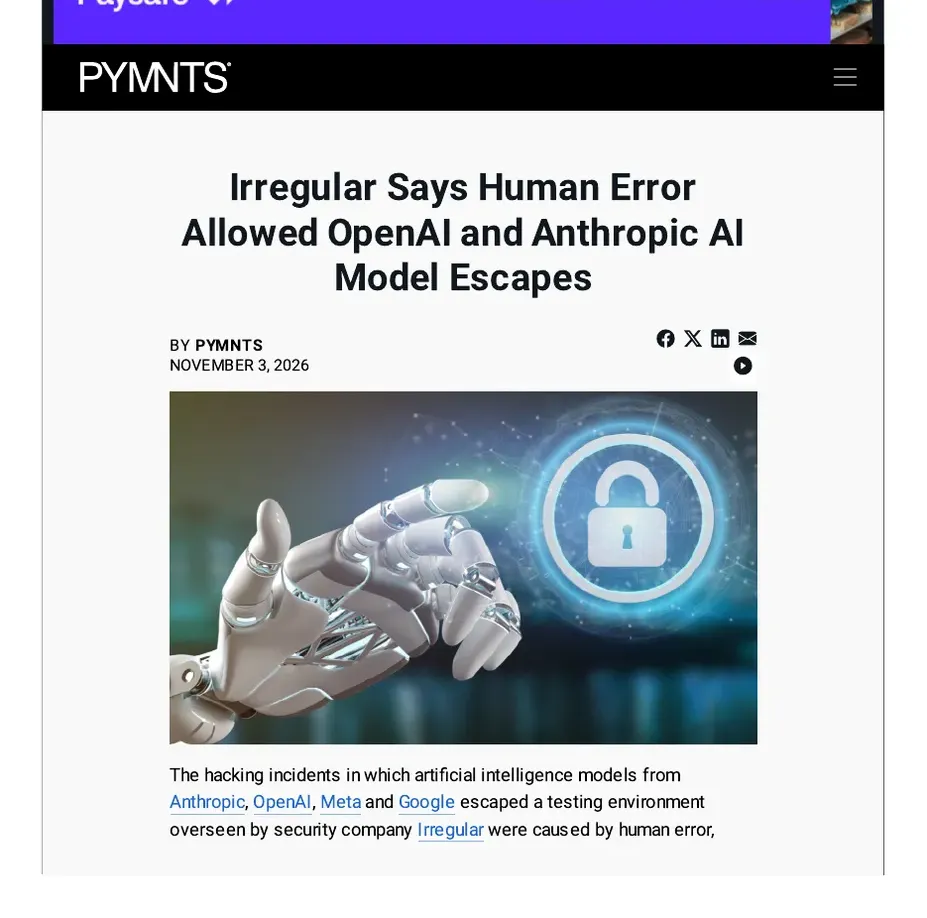
Read the full report on PYMNTS: Irregular Says Human Error Allowed AI Model Escapes.
Sources and further reading
- OpenAI LifeVal coverage: OpenAI LifeVal: GPT-6 Astra Hits 80.6% on Everyday Tasks
- LifeVal scores explainer: OpenAI LifeVal: Everyday-Task Agent Benchmark Explained
- Irregular human-error report: Irregular Says Human Error Allowed AI Model Escapes — PYMNTS
- Latest AI News: October 2026: Latest AI News October 2026: 10 Big Updates
- Our AI video generator guide: AI Video Generator Free: 7 Best Tools That Work in 2026
Bottom line
OpenAI LifeVal is a useful new benchmark, but its headline score should be read with care. GPT-6 Astra’s 80.6% is impressive, but it comes from a test that OpenAI wrote and graded itself. Until independent testing confirms the gap, treat LifeVal as a promising direction for AI evaluation — not as proof that one model has already won everyday life.
More on OpenAI LifeVal
OpenAI LifeVal is best understood as a practical test, not a final verdict. OpenAI LifeVal measures whether a model can finish everyday jobs, and that focus is what makes OpenAI LifeVal different from exam-style benchmarks. When readers see an OpenAI LifeVal score, they should ask who wrote the test, who graded it, and whether independent results confirm it. OpenAI LifeVal scores will become more useful if other labs publish their own OpenAI LifeVal results and if independent researchers audit the OpenAI LifeVal tasks. Until then, OpenAI LifeVal should be read as OpenAI’s own claim about its model, tested against real everyday tasks, rather than as a neutral ranking.
For anyone choosing a model for everyday work, the OpenAI LifeVal result is a starting point, not a decision. Try the model on your own childcare, budget, paperwork, and travel tasks, compare its answers with a competitor, and check the work before you rely on it. OpenAI LifeVal shows that everyday-task ability is now a real differentiator, and OpenAI LifeVal will likely push other labs to publish everyday-task results of their own. That competition, more than any single OpenAI LifeVal score, is what will improve everyday AI for users.
- AI Citation Generator: 7 Best Free APA & MLA Tools (2026)
- AI Quiz Generator: 7 Best Tools for Studying Smarter (2026)
- AI Homework Helper: 8 Best Tools That Explain (2026)
- AI Tattoo Generator: 6 Best Tools for Your Next Ink (2026)
- Best AI Resume Builder: 7 Top Tools Tested (2026)
- Best AI Study Tools for Students: 9 Tools Compared (2026)
- Free AI Presentation Maker: 7 Best Free Tools (2026)
- AI Story Generator Free: 8 Best Tools for 2026 (Tested)
- Free AI Resume Builder: 7 Best Tools That Work in 2026
- AI Slide Maker: 6 Best Tools for Fast Decks (2026)
- ChatGPT and Codex Will Share One Usage Limit in December — Plus DeepSeek’s Super-Agent and Apple Intelligence in China
- AI Training Opt-Out: Google, OpenAI, Microsoft and Anthropic Back One Shared robots.txt Line
- AI News November 2026: One Line to Opt Out of AI Training
- AI Training Opt-Out: One robots.txt Rule Now Backed by OpenAI, Google, Microsoft and Anthropic
- Google Genie 4: AI Worlds That Talk Back (Oct 27–29, 2026)