
Tip Calculator Guide: How to Calculate a Tip and Split Bills (2026)
Last checked: November 2026
A tip is calculated on the bill before tax: multiply the pre-tax bill by your tip percentage, add any tax, and divide the total by the number of people splitting it. For a $100 bill at 20%, that is a $20 tip. Below, this tip calculator guide covers the exact formula, US tipping norms, the pre-tax versus post-tax question, and how to split fairly.
Key takeaways
- The formula: Tip = pre-tax bill × tip percentage. Total = bill + tax + tip. Per person = total ÷ number of people. A tip calculator applies this formula instantly.
- The US norm: 15–20% of the pre-tax bill at sit-down restaurants, 10% at buffets, 10–15% for delivery, and $1–2 per drink at the bar (Emily Post Institute).
- Pre-tax is the standard: tip on the food and drinks, not on the tax. Tipping on the post-tax total is common with card-machine prompts, but it is not required.
- Fair splits: split evenly only when everyone ordered about the same. For uneven orders, split each person’s items, tax, and tip separately.
- Check large-party bills: many restaurants add an automatic gratuity for large parties, so check before tipping twice.
Table of Contents
- How Do You Calculate a Tip?
- How Much Should You Tip in the US?
- Should You Tip on the Pre-Tax or Post-Tax Total?
- How Do You Split a Bill Fairly?
- What About Large Parties and Automatic Gratuity?
- How Can a Free Tip Calculator Help?
- Frequently Asked Questions
How Do You Calculate a Tip?
The formula has three steps, and it works for any bill:
- Tip = bill × tip percentage. Use the pre-tax bill — the food and drinks subtotal, before sales tax is added.
- Total = bill + tax + tip. Add the tax and the tip to the original bill.
- Per person = total ÷ number of people. Divide only when the bill is being split.
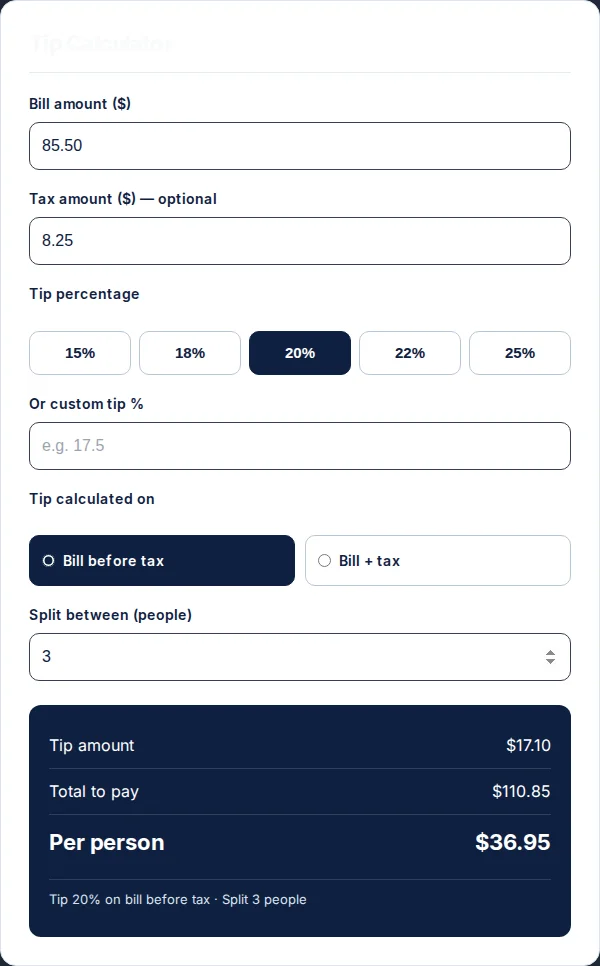
Here is a worked example, calculated with our own free tip calculator: a bill of $85.50 with $8.25 tax, a 20% tip on the pre-tax bill, split between 3 people. The tip is $85.50 × 20% = $17.10. The total is $85.50 + $8.25 + $17.10 = $110.85. Each person pays $110.85 ÷ 3 = $36.95.
A fast mental shortcut for 20%: move the decimal point one place to the left to get 10%, then double it. On an $85.50 bill, 10% is $8.55, so 20% is $17.10 — the same answer as a tip calculator gives, no phone needed.
How Much Should You Tip in the US?
Tipping norms vary by service, and the figures below come from the Emily Post Institute, the United States’ long-standing etiquette authority. They are norms, not laws — generous service can always earn more, and genuinely poor service is the one case where tipping less is understood.
| Service | Standard tip (US) |
|---|---|
| Sit-down restaurant (wait service) | 15–20% of the pre-tax bill |
| Buffet | 10% of the pre-tax bill |
| Food delivery | 10–15% of the pre-tax bill ($2–$5 for pizza delivery) |
| Bartender | $1–2 per drink, or 15–20% of the tab |
| Taxi driver | 15–20% of the fare |
| Takeout (pickup) | No obligation; 10% for extra service or a large, complicated order |
| Host or maître d’ | No obligation; $10–$20 for going above and beyond on a busy night |
Two things are worth noticing. First, the restaurant range is 15–20%, not a single number: 15% covers acceptable service, 20% is now the standard for good service. Second, takeout tipping is genuinely optional — unlike sit-down service, nobody is serving you at a table, so a zero tip on a simple pickup is not a breach of etiquette.
Should You Tip on the Pre-Tax or Post-Tax Total?
Tip on the pre-tax total. The Emily Post Institute’s guidance is explicit: at a sit-down restaurant or buffet, the percentage applies to the pre-tax bill, because tax is a government charge, not part of the service you received.
In practice, many card machines and delivery apps calculate their suggested tips on the post-tax total, which is why the question comes up at all. Tipping on the post-tax total is common and accepted — but it is a choice, not an obligation, and on a large bill the difference is real. On a $100 dinner with 8% sales tax, a 20% tip on the pre-tax subtotal is $20.00, while 20% on the post-tax total of $108 is $21.60.
The simplest rule: look for the subtotal line on your receipt, not the grand total, and calculate from there. If you are using a tip calculator, enter the bill and the tax separately and choose the “before tax” option — that is exactly how the percentages above are meant to be applied.
How Do You Split a Bill Fairly?
An even split is fair only when everyone ordered roughly the same amount. The moment one person had a salad and another had steak and cocktails, an even split quietly overcharges the light eater — and that is where most bill-splitting arguments start.
The even split (equal orders). Add tax and tip to the bill, then divide by the number of people. Using the example above: $110.85 ÷ 3 = $36.95 each. Done.
The itemized split (uneven orders). Split each person’s share of items, tax, and tip separately:
- Person A ordered $35.50 of food; Person B ordered $50.00. Subtotal: $85.50.
- Tax of $8.25 splits in proportion to what each ordered: about $3.42 for A and $4.83 for B (rounded so the tax adds up exactly).
- A 20% pre-tax tip splits the same way: $7.10 for A and $10.00 for B.
- Person A pays $35.50 + $3.42 + $7.10 = $46.02. Person B pays $50.00 + $4.83 + $10.00 = $64.83. Together: $110.85 — the same total, divided fairly.
Two etiquette points make any split smoother. First, agree on the method before ordering, not after the bill arrives — “shall we split evenly or go item by item?” takes five seconds and prevents the awkward silence. Second, if one person is being treated — a birthday dinner, for example — the group covers that person’s share between them; the guest of honour is not expected to split their own celebration. For uneven orders, running each share through a tip calculator keeps the math honest.
What About Large Parties and Automatic Gratuity?
Many restaurants add an automatic gratuity to the bill for large parties — often 18–20% — because serving a big table is more work and the tip is less certain. This is not a scam; it is a published house policy, usually printed on the menu or the receipt.
The practical point is simple: read the bill before you tip. If an automatic gratuity is already included, you have already tipped, and adding another 20% on top means tipping twice. You can still add a little extra for exceptional service, but the base tip is done. If no gratuity is listed, tip normally — 15–20% of the pre-tax total, as usual. A tip calculator can still split the remaining balance fairly even when gratuity is included.
How Can a Free Tip Calculator Help?
Mental math is fine for a round $100 bill, but real bills are $85.50 with $8.25 tax split three ways unevenly — and that is where mistakes happen. A free tip calculator does the three-step formula instantly: enter the bill, add the tax if you have it, pick a percentage or type a custom one, choose whether the tip is calculated before or after tax, and set how many people are splitting. It shows the tip amount, the total, and each person’s share as you type — no sign-up, no app, and nothing to install.
If you want to skip the arithmetic entirely, use our free tip calculator — it handles the cases this guide covers — pre-tax and post-tax tipping, custom percentages, and even or uneven splits — so you can check the math at the table in seconds. You can also browse all of our free tools.
Frequently Asked Questions
How do you calculate a 20% tip quickly?
Move the decimal point one place to the left to get 10% of the bill, then double it. On a $64 bill, 10% is $6.40, so 20% is $12.80. For 15%, take 10% and add half of it again: $6.40 + $3.20 = $9.60. Or check it on a tip calculator in seconds.
Do you tip on tax?
No — the standard is to tip on the pre-tax subtotal. Many card machines suggest tips calculated on the post-tax total, which is common and accepted, but tipping on the pre-tax amount is the etiquette norm and always a safe choice. A tip calculator with a before-tax option applies the norm automatically.
How do you split a bill when everyone ordered different things?
Split item by item: each person pays for their own items, plus their proportional share of the tax and the tip. On an $85.50 bill with $8.25 tax and a 20% pre-tax tip, a person who ordered $35.50 pays $46.02 while a person who ordered $50.00 pays $64.83. An even split is only fair when everyone ordered about the same.
What if the service was bad?
Tip less, but do not use a zero tip as your only feedback for an ordinary disappointment — 15% covers acceptable service, and below that signals a real problem. For a serious issue (a wrong order never fixed, rudeness), speak to the manager instead: it fixes the problem, while stiffing the server only creates a second one.
Do you have to tip on takeout or delivery?
Takeout pickup carries no tipping obligation, though 10% is a kind gesture for extra service or a large, complicated order. Delivery is different: 10–15% of the pre-tax bill is the norm, or $2–$5 for pizza delivery, because the driver is bringing the food to you.
Final Takeaway
Calculating a tip is three steps — percentage on the pre-tax bill, add tax, divide by people — and splitting fairly is one decision: even split for equal orders, itemized split for uneven ones. Get those two things right and the awkward end-of-dinner math disappears. For the next bill, run the numbers through the free tip calculator above and check them against the norms in this guide.
Last checked: November 2026
- AI Citation Generator: 7 Best Free APA & MLA Tools (2026)
- AI Quiz Generator: 7 Best Tools for Studying Smarter (2026)
- AI Homework Helper: 8 Best Tools That Explain (2026)
- AI Tattoo Generator: 6 Best Tools for Your Next Ink (2026)
- Best AI Resume Builder: 7 Top Tools Tested (2026)
- Best AI Study Tools for Students: 9 Tools Compared (2026)
- Free AI Presentation Maker: 7 Best Free Tools (2026)
- AI Story Generator Free: 8 Best Tools for 2026 (Tested)
- Free AI Resume Builder: 7 Best Tools That Work in 2026
- AI Slide Maker: 6 Best Tools for Fast Decks (2026)
- AI Prompt Generator: 7 Best Free Tools That Work (2026)
- How to Remove Background from Video: 7 Best Free AI Tools (2026)
- HEIC to JPG Converter: 7 Best Free Tools That Work (2026)
- AI Lyrics Generator: 7 Best Free Tools for Song Lyrics Only (2026)
- AI Video Generator Free: 7 Best Tools That Actually Work in 2026