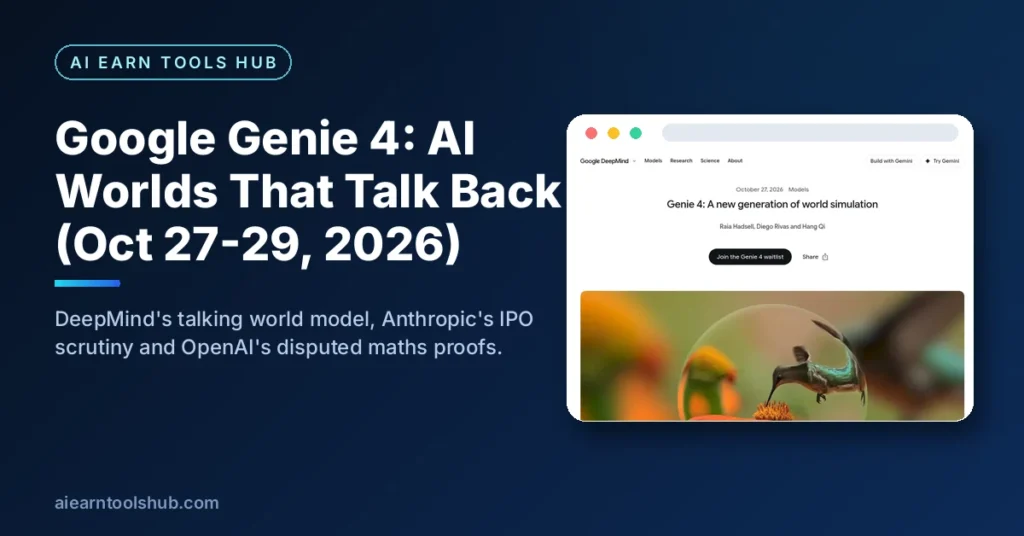
Google Genie 4: AI Worlds That Talk Back (Oct 27–29, 2026)
Google Genie 4 is Google DeepMind’s new world model, announced on October 27, 2026, that generates interactive, photorealistic worlds in real time — and for the first time, generates their sound at the same time. Music, ambient noise and spoken dialogue now come out of the same model that draws the scene, so characters in a Google Genie 4 world can actually talk back while you steer the world with plain-language prompts. It is still a research preview for trusted testers, not a public product, but it is the week’s clearest sign of where interactive AI is heading: from watching generated video to walking around inside a generated world.
Key takeaways
- Lead story: Google Genie 4, announced October 27, adds native audio and live prompt steering to real-time world simulation; scenes hold together for about two minutes, double Genie 3’s limit.
- Money story: Anthropic’s IPO filing shows $16.3 billion of first-half 2026 revenue — and an $80.7 billion net loss driven mostly by a non-cash accounting charge — while a US senator questions its pre-IPO risk disclosures.
- Science story: OpenAI says its models disproved a famous 1999 computer-science conjecture and settled two maths problems, with proofs checked by machine — but independent experts have only just begun reviewing the claims.
- What is NOT settled: none of OpenAI’s three proofs has been peer-reviewed yet, and Genie 4 is not publicly available — both stories need the follow-up, not just the announcement.
Table of Contents
- Google Genie 4: what it actually does
- Why does native audio matter in a world model?
- Who can try Google Genie 4 today?
- Anthropic’s IPO filing: $16.3B revenue, $80.7B loss, and new scrutiny
- OpenAI’s three proofs: breakthrough claim, review pending
- Also in brief: AI spending surges in Big Tech earnings
- What to watch next
- FAQs
- Bottom line
What is Google Genie 4, and what does it actually do?
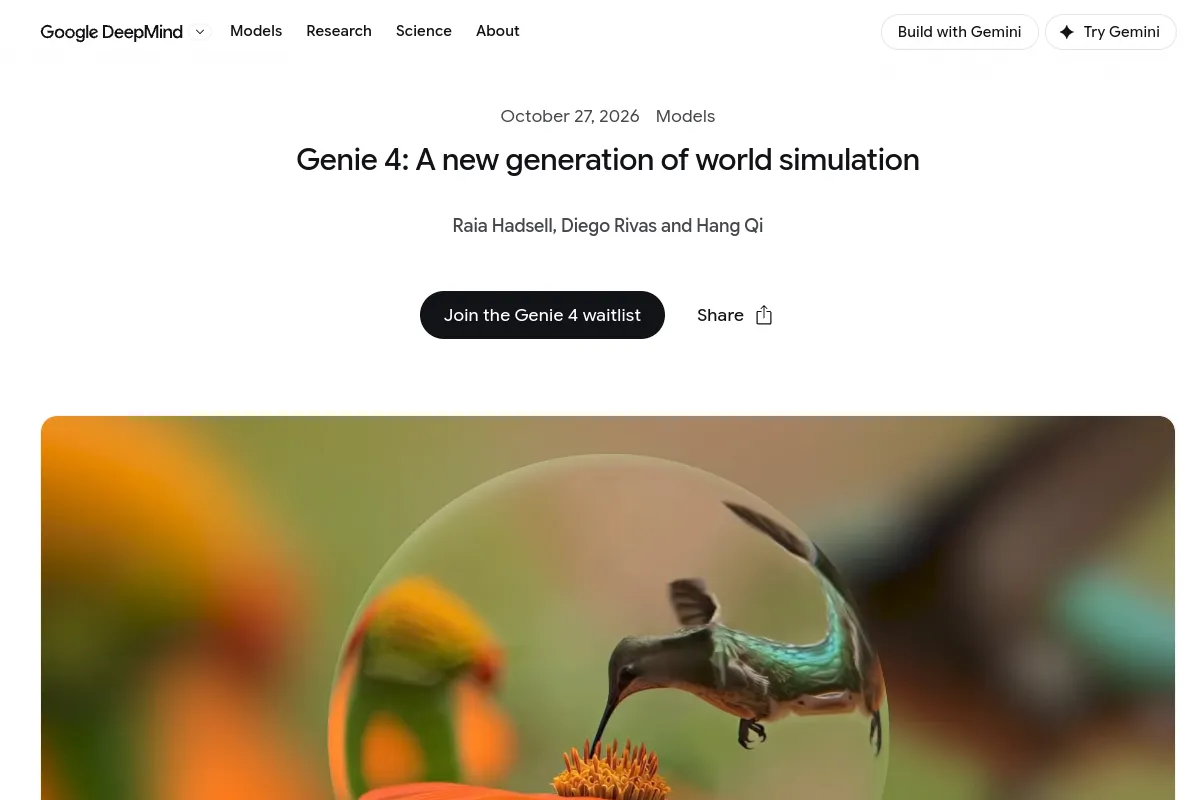
Google Genie 4 is a world model from Google DeepMind that builds an explorable virtual world frame by frame in real time, from a text prompt or an image, instead of playing back a pre-rendered video. Type a sentence, get a place you can move through with keyboard controls; type another sentence mid-simulation and the weather changes, a person appears, or the camera moves — while the scene keeps running. That is the difference between a video generator and a world model: a video generator shows you a clip, while Google Genie 4 simulates a place that responds when you act. DeepMind says Genie 4 improves photorealism and physics — how things collide, move and behave — and that its biggest leap is people, who now move naturally and can be steered in real time.
Why does native audio matter in a Google Genie 4 world?
Native audio matters because Google Genie 4 is DeepMind’s first real-time world model that generates sound inside the same model that generates the picture, not as an afterthought pasted on afterwards. Wind, footsteps, music and dialogue are produced together with the visuals, so a sound is tied to the event that caused it — a door slams when it closes, a character answers when spoken to. Interactive dialogue is the headline change: characters converse and react to your inputs or to events in the world, in real time. That turns a simulation from something you watch into something you can talk to, which is why game designers, robotics trainers and interactive-story creators are paying attention even though the model is still in preview.
Who can try Google Genie 4 today?
Almost nobody can try Google Genie 4 today — and that limit is part of the story. DeepMind says Genie 4 has started rolling out as a research preview for trusted testers, with Google AI Ultra subscribers in Project Genie and early-access partners of the Gemini API and Google AI Studio next, and a waitlist open for everyone else. There is no public release date and no consumer price yet. Two limits are also stated openly by DeepMind and its early coverage: scenes stay coherent for about two minutes, double the one-minute limit of Genie 3, and visual details and object permanence can still drift over longer runs or after many complex prompt edits. In other words, Google Genie 4 is a genuine step forward in world simulation, but it is a preview with stated limits, not a finished product you can open today.
What does Anthropic’s IPO filing actually show?
Anthropic’s IPO filing shows a company growing at extraordinary speed while carrying extraordinary costs. The Claude maker filed a Form S-1 with the US Securities and Exchange Commission on October 26, 2026, applying to list Class A shares on the Nasdaq Global Select Market under the ticker “ANT” — with the share count and price range still blank, so no valuation is set yet. Revenue was $16.286 billion for the six months ended June 30, 2026, against $1.163 billion a year earlier, and the operating loss for that half was $693 million. The eye-catching $80.7 billion net loss is mostly not cash spent running the business: $72.4 billion of it is a non-cash change in the fair value of convertible notes, derivative liabilities and SAFEs, driven by the rise in Anthropic’s own valuation. Governance is unusual for a public company: a Long-Term Benefit Trust elects a majority of the board, and a single Class F share held by the founders’ LLC carries about 50.1% of voting power. Scrutiny followed fast — on October 28, US Senator Elizabeth Warren wrote to CEO Dario Amodei raising concerns about the filing’s pre-IPO risk disclosures, a reminder that an S-1 is the start of public examination, not the end of it.
Did OpenAI’s models really disprove a famous maths conjecture?
OpenAI says yes — but the honest answer is that nobody in dependent has finished checking yet. On October 26, 2026, OpenAI announced three AI-produced results: a refutation of the Exponential Time Hypothesis (ETH), a 1999 conjecture about how hard Boolean satisfiability problems are to solve; a proof of the local smoothing conjecture in every dimension, which also settles the Kakeya and Stein restriction conjectures; and existence proofs for quantum field theories in four dimensions, including quantum chromodynamics and pure Yang-Mills theory, part of a Clay Millennium Prize problem. The ETH disproof was produced by an internal model on October 16 and formalised in the Lean proof assistant on October 17, and OpenAI published the write-ups and Lean proofs in its public math repository. That machine-checking matters: Lean verifies that each logical step follows, even though it cannot judge whether the result is interpreted correctly or what it means in practice. Independent review is now led by Russell Impagliazzo and Ramamohan Paturi of UC San Diego — two of the researchers who originally proposed ETH — with Ryan Williams of MIT, and they have stressed their involvement is not certification of the claim. Until that review reports, the right description is “OpenAI claims a disproof, machine-checked in Lean, awaiting independent verification” — not a settled breakthrough.
Also in brief: AI spending surges in Big Tech earnings
Alphabet and Microsoft’s earnings reported on October 28–29 told the same infrastructure story from the spending side: surging AI demand alongside sharply rising capital spending on data centres and chips. Alphabet shares slipped on the heavy spending even as AI demand grew, a pattern now familiar across the sector — investors reward AI growth but flinch at the bill for building it. For readers of our earlier news roundup at Latest AI News: 10 Big Updates (Oct 21–25, 2026), this is the same investment supercycle continuing, not a new turn: the companies building models like Google Genie 4 are also the ones spending tens of billions to run them. Our free tools library covers the free side of that same AI wave, including the video generators in today’s companion article.
What should you watch next on Google Genie 4 and the other stories?
Three follow-ups matter more than this week’s headlines. First, who actually gets Google Genie 4 access, and what do trusted testers report about drift and audio quality once the novelty wears off — that will decide whether world models are a creator tool or still a lab demo.
Second, Anthropic’s IPO pricing: when the share count and price range are filled in, the market will put its first real number on the $16.3 billion revenue story. Third, the independent review of OpenAI’s proofs: a Lean-checked disproof of ETH would reshape complexity theory if it holds, and would be a major embarrassment if a flaw is found — either way, the reviewers’ verdict is the real news, and it will take months. Watch those three, and ignore the hype cycle in between.
FAQs
What is Google Genie 4 in simple terms?
Google Genie 4 is an AI that creates a virtual world you can walk around in and talk to, generated live from a text or image prompt. Unlike a video clip, the world responds when you move or type a new instruction, and its sounds are generated together with its pictures.
Can I use Google Genie 4 for free today?
No. Google Genie 4 is in research preview for trusted testers, with Google AI Ultra subscribers and selected developers next. A waitlist is open through Project Genie, but there is no public free access or release date yet.
What is the Exponential Time Hypothesis that OpenAI says it disproved?
The Exponential Time Hypothesis, proposed in 1999, says that 3-SAT — deciding whether a set of small logic rules can all be true at once — needs exponential time in the worst case. Hundreds of papers used it as an assumption for hardness results; OpenAI claims a subexponential counting algorithm refutes it, but independent review is still pending.
Is Anthropic’s $80.7 billion loss a sign the company is failing?
Not on its own. Most of the $80.7 billion is a non-cash accounting revaluation, not money spent, and the operating loss was $693 million on $16.3 billion of half-year revenue. The real questions for investors are cash, compute commitments and whether revenue growth continues — all of which the IPO process will test.
Where can I read the original announcements?
Google DeepMind’s Genie 4 announcement is on the DeepMind blog, Anthropic’s S-1 is filed with the SEC, and OpenAI’s proofs are in its public math repository on GitHub. This article links the DeepMind announcement and reputable summaries of the other two filings below.
Bottom line
The week of October 27–29, 2026 belonged to Google Genie 4: a world model that talks back is a real step, even in preview, because it moves AI from generating clips to simulating places. Anthropic’s IPO filing and OpenAI’s disputed proofs are the necessary counterweights — spectacular numbers and spectacular claims, both still awaiting the verification that turns an announcement into a fact. That is the story to carry into next week.
Last checked: October 2026. Sources: Google DeepMind blog (Genie 4, October 27, 2026); SEC Form S-1 summaries (Anthropic, filed October 26, 2026); OpenAI proof announcements and independent-review coverage (October 26–28, 2026). Claims described as claims until independent review reports.
- AI Citation Generator: 7 Best Free APA & MLA Tools (2026)
- AI Quiz Generator: 7 Best Tools for Studying Smarter (2026)
- AI Homework Helper: 8 Best Tools That Explain (2026)
- AI Tattoo Generator: 6 Best Tools for Your Next Ink (2026)
- Best AI Resume Builder: 7 Top Tools Tested (2026)
- Best AI Study Tools for Students: 9 Tools Compared (2026)
- Free AI Presentation Maker: 7 Best Free Tools (2026)
- AI Story Generator Free: 8 Best Tools for 2026 (Tested)
- Free AI Resume Builder: 7 Best Tools That Work in 2026
- AI Slide Maker: 6 Best Tools for Fast Decks (2026)
- OpenAI LifeVal: AI Now Graded on Everyday Life (Nov 2026)
- ChatGPT and Codex Will Share One Usage Limit in December — Plus DeepSeek’s Super-Agent and Apple Intelligence in China
- AI Training Opt-Out: Google, OpenAI, Microsoft and Anthropic Back One Shared robots.txt Line
- AI News November 2026: One Line to Opt Out of AI Training
- AI Training Opt-Out: One robots.txt Rule Now Backed by OpenAI, Google, Microsoft and Anthropic

[…] Google Genie 4: real-time world model with native audio and spatial dialogue (October 27) […]