AI Social Media Captions: Best Free Tools in 2026
Last checked: October 2026
Are you struggling to write AI social media captions that actually get results? You are not alone. In 2026, creating consistent, high-quality captions for Instagram, LinkedIn, and TikTok is one of the biggest challenges for creators and businesses alike. The good news is that free AI tools now make this task fast, easy, and professional.
Furthermore, these tools require no writing experience. They generate engaging AI social media captions in seconds. In this guide, therefore, we cover the top free AI caption tools of 2026. We also explain how to use them step by step for the best results.
Why Do AI Social Media Captions Matter in 2026?

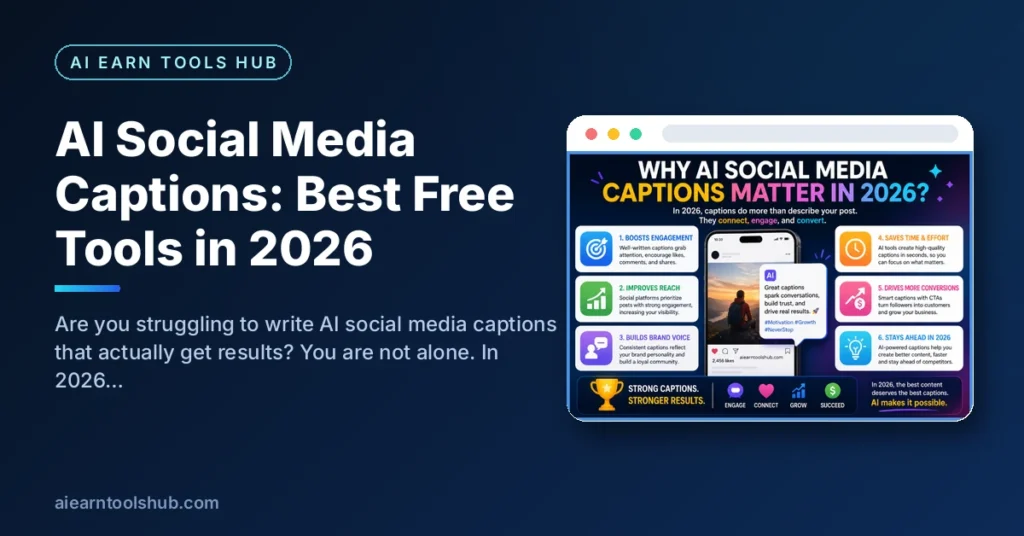
AI social media captions matter in 2026 because they turn ordinary posts into engagement drivers while saving creators hours of writing every week.
First of all, captions do far more than describe a photo. They communicate your brand voice and drive engagement. They encourage followers to take action. Moreover, platforms like Instagram and LinkedIn reward posts with strong captions. As a result, a well-written caption can significantly increase your reach.
However, writing 20 to 30 captions every week is exhausting. This is where AI social media captions save the day. They help you produce professional content quickly. Additionally, they match the tone and style of each platform. Therefore, your posts always look and sound consistent.
In short, free AI caption tools give every creator a real advantage. They save time, reduce creative burnout, and improve content quality — all without spending money.
Top Free Tools for AI Social Media Captions in 2026

The best free tools for AI social media captions in 2026 are ChatGPT, Canva AI, Copy.ai, QuillBot, and SocialBee AI. Each one generates platform-ready captions in seconds, and every tool on this list offers a free plan.
Below are the best free tools for generating AI social media captions in 2026. Each one delivers professional results without any payment or technical experience required.
1. ChatGPT — Best for Captions on Any Platform
To begin with, ChatGPT is the most flexible free tool for AI social media captions. It works for every platform — Instagram, LinkedIn, TikTok, Facebook, and X. You simply describe your post. Then you tell it the tone you want. ChatGPT instantly generates multiple caption options. Moreover, it includes hashtag suggestions on request. Therefore, it covers everything you need in one place.
- Price: Free plan available; Plus at $20/month
- Platforms: All major social media platforms
- Best for: Creators who post across multiple platforms daily
2. Canva AI — Best for Design and Captions Together
Next, Canva AI combines graphic design with AI social media captions in one tool. Its Magic Write feature generates captions directly inside your design. Consequently, your visuals and text always match in tone and style. Furthermore, Canva offers thousands of free social media templates. As a result, you can design a post and write its caption without switching apps.
- Price: Free plan available; Pro at $12.99/month
- Platforms: Instagram, Facebook, LinkedIn, Pinterest, X
- Best for: Small businesses and content creators who design their own posts
3. Copy.ai — Best for Captions That Drive Action
Another excellent option is Copy.ai. It specializes in short-form marketing copy. It offers platform-specific templates for Instagram, Facebook, LinkedIn, and TikTok. Moreover, its free plan includes over 90 content templates. In particular, Copy.ai excels at writing captions with a clear call-to-action. Therefore, it works best for businesses that want captions to drive clicks and conversions.
- Price: Free plan available; Pro at $36/month
- Platforms: Instagram, Facebook, LinkedIn, TikTok
- Best for: Marketers and businesses focused on engagement and conversions
4. QuillBot Caption Generator — Best Free Auto Caption Tool
QuillBot is best known as a paraphrasing tool. However, it also offers a powerful free auto caption generator. You describe your content and add your target keywords. QuillBot then creates tailored AI social media captions instantly. Additionally, you can adjust caption length and style. Consequently, it works well for creators who need quick, keyword-optimized results.
- Price: Free plan available; Premium at $4.17/month
- No signup required: Start generating captions immediately
- Best for: Bloggers and social media managers who need fast results
5. SocialBee AI — Best for Scheduling and Caption Creation
Finally, SocialBee AI offers one of the most complete free tools for AI social media captions in 2026. It generates platform-specific captions for each network separately. Therefore, your Instagram caption differs from your LinkedIn post, as it should. Furthermore, SocialBee connects caption creation with scheduling. As a result, you can plan and publish an entire week of content in one session.
- Price: 14-day free trial; paid plans from $29/month
- Platforms: Instagram, Facebook, LinkedIn, TikTok, Pinterest, X
- Best for: Social media managers handling multiple accounts
How Do You Create AI Social Media Captions? (Step by Step)
You can create AI social media captions in five simple steps: pick a tool, describe your post, choose a tone, generate several options, and polish the winner before publishing. Follow these simple steps to get great results every time:
- First, choose a tool that suits your main platform and goals.
- Then, describe your post clearly — what it shows and what message you want to share.
- Next, select your tone — professional, friendly, or persuasive.
- After that, generate multiple options and pick the best one.
- Finally, add hashtags, make small edits, and publish your post.
What Caption Formulas Work Best for AI Social Media Captions on Each Platform?
The best caption formula depends on the platform. Instagram rewards story-style captions with hashtags, TikTok favors short hooks, LinkedIn values professional insights, and X demands punchy one-liners. These ready-to-use AI social media caption formulas give you a proven starting template for each network — just fill in the brackets and ask your AI tool to expand them.
Instagram: Hook + Story + Call-to-Action
Instagram gives you generous space, so use a three-part structure. Start with an attention-grabbing first line, add two or three sentences telling the story behind the photo, and finish with a question or call-to-action plus three to five relevant hashtags.
Template: “[Surprising statement or question] [What happened, in 2-3 sentences] [Question for your followers?] #[niche] #[niche] #[brand]”
Example prompt for your AI tool: “Write an Instagram caption about my new home office setup. Start with a hook, tell a short story, end with a question, and add 4 hashtags.”
TikTok: Hook + Context + Hashtags
On TikTok, the video does the heavy lifting, so keep the caption short. Lead with a bold hook in the first words, add one line of context, and finish with two to four niche hashtags that help the algorithm categorize your video.
Template: “[Bold claim or curiosity gap] [One line of context] #[niche] #[trend]”
Example prompt: “Write a short TikTok caption for a 30-second productivity tip video. Make the first five words impossible to ignore.”
LinkedIn: Insight + Lesson + Question
LinkedIn rewards professional value. Open with a concrete insight or result, share the lesson you learned, and close with a question that invites comments. Keep hashtags minimal — one or two industry tags are enough.
Template: “[Result or insight] [What I learned] [What has worked for you?]”
Example prompt: “Write a LinkedIn post about doubling my newsletter subscribers. Share one lesson, keep it professional, and end with a discussion question.”
X: Punchy Line + Link or Call-to-Action
X is built for brevity. Say one thing well in a sentence or two, then add your link or call-to-action. Hashtags are optional here — one or two at most, since too many hurt readability.
Template: “[One punchy line] [Link or CTA]”
Example prompt: “Write a punchy X post announcing my free caption guide. Keep it under 30 words and end with a call-to-action.”
What Should You Know About AI Social Media Caption Length?
Caption length should match the platform. Longer, storytelling-style AI social media captions work well on Instagram and LinkedIn, while TikTok and X perform best with short, punchy text. As a rule, put the most important words first, because most platforms hide the rest of the caption behind a “more” link.
Caption Length by Platform
Instagram allows long captions, so you can tell a full story — but the first line still decides whether anyone taps “more.” TikTok captions sit beside the video, so a single sharp hook usually beats a paragraph. LinkedIn readers expect professional substance, so a few concise paragraphs outperform both one-liners and essays. X is short by design, so every word must earn its place.
The easiest way to control length is to tell your AI tool exactly what you want. Prompts like “write it in under 30 words” or “expand this into a longer Instagram caption” give you consistent results across platforms. If you want a deeper productivity setup for this workflow, see our guide to AI tools for productivity.
What Are the Most Common AI Caption Mistakes to Avoid?
The most common AI caption mistakes are publishing the raw output without editing, using the same caption on every platform, stuffing too many hashtags, and skipping the call-to-action. Avoid these six mistakes and your AI social media captions will perform far better:
- Publishing the raw AI output. AI gives you a strong draft, not a finished post. Always add your brand voice and one specific detail about your post before publishing.
- Using one caption everywhere. A LinkedIn audience and a TikTok audience expect different tones. Generate a separate version for each platform instead of cross-posting the same text.
- Hashtag stuffing. Three to five relevant hashtags beat thirty generic ones. Too many tags make captions look spammy and dilute your reach.
- Skipping the call-to-action. Every caption should tell the reader what to do next — comment, share, save, or click the link. Without a CTA, engagement drops.
- Burying the hook. Most platforms cut captions off after the first line or two. If the opening is boring, nobody taps “more.”
- Sounding robotic or overpromising. Keep the tone human and check any facts, prices, or feature claims in the AI output before you post. Your credibility is on the line, not the tool’s.
Are Free AI Caption Tools Good Enough for Professionals?

Yes, absolutely. In 2026, free tools for AI social media captions produce genuinely professional results. Tools like ChatGPT, Canva AI, and Copy.ai consistently generate polished captions. They rival content written by professional copywriters. Moreover, they do it in a fraction of the time.
However, always personalize the output slightly before publishing. Add your brand voice. Include a specific detail about your post. This small step makes your captions feel authentic and unique. As a result, your audience will connect with your content more deeply.
Frequently Asked Questions About AI Social Media Captions
Here are answers to the most common questions readers ask about AI social media captions.
Are AI-generated captions detectable by social media platforms?
No. Social media platforms do not penalize AI-assisted captions, and there is no reliable way for them to detect one. What matters is quality: a caption that sounds human, adds value, and fits the platform will perform well no matter how it was drafted. Always edit the output so it carries your voice.
Do I need to pay for a good AI caption generator?
No. The free plans of ChatGPT, Canva AI, Copy.ai, and QuillBot cover everything most creators need, including platform-specific captions and hashtag suggestions. Paid plans only make sense when you need extras like bulk scheduling, brand voice memory, or team collaboration.
How long should my AI social media captions be?
Match the length to the platform. Use short, punchy captions for X and TikTok, medium-length storytelling captions for Instagram, and concise professional posts for LinkedIn. When in doubt, tell your AI tool the exact length you want, such as “under 30 words.”
Can AI caption tools include hashtags and emojis?
Yes. Just ask for them in your prompt, for example: “add 4 relevant hashtags and 2 emojis.” Keep hashtags relevant rather than popular — three to five niche tags usually outperform a wall of generic ones, and one or two emojis add personality without looking unprofessional.
Will AI captions work for my small business?
Yes. For small businesses, consistent posting matters more than perfect writing, and AI captions remove the biggest bottleneck: staring at a blank caption box. Pair the tools in this guide with a simple weekly content plan, and you can maintain an active, professional presence on every platform. If you are just starting out, our beginner’s guide to AI tools is a good next read.
Conclusion: Start Creating AI Social Media Captions Today
In summary, AI social media captions are no longer a luxury — they are a necessity in 2026. Whether you manage one account or many, these free tools save time and improve quality. They help you stay consistent, sound professional, and grow your audience faster.
Therefore, choose one tool from this guide and try it today. All five options are free, easy to use, and ready right now. Moreover, they all deliver real results from day one.
Ultimately, the best caption is the one your audience reads—and AI makes sure they always will.
- AI Note Taker: 7 Best Free Tools for Notes & Summaries (2026)
- AI Book Generator: 7 Best Free Tools to Write a Full Book (2026)
- AI Prompt Generator: 7 Best Free Tools That Work (2026)
- How to Remove Background from Video Free: AI Tools That Do It in Seconds (2026)
- Tip Calculator Guide: How to Calculate a Tip and Split Bills