
Free Unit Converter: 7 Best Tools to Convert Anything (2026)
The best free unit converter for most people is UnitConverters.net: it covers 80+ converters, needs no sign-up, and puts the six everyday measures — length, temperature, area, volume, weight and time — on one page. If you want to learn the formula behind the answer, RapidTables is the better pick: every conversion pair has a “how to convert” page showing the working. A unit converter changes a measurement from one unit to another without changing the physical quantity — 5 miles and 8.04672 km are the same distance, written two ways. Every tool below is free, needs no account, and was checked in November 2026.
Key takeaways
- UnitConverters.net is the best free unit converter overall: 80+ converters, no sign-up, and a one-page Express version for the six common measures.
- ConvertUnits.com is the best for awkward inputs: type “70 kg”, “6’3″” or “10 stone 4” in plain language and it understands you.
- RapidTables is the best for learning: every conversion pair shows its formula, so you can repeat the sum by hand.
- Convert-Me.com is the only pick with cooking conversions — weight to volume for 100+ ingredients — and it has run since 1996 with 2,000+ units.
- Smart Calculators is the best for precision work: 15 categories and 151 units, with every result tagged exact or approximate from NIST factors.
- The traps are US vs UK units: a UK gallon (4.54609 L) is about 20% larger than a US gallon (3.78541 L).
Table of Contents
- What is a unit converter?
- How do I use a unit converter?
- The 7 best free unit converter tools compared
- UnitConverters.net: best overall
- ConvertUnits.com: best for plain-language input
- RapidTables: best for learning the formula
- Calculator.net: best for history and context
- Convert-Me.com: best for cooking conversions
- Metric-Conversions.org: best for printable tables
- Smart Calculators: best for precision
- Unit conversion formulas: quick reference
- Worked examples: 5 conversions, solved step by step
- US vs UK units: the traps that catch everyone
- Which free unit converter should you pick?
- FAQs
- Bottom line
What is a unit converter?
A unit converter is a tool that changes a measurement from one unit to another without changing the physical quantity being measured. Ten kilograms and 22.0462 pounds are the same mass; 100 °C and 212 °F are the same temperature. The tool does the arithmetic so you do not have to remember the factors.
Underneath, almost every unit converter works the same way: it converts your value to one base unit, then converts back out to the target unit. Length goes through metres, mass through kilograms, volume through litres. The sum is value × (from factor ÷ to factor). Temperature is the exception — because Celsius and Fahrenheit start at different zero points, converting needs an offset as well as a factor: °F = (°C × 9/5) + 32.
How do I use a unit converter?
Using a unit converter takes about thirty seconds, and the steps are the same on every tool in this guide.
- Pick the category. Choose what you are measuring — length, weight, temperature, volume, area, speed or time. The unit lists change to match the category.
- Type the value. Enter the number you have. Most converters update the answer as you type, so there is no convert button to press.
- Choose From and To. Pick the unit you have and the unit you want. Use the swap button to reverse the pair, and check the formula line under the answer if you want to verify the sum by hand.
That is the whole workflow. The differences between tools are breadth (how many categories), extras (formulas, tables, cooking conversions) and how much they explain — which is what the comparison below is for.
The 7 best free unit converter tools compared
| Tool | Categories | Best for | Sign-up |
|---|---|---|---|
| UnitConverters.net | 80+ converters | Widest coverage, one-page Express version | No |
| ConvertUnits.com | ~40 | Plain-language input, chemistry and moles | No |
| RapidTables | 13 main | Learning the formula behind each answer | No |
| Calculator.net | Common units | History of the pound and the metric system | No |
| Convert-Me.com | 2,000+ units | Cooking and recipe conversions | No |
| Metric-Conversions.org | Metric charts | Printable conversion tables | No |
| Smart Calculators | 15 (151 units) | Exact vs approximate labels, shareable links | No |
UnitConverters.net: best overall
UnitConverters.net is the broadest free unit converter on this list. Its Express version puts the six everyday measures on one page — length, temperature, area, volume, weight and time — while the full site lists 80+ converters across common, engineering, heat, fluids, light, electricity, magnetism and radiology groups. A “Common Conversions” list covers the pairs people actually search for: cm to inches, kg to lbs, °C to °F, km to miles. The homepage also explains the unit systems themselves, SI versus imperial, which helps when you are not sure which side of a conversion you are on. Free, no sign-up, no stated limits.
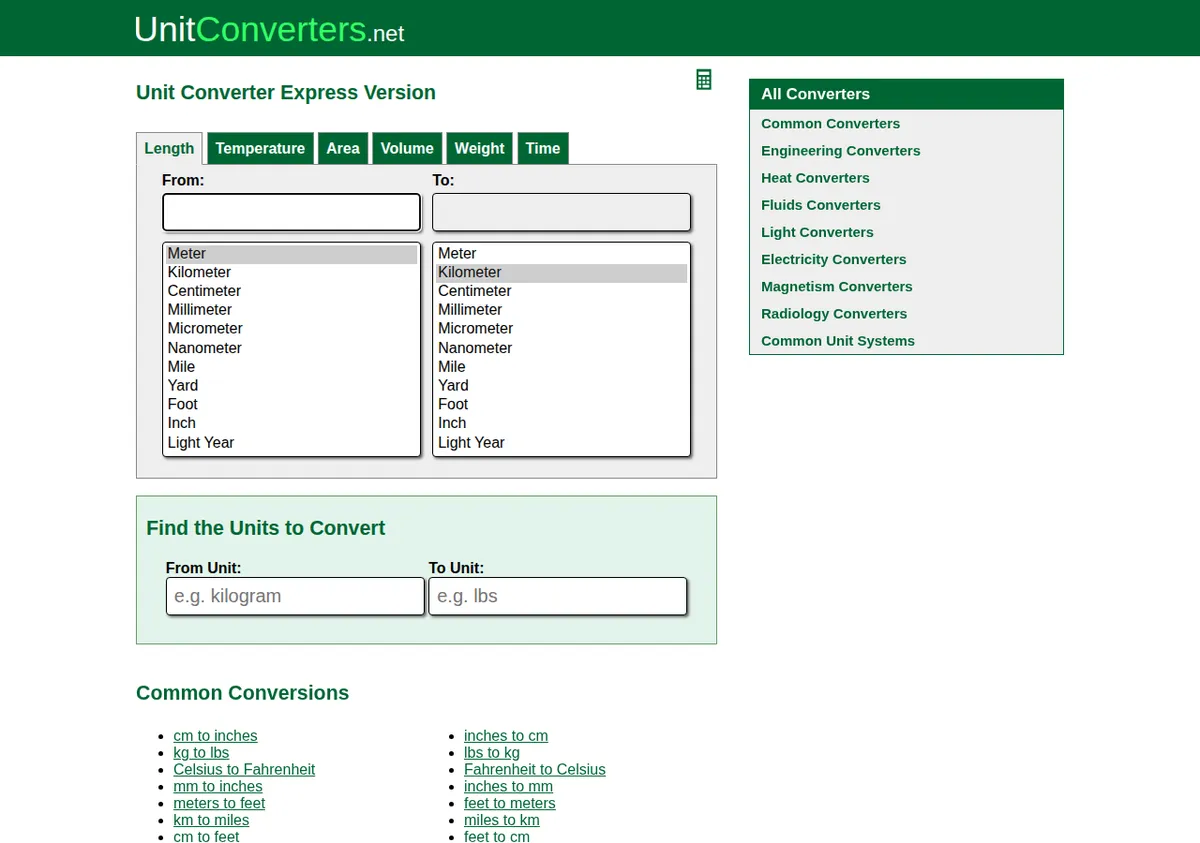
UnitConverters.net’s Express converter: six everyday measures on one page, with the full 80+ converter list in the sidebar.
ConvertUnits.com: best for plain-language input
ConvertUnits.com accepts the input the way people actually type it. Enter “70 kg”, “150 lbs”, “6’3″” or “10 stone 4” and it understands the units, symbols and abbreviations without you picking from a dropdown first. It covers about 40 categories, including the ones other converters skip: electric current, amount of substance, luminous intensity, acceleration, capacitance, molecular weight and chemical compounds. That makes it the only tool here that handles mole conversions and compound weights — useful for students and lab work. Free, no sign-up, no stated limits.
RapidTables: best for learning the formula
RapidTables is the pick when you want to understand the answer, not just read it. Every conversion pair has a “How to convert…” page that shows the formula and the calculation — for example, the Celsius to Fahrenheit page walks through the multiply-by-9/5-add-32 working. The site covers 13 main categories (length, weight, temperature, energy, power, frequency, voltage, electric charge, number, image and colour among them) plus electrical calculators and a chemistry section. If you are a student who has to show working, this is the unit converter to use. Free, no sign-up, no stated limits.
Calculator.net: best for history and context
Calculator.net’s conversion calculator covers the commonly used units and pairs the tool with unusually deep educational content: the history of the pound (defined since 1959 as exactly 0.45359237 kg) and of the metric system. The category list is script-driven, so the page itself points you to unitconverters.net for a full list of conversions — an honest bit of cross-linking that tells you where its own coverage ends. Use it when you want the story behind the units, and use one of the broader tools above when you need an obscure category. Free, no sign-up, no stated limits. Like our Tip Calculator guide, it is a calculator-first site, not an article farm.
Convert-Me.com: best for cooking conversions
Convert-Me.com has run since 1996 and lists over 2,000 units, including ancient Greek and Roman units you will never need and cooking conversions you will use every week. Its recipe conversion turns weight into volume for 100+ ingredients — the feature that separates it from every other unit converter here, because cups to grams depends on the ingredient’s density and most converters refuse to answer it. It also has a fuel-economy section (L/100 km versus mpg). Free, no sign-up, no stated limits; its forum is closed to new posts and kept as an archive.
Metric-Conversions.org: best for printable tables
Metric-Conversions.org pairs every calculator with a printable metric conversion chart, so you can stick the table on a wall instead of opening a page each time. The site explains the metric system’s history — it originated in France in 1799 — and organises units into types (temperature, weight, length and so on) with a category menu. The search box accepts pairs directly: type “celsius” and “fahrenheit” and it jumps to the right converter. Free, no sign-up, no stated limits.
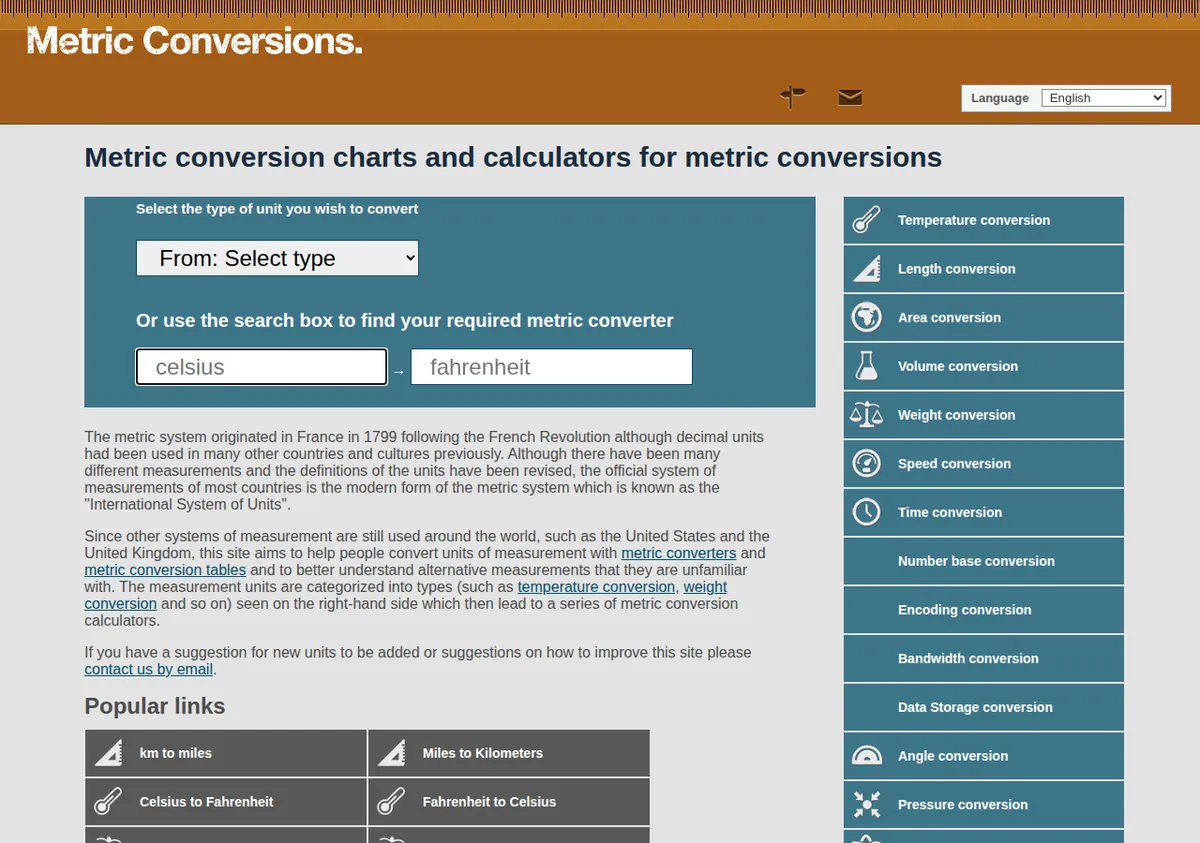
Metric-Conversions.org pairs every converter with a printable chart — the pick when you want the table, not just the tool.
Smart Calculators: best for precision
Smart Calculators puts 15 categories and 151 units on a single page — length, mass, temperature, volume, area, density, pressure, energy, power, force, torque, angle, speed, time and data storage. Its difference is honesty about precision: factors come from NIST and BIPM standards, and every result is tagged exact or approximate, so you can tell a definitionally exact conversion from one rounded by floating-point arithmetic. Every choice is encoded in the URL, so you can share or bookmark an exact conversion. One caveat it states itself: month, year and decade results are averages, flagged with ≈. Free, no sign-up, no stated limits.
Unit conversion formulas: quick reference
| Conversion | Formula |
|---|---|
| Miles to kilometres | km = mi × 1.609344 |
| Kilometres to miles | mi = km × 0.621371 |
| Metres to feet | ft = m × 3.28084 |
| Feet to metres | m = ft × 0.3048 |
| Kilograms to pounds | lb = kg × 2.20462 |
| Pounds to kilograms | kg = lb × 0.45359237 |
| Celsius to Fahrenheit | °F = (°C × 9/5) + 32 |
| Fahrenheit to Celsius | °C = (°F − 32) × 5/9 |
| US gallons to litres | L = gal × 3.78541 |
| UK gallons to litres | L = gal × 4.54609 |
Worked examples: 5 conversions, solved step by step
1. A 5-mile run in kilometres. 5 × 1.609344 = 8.04672 km. This is the conversion runners and travellers use most, and the one every tool above answers first.
2. 150 lb in kilograms. 150 × 0.45359237 = 68.0388555 kg. The pound is defined as exactly 0.45359237 kg, so this conversion is exact, not approximate.
3. 68 °F in Celsius. (68 − 32) × 5/9 = 20 °C. Room temperature in one system is a round number in the other — a useful check that your sum is right.
4. 10 gallons in litres — US versus UK. 10 US gallons × 3.78541 = 37.8541 L. 10 UK gallons × 4.54609 = 45.4609 L. Same number, 7.6 litres apart: always check which gallon a recipe or a fuel figure means.
5. Cups to grams in a recipe. This one has no single answer, because a cup of flour (≈120 g) weighs less than a cup of sugar (≈200 g). Use Convert-Me.com’s ingredient tables for it, or see our AI recipe generator guide for tools that convert a whole recipe at once.
Travel is the other everyday case: one page that handles length, weight, temperature, volume, speed and fuel economy together saves switching tools at the airport. OurCalculators’ travel converter does exactly that, with NIST factors and a one-click unit swap.
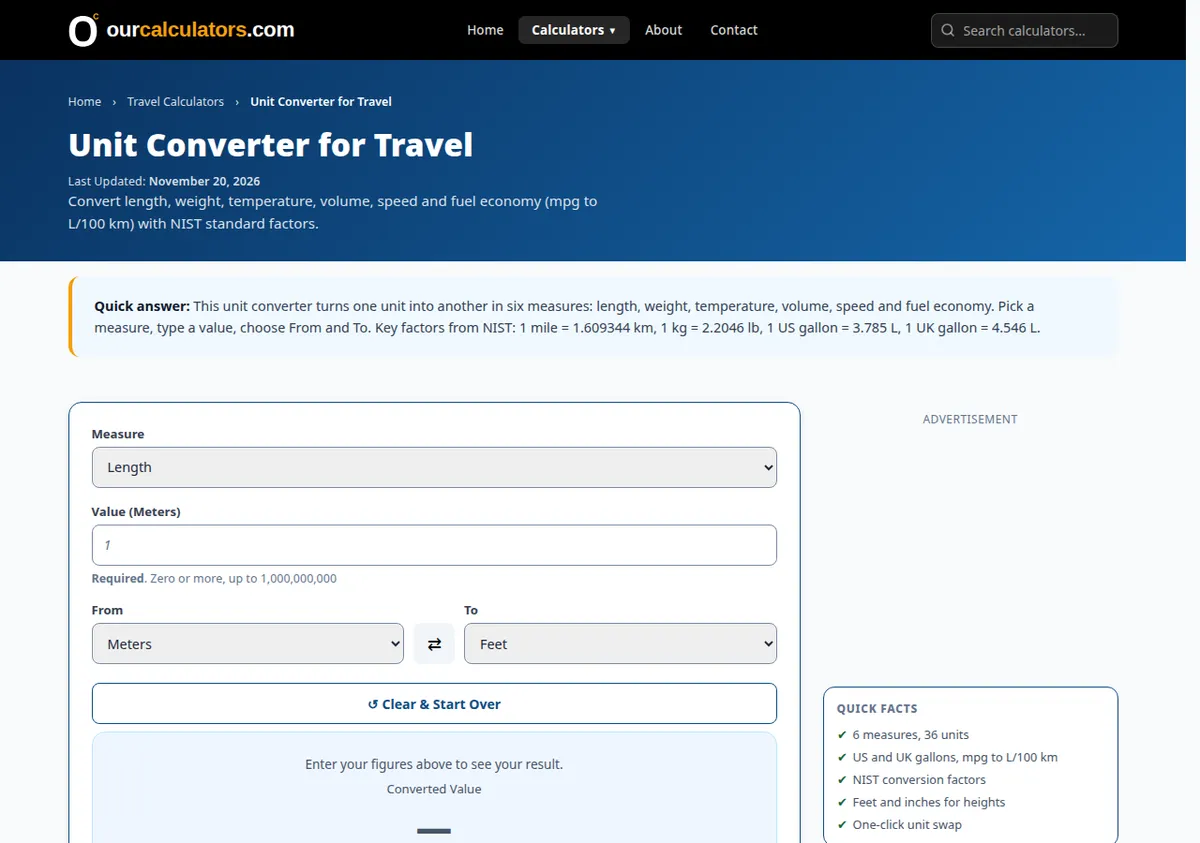
OurCalculators’ travel converter covers six measures on one page — the handy option for trips, with US and UK gallons handled separately.
US vs UK units: the traps that catch everyone
Three pairs cause nearly every conversion mistake. Gallons: a UK (imperial) gallon is 4.54609 litres and a US gallon is 3.78541 litres, so the UK gallon is about 20% larger — a car that does 40 mpg in the UK does about 33 mpg in US gallons. Pints: a UK pint is 568 ml and a US pint is 473 ml. Stones: a stone is 14 lb (6.35029 kg) and is still the everyday body-weight unit in the UK — ConvertUnits.com is the easiest place to type “10 stone 4” and get kilograms. Tons are a fourth trap: a US short ton is 2,000 lb, a UK long ton is 2,240 lb, and a metric tonne is 1,000 kg. When a number looks wrong by about 10–20%, check the country before you check the maths.
Which free unit converter should you pick?
- Widest coverage: UnitConverters.net — 80+ converters, nothing to install, nothing to sign up for.
- Learning the formula: RapidTables — the “how to convert” page for every pair.
- Cooking: Convert-Me.com — the only one with ingredient weight-to-volume tables.
- Printable tables: Metric-Conversions.org — charts you can keep by the desk.
- Precision and engineering: Smart Calculators — exact/approximate labels and shareable URLs.
- Travel: OurCalculators — six measures plus fuel economy on one page.
- Plain-language input: ConvertUnits.com — type “6’3″” and it just works.
FAQs
What is the best free unit converter?
UnitConverters.net is the best free unit converter overall: 80+ converters, a one-page Express version for everyday measures, no sign-up and no stated limits. Pick RapidTables if you want the formula shown, or Convert-Me.com for cooking conversions.
How do I convert miles to km?
Multiply miles by 1.609344. So 5 miles = 5 × 1.609344 = 8.04672 km. The reverse is miles = km × 0.621371.
How do I convert Celsius to Fahrenheit?
Use °F = (°C × 9/5) + 32. So 20 °C = (20 × 9/5) + 32 = 68 °F. To go back, °C = (°F − 32) × 5/9.
Is there a difference between US and UK gallons?
Yes. A US gallon is 3.78541 litres and a UK (imperial) gallon is 4.54609 litres — the UK gallon is about 20% larger. Always check which gallon a recipe, fuel figure or tank size means.
Do I need to sign up for a free unit converter?
No. Every tool in this guide is free with no account: UnitConverters.net, ConvertUnits.com, RapidTables, Calculator.net, Convert-Me.com, Metric-Conversions.org and Smart Calculators all work in the browser with no sign-up.
Can a unit converter convert cups to grams?
Only with an ingredient table, because a cup of flour and a cup of sugar weigh different amounts. Convert-Me.com has weight-to-volume tables for 100+ ingredients; ordinary converters refuse the question because there is no single factor.
Bottom line
A free unit converter is a thirty-second tool, and the best one is the one that matches your job: UnitConverters.net for breadth, RapidTables for formulas, Convert-Me.com for cooking, Metric-Conversions.org for printable tables, Smart Calculators for precision. Bookmark one general converter and one specialist, learn the four factors you use most — 1.609344, 2.20462, 3.78541 and the °F formula — and check US versus UK units before you trust any gallon or pint. For more free tools we have tested, see our free tools hub and our guide to converting HEIC photos to JPG.
Visit UnitConverters.net.
Last checked: November 2026. All tool facts come from the tools’ own homepages, checked in November 2026. Conversion factors follow NIST definitions: 1 inch = 2.54 cm and 1 lb = 0.45359237 kg exactly.
- AI Note Taker: 7 Best Free Tools for Notes & Summaries (2026)
- AI Book Generator: 7 Best Free Tools to Write a Full Book (2026)
- AI Prompt Generator: 7 Best Free Tools That Work (2026)
- How to Remove Background from Video Free: AI Tools That Do It in Seconds (2026)
- Tip Calculator Guide: How to Calculate a Tip and Split Bills