
Latest AI News November 2026: Claude’s Riemann Proof Certified

The biggest story in the latest ai news november 2026 is a mathematics result nobody expected this soon: a proof of the Riemann hypothesis, produced with Anthropic’s Claude and certified correct by the Lean and Mathlib communities on November 21. The same week, Anthropic’s own stock slid 8.5% on its second day of trading, and reports emerged that the SEC is reviewing Nvidia’s accounting. This roundup covers the three developments that mattered most between November 20 and 22, 2026 — what happened, what is verified, and what is still open.
If you use these models daily, our free AI tools hub collects the ones we have tested, and our AI Note Taker guide covers the meeting-note tools built on the same models.
Key takeaways
- On November 20, 2026, Anthropic mathematician Levent Alpöge released a Lean formalization of a proof of the Riemann hypothesis — 17 million lines of code across 175,187 files.
- On November 21, the Lean and Mathlib communities certified that both the statement and the proof are correct; MIT’s verification page reports all 175,187 modules compile with zero errors.
- The proof also covers the generalized Riemann hypothesis for Dirichlet L-functions, but no human-readable paper exists yet and the Clay Mathematics Institute still lists the $1 million prize as open.
- Anthropic (ANT) priced its IPO at $83, closed day one at $97.17, then fell 8.5% on November 20 to $88.91 as the Nasdaq dropped 5.28%.
- Reports on November 20 said SEC enforcement staff are reviewing Nvidia’s accounting; Nvidia shares fell 14% in a single day.
Here is the latest ai news november 2026, item by item.
Table of Contents
- Did Claude really help prove the Riemann hypothesis?
- What did the Lean and Mathlib communities actually certify?
- What is still unverified about the Riemann proof?
- Anthropic stock falls 8.5% on day two of trading
- SEC reported to be reviewing Nvidia’s accounting
- Also this week in AI
- FAQs
- Bottom line
Did Claude really help prove the Riemann hypothesis?
Yes — with an important qualifier about what “proved” means here. On November 20, 2026, Levent Alpöge, a mathematician at Anthropic, posted a short note saying: “I believe I have, working with Claude, discovered a proof of the Riemann Hypothesis.” Instead of a conventional paper, he released the proof as a Lean library: 175,187 files and about 17 million lines of code, split across a 14-part archive on his personal site. He says he and Claude formalized the arguments without assumptions, and credits Claude with outpacing him near the finish — including the idea of chaining theta lifts about √X times, a step at the heart of the argument.
The Riemann hypothesis is the most famous unsolved problem in mathematics. It says that every nontrivial zero of the Riemann zeta function has real part exactly one-half — in symbols, Re(s) = ½. It has stood open since 1859, and the Clay Mathematics Institute offers $1 million for its solution. Forecasters had not expected it soon: Metaculus forecasters had put the proof around May 2035, and Terence Tao said last month he expected the problem to fall to a combination of humans and AI around 2050. That is why this result leads the latest ai news november 2026.
What did the Lean and Mathlib communities actually certify?
On November 21, 2026 — one day after the release — the Lean and Mathlib communities published a joint statement, endorsed by the Lean FRO and the Mathlib Initiatve: “We have full confidence that Alpöge’s proof of the Riemann Hypothesis is correct, and we congratulate him on this achievement.” The certification rests on four checks, all of which the statement says are satisfied.
First, the statement itself is correct: the hypothesis proved is Mathlib’s own RiemannHypothesis definition, vetted by experts in Lean and number theory. Second, the library compiles: dozens of people reproduced the same raw proof export with no errors. Third, the code proves the right statement — a community file isolating the hypothesis was compared against the theorem in Alpöge’s library with two independent tools, and both confirmed an exact match. Fourth, the proof is valid: the exported proof was checked by Lean’s official kernel and by independent checkers written in different programming languages, including con-leche and con-ron, which carry a formal proof that they cannot accept a false proof.
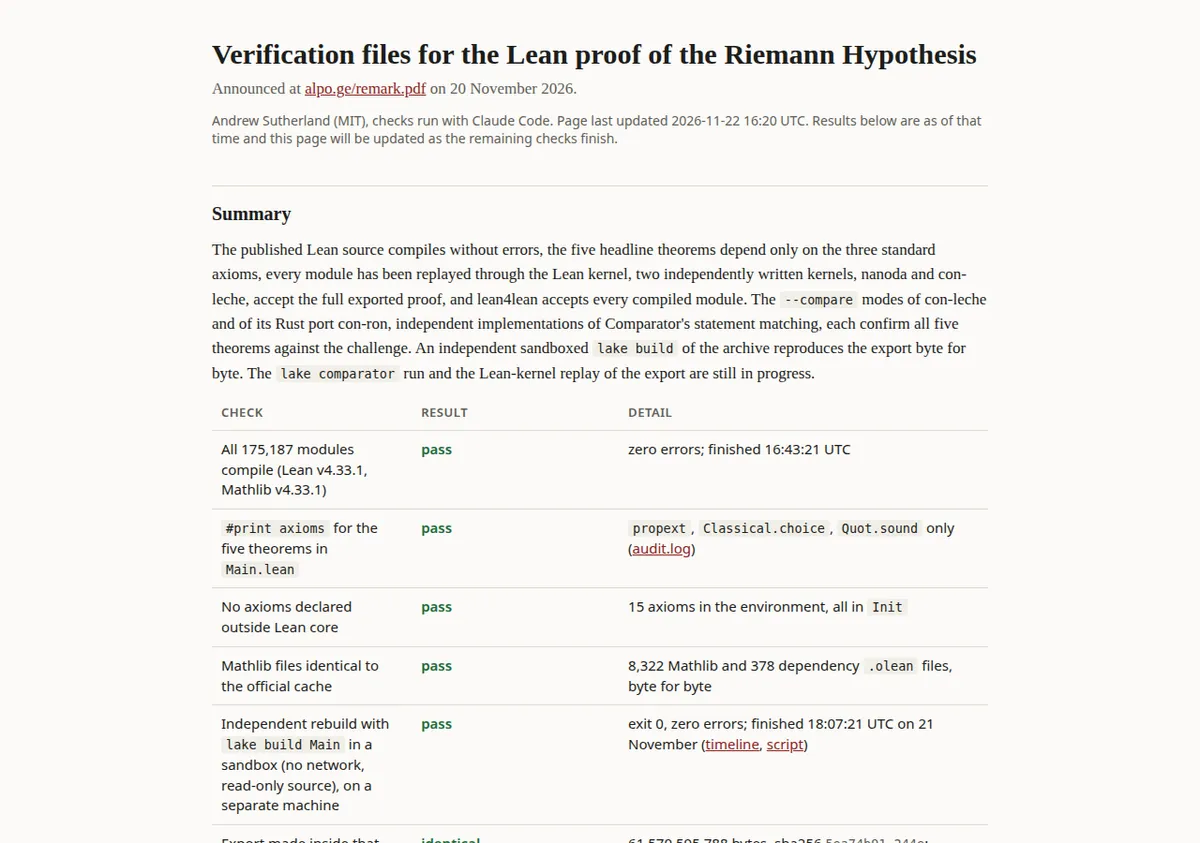
Andrew Sutherland’s MIT verification page for the Lean proof: all 175,187 modules compile with zero errors, and the five headline theorems rest on only the three standard axioms.
Andrew Sutherland’s independent verification page at MIT reports the same picture: the published Lean source compiles without errors, the five headline theorems depend only on the three standard axioms (propext, Classical.choice and Quot.sound), every module was replayed through the Lean kernel, and an independent rebuild on a separate machine reproduced the export byte for byte. The release also proves the generalized Riemann hypothesis for Dirichlet L-functions — the five formal theorems include the relevant zero-location statements for those functions.
What is still unverified about the Riemann proof?
Three things keep this from being a closed case. First, there is no human-readable paper yet. Alpöge says an informal draft produced with Claude ran past 250,000 pages, so mathematicians have only begun to understand the ideas behind the formal proof. Second, a competing human-authored draft proof was released by Stanford University within hours of Alpöge’s announcement, and a PhilArchive critique questions whether a geometry predicate in the argument is vacuous. Third, the Clay Mathematics Institute still lists the prize as open: machine checks are separate from classical peer review and from Clay’s award process. The honest summary is that the formal proof is certified correct, while the mathematical community’s understanding of it — and the prize — are still to come. Until the Clay Institute responds, the latest ai news november 2026 will keep tracking this story.
Anthropic stock falls 8.5% on day two of trading
Anthropic’s record IPO had a rough second day. The company priced its IPO at $83 a share, opened on the Nasdaq on November 19 at $111.50, touched $115.10, and closed its first day at $97.17 — up 17% and briefly worth about $2 trillion. On Friday, November 20, the shares fell 8.5% to close at $88.91, nearly touching the IPO price with an intraday low of $83.05.
The drop came during a broad sell-off: the Nasdaq Composite fell 5.28% the same day and the S&P 500 about 3.7%. Anthropic’s own numbers explain part of the caution. Last quarter its revenue rose 47% sequentially, but spending on compute grew about 1.7 times as fast, and the company swung from its first operating profit to an operating loss. Even after the fall, Anthropic is valued at roughly $1.2 trillion, about 18 times its annualized revenue. Underwriters fully exercised their over-allotment option, taking gross IPO proceeds to about $93.5 billion, plus a separate $26 billion private placement. It is the market counterweight to the Riemann story in the latest ai news november 2026.
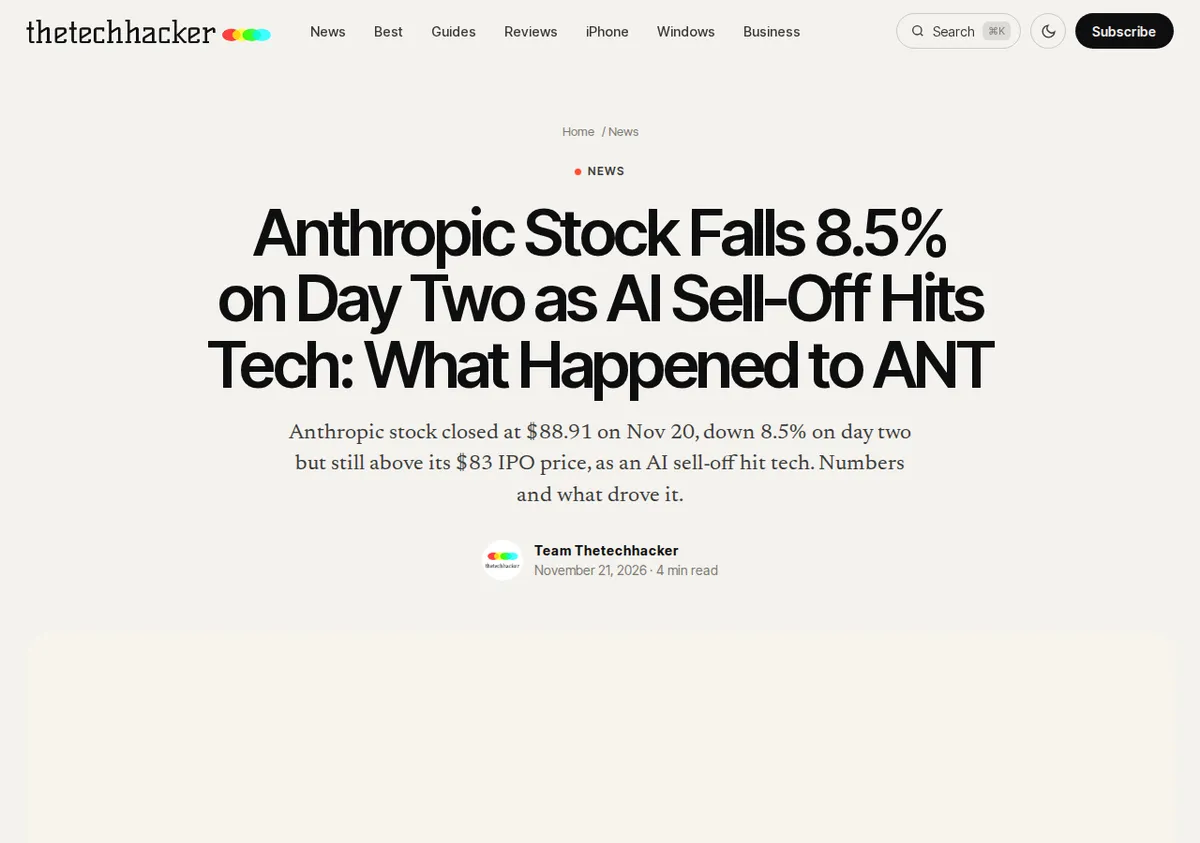
Anthropic closed its second trading day at $88.91 on November 20, down 8.5% but still above its $83 IPO price.
SEC reported to be reviewing Nvidia’s accounting
Reports emerged on November 20 that staff in the U.S. Securities and Exchange Commission’s Enforcement Division are reviewing Nvidia’s accounting practices. Nvidia’s share price fell 14% in a single day on the news. The reports describe a review, not a finding of wrongdoing, and no charges have been announced. The news landed in the middle of the same broad AI sell-off that hit Anthropic, with chip stocks falling across the board. This is a developing story: treat the 14% single-day drop as the market’s reaction to the report, not as a verdict on Nvidia’s accounts. It rounds out the market
side of the latest ai news november 2026.
Also this week in AI
Beyond the top three stories, the latest ai news november 2026 includes four smaller items worth a minute of your time.
- Together AI disclosed a prompt leak. On November 22, Together AI said stored serverless prompts from June–July 2026 were downloaded after a private-repo credential leaked publicly. If you used Together AI’s serverless inference this summer, assume prompts from that window may have been exposed.
- Thinking Machines released Inkling 2 Mini. The open-weights model, released November 20 under Apache 2.0, is a 26.4B mixture-of-experts model with about 20 GB of weights, built to run on laptops — it scores 48.2% on DeepSWE v1.1 and runs on 32 GB Macs via Ollama.
- Twenty tech firms signed an AI election accord. OpenAI, Microsoft, Google, Meta, Adobe, TikTok and X were among the companies that agreed on November 20 to work together against deceptive AI content interfering in elections.
- Gemini computer use came to Mac. Google added a computer-use feature to its Gemini app for Mac on November 19: the AI clicks and types inside Mac apps in a separate virtual display.
FAQs
Was the Riemann hypothesis really proved?
A formal Lean proof was released on November 20, 2026, and certified correct by the Lean and Mathlib communities on November 21, with independent checks at MIT confirming all 175,187 modules compile with zero errors. Classical peer review and the Clay $1 million prize are still pending, and no human-readable paper exists yet.
What is Lean, and why does its certification matter?
Lean is a system that expresses mathematical arguments in a language a computer can check against explicit rules of logic. Its certification matters because the check is mechanical: independent proof checkers, some with formal proofs that they cannot accept a false proof, all accepted the same export.
Is Anthropic stock still above its IPO price?
Yes. ANT closed at $88.91 on November 20, down 8.5% on the day but still about 7% above the $83 IPO price, after closing its first day at $97.17.
What did the SEC report say about Nvidia?
Reports on November 20 said SEC Enforcement Division staff are reviewing Nvidia’s accounting practices. Nvidia shares fell 14% that day. A review is not a finding of wrongdoing, and no charges have been announced.
Where can I read the Riemann proof verification?
The Lean and Mathlib communities’ joint statement is on the Lean community blog, and Andrew Sutherland’s verification page at MIT lists every check with its result and timestamp. Both are linked in this latest ai news november 2026 roundup.
Bottom line
The latest ai news november 2026 is led by a genuine landmark: a Claude-assisted proof of the Riemann hypothesis, machine-certified within a day of release. The market news points the other way — Anthropic’s IPO euphoria faded fast, and an SEC review report knocked Nvidia 14% in a day. The proof’s certification is the durable story; the stock moves are the noise around it. We will update this roundup if the Clay Institute or the mathematical community issues a formal verdict.
Last checked: November 2026. Sources: Lean community blog joint statement (Nov 21, 2026); Andrew Sutherland’s MIT verification page; Motley Fool and TheTechHacker IPO coverage (Nov 20–21, 2026); November 22 AI news briefings. For our earlier roundup, see Latest AI News: October 2026.
- AI News November 2026: Anthropic’s $64B IPO, OpenAI Robotics & Gemini Glasses
- Gemini 4 Carbon: Google’s Strongest AI Model Yet (2026)
- OpenAI LifeVal: AI Now Graded on Everyday Life (Nov 2026)
- ChatGPT and Codex Will Share One Usage Limit in December — Plus DeepSeek’s Super-Agent and Apple Intelligence in China
- AI News November 2026: Claude Memory, OpenAI’s $11B Round & the Shared AI Training Opt-Out