AI plagiarism checker free tools are now the first place students check an essay, a research draft, or a take-home assignment before they hand it in. You do not need an expensive university licence to catch accidental copying, a missing citation, or a paragraph that sounds too close to its source. The right free tool will flag the problem, show you the matching source, and let you fix it in minutes.
The best Duplichecker plans, Quetext checks, and GPTZero scans all answer slightly different questions, though. Some check for copied text. Some check whether text looks AI-written. Some do both, but with very different free limits. This guide tests the real free tiers, compares them honestly, and tells you which ai plagiarism checker free option fits each kind of student work.
Used well, an ai plagiarism checker free tool is not a way to hide copying. It is a way to prove your work is yours, to quote correctly, and to rewrite in your own words before a teacher or a checker ever sees a problem.
At a Glance: The Best AI Plagiarism Checker Free Picks
- Best overall free pick: Duplichecker — generous free checks, a simple report, and AI detection in one place.
- Best for deep source matching: Quetext — strong source matching and a clear, academic-style report.
- Best for AI detection: GPTZero — the most student-friendly AI writing detector, with sentence-level highlighting.
- Best for academic accuracy: Scribbr — the most careful checker for theses and journal-style work, but with a tighter free trial.
- Quick verdict: Start with Duplichecker for everyday checks, add Quetext when a source matters, and use GPTZero when you need to check AI-style writing.
This ai plagiarism checker free comparison is designed to save you time: pick from the list above, check your draft once, and fix only the passages that actually need attention.
Why Free Plagiarism Checkers Still Matter in 2026
Plagiarism is rarely deliberate in student work. It usually comes from a rushed paraphrase, a copied definition, a quotation without quotation marks, or notes pasted into a draft and forgotten. A free checker catches those accidents while you can still fix them.
AI writing has added a second risk. A paragraph can be completely original in the sense that it was not copied from the web, and still be flagged as AI-generated because it follows a predictable pattern. Teachers increasingly run both kinds of checks. That is why the best ai plagiarism checker free tools in 2026 are useful in pairs: one for copied text, one for AI-style text.
Free tools also teach good habits. When you see a highlighted sentence next to its source, you learn the difference between a summary, a paraphrase, and a direct quote. Over a semester, that feedback is worth more than any single report.
How We Tested These AI Plagiarism Checker Free Tools
We judged each tool on the same questions a student would ask. How much can you check for free, without a card? How clear is the report? Does it find real matches, or does it cry wolf over common phrases? Does it handle AI detection, and how honest is it about uncertainty?
We also checked practical details: whether you need an account, whether uploads are kept private, whether the free version limits words per check, and whether the paid upgrade is actually worth it for a student budget. Each ai plagiarism checker free tool in this guide was assessed on those practical details, not just on its marketing claims.
No free checker is perfect. They miss paywalled sources, books, and some classroom databases. They also flag common phrases and correctly cited quotations. Treat every report as a starting point for editing, not as a final judgement.
1. Duplichecker — Best Overall AI Plagiarism Checker Free Tool
Duplichecker is the easiest recommendation for most students because its free tier is genuinely usable day to day. Paste text, upload a file, or check a URL, and you get a percentage, highlighted matches, and a list of sources to review.
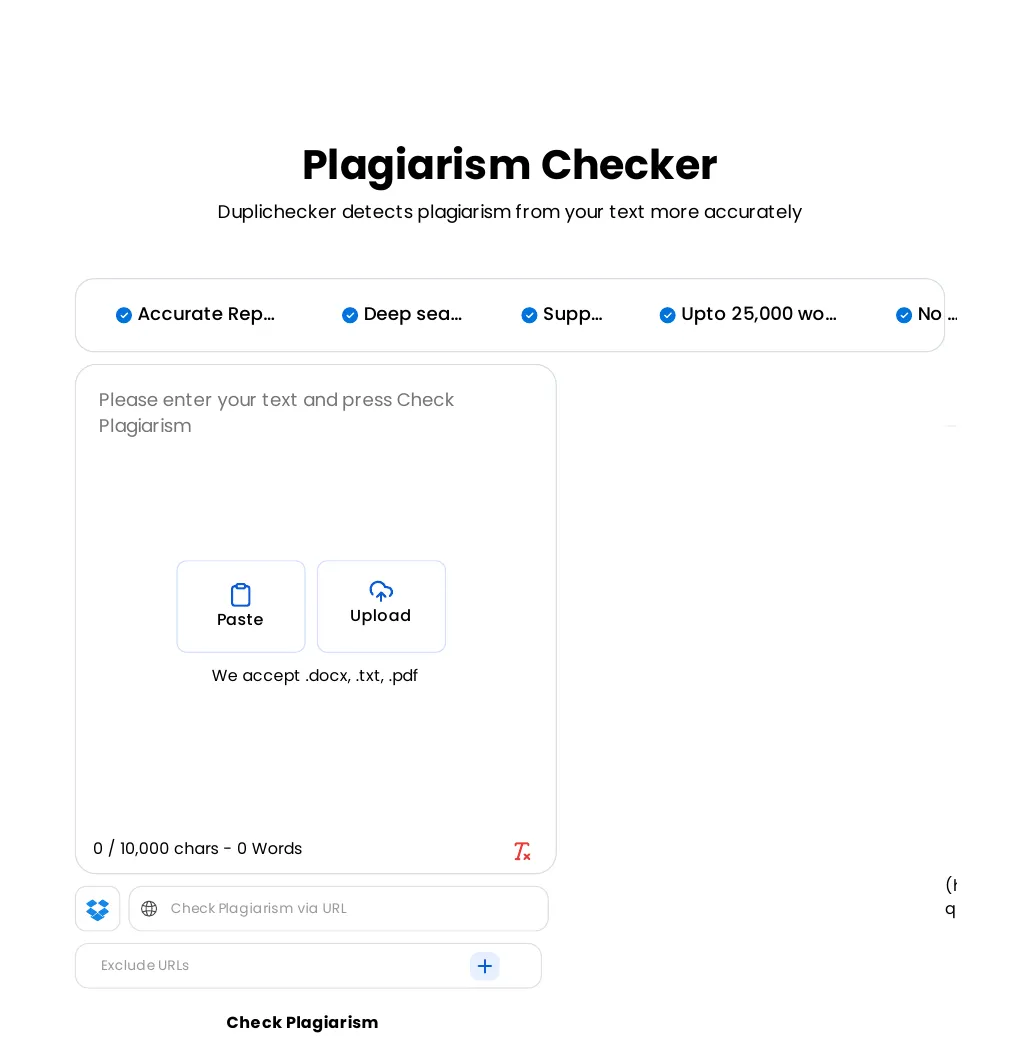
Free limits: Duplichecker gives free users a set number of checks per day, with a word limit per check that covers most essays and short assignments. Longer theses will need to be split into sections, which is actually good practice for editing anyway.
What it does well: The report is simple to read, the source list is clear, and the tool also offers grammar, paraphrasing, and AI detection features in the same dashboard. For a student who wants one ai plagiarism checker free tool for everything, this is the best starting point.
Watch out for: Free checks run out faster than you expect if you re-check the same draft repeatedly. Edit first, then check once, then fix the flagged passages and check a final time. Also, always read the source yourself before changing a citation — a match is not proof that you copied.
Best for: Everyday essays, coursework, blog posts, and quick pre-submission checks.
2. Quetext — Best for Deep Source Matching
Quetext is built for writers who want to understand exactly where a match came from. Its DeepSearch technology looks beyond surface wording, so it can catch paraphrased passages that simpler checkers miss.
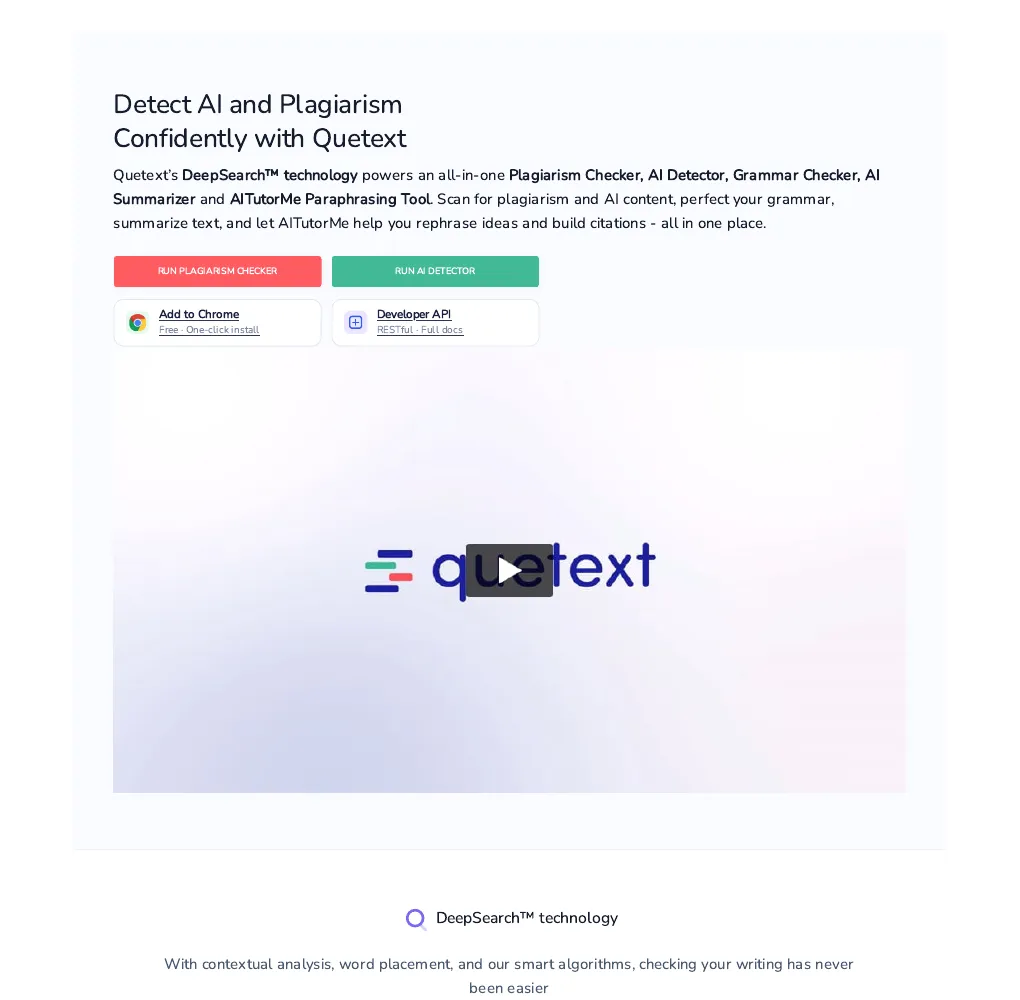
Free limits: Quetext offers a limited free check, usually a few hundred words at a time, which is enough to test a paragraph or an introduction. The full report and larger checks require a paid plan, so use the free tier strategically on the sections you are least sure about.
What it does well: The report is academic and detailed, with colour-coded matches and a clean source breakdown. It is particularly good at showing whether a paraphrase is still too close to the original.
Watch out for: The free word limit is tight for a full essay. Check section by section, and prioritise introductions, literature reviews, and conclusions, where accidental copying is most common.
Best for: Research essays, literature reviews, and any work where the source matters as much as the match.
3. GPTZero — Best AI Plagiarism Checker Free Tool for AI Detection
GPTZero started as an AI detector for teachers, but students now use it to check their own drafts before submission. It highlights sentences that look AI-generated, gives an overall AI probability, and explains its reasoning sentence by sentence.
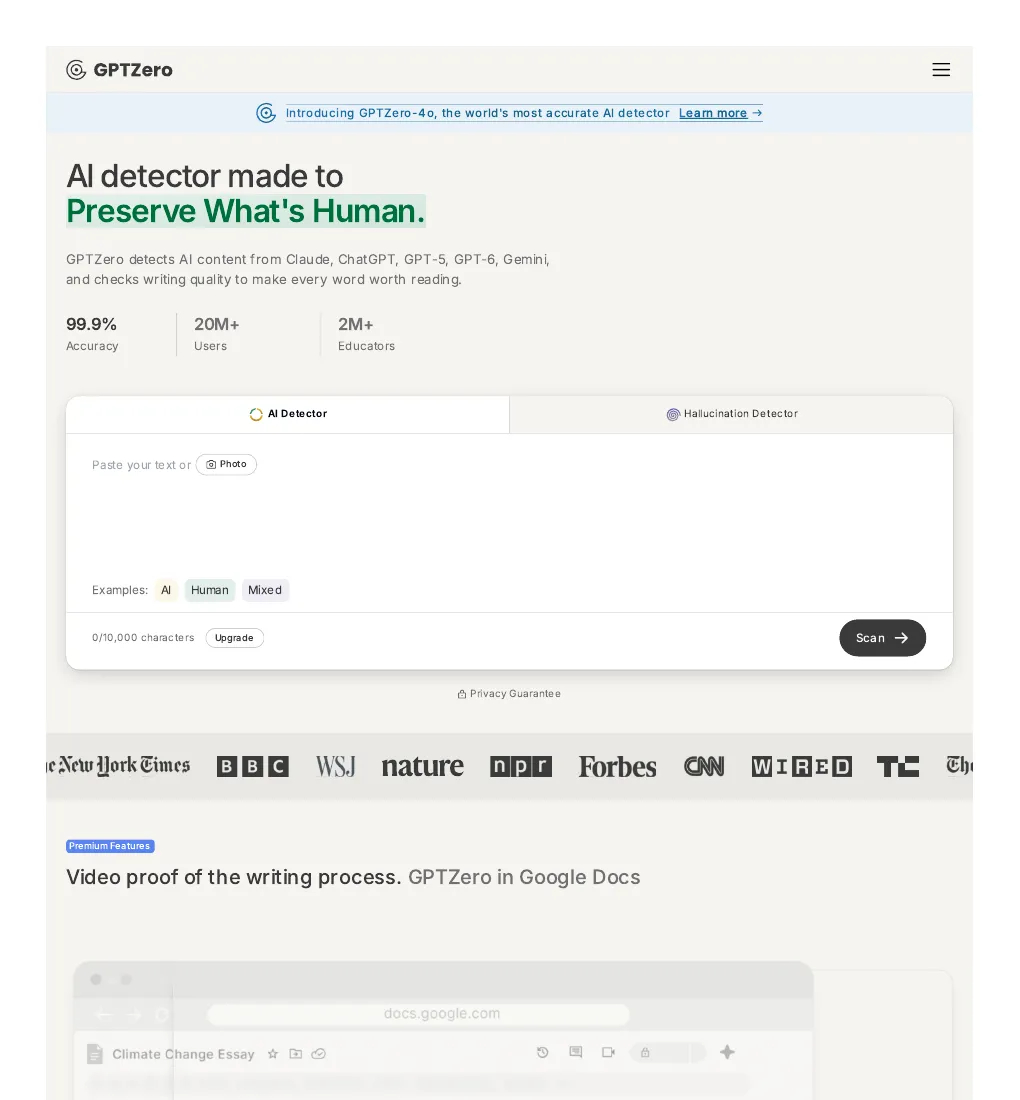
Free limits: GPTZero offers free scans with a generous word allowance, plus a dashboard where you can keep track of past checks. That makes it practical for checking a full essay in one go.
What it does well: Sentence-level highlighting is the key feature. Instead of a single scary percentage, you see which sentences triggered the detector, and you can rewrite those sentences in a more natural, specific, human voice.
Watch out for: AI detectors are not perfect, and GPTZero itself says so. Human writing can be flagged, especially formal academic prose. Never treat a GPTZero score as proof of AI use — treat it as a prompt to add personal analysis, examples, and varied sentence structure.
Best for: Checking AI-style phrasing, pre-submission AI scans, and rewriting flagged sentences.
4. Scribbr — Best for Academic Accuracy
Scribbr is the checker many universities recommend because it is powered by Turnitin technology and searches a huge academic database. Its reports are careful, detailed, and trusted in academic settings.
Free limits: Scribbr’s free option is more limited than the others here, and the full checker is paid. Think of it as a final, high-stakes check for a thesis or a major paper, rather than a daily tool.
What it does well: Accuracy and academic credibility. If Scribbr flags a passage, it is worth investigating, and its citation tools help you fix the problem correctly.
Watch out for: Cost. Do not pay for Scribbr for a short homework assignment. Use the free tools above first, and save Scribbr for work that really counts.
Best for: Theses, dissertations, journal submissions, and final-year projects.
5. Copyscape — Best for Checking Published Work
Copyscape works the other way round: instead of checking your draft against the web, it checks whether your published work has been copied elsewhere. That makes it useful for student bloggers, portfolio writers, and anyone publishing online.
Free limits: Copyscape’s free search lets you check a URL, while deeper batch checks are paid. It is not a full essay checker, but it is excellent at its specific job.
What it does well: Fast, simple URL checks and clear duplicate results. If you publish essays, articles, or creative work online, it helps you protect that work.
Watch out for: Do not use Copyscape as your only pre-submission checker. Pair it with Duplichecker or Quetext for draft checking.
Best for: Published articles, portfolios, and blog posts.
6. Paperpal — Best AI Plagiarism Checker Free Companion for Academic Writing
Paperpal combines language checking, academic phrasing suggestions, and plagiarism-related tools in a single editor. It is less of a standalone checker and more of a writing companion for researchers.
Free limits: Paperpal’s free tier covers basic language and writing checks, with advanced features behind a subscription. It is useful for non-native English speakers who want clearer, more academic phrasing.
What it does well: It improves the writing itself, not just the originality score. Better phrasing often reduces accidental similarity as a side effect.
Watch out for: Accepting every AI suggestion can make your writing sound generic, which can itself trigger AI detectors. Use suggestions selectively and keep your own voice.
Best for: Academic writers, researchers, and students writing in English as a second language.
7. PlagiarismCheck.org — Best Simple, No-Fuss Checker
PlagiarismCheck.org is a straightforward checker with a clean interface and a focus on education. Teachers and students use it for quick checks without a complicated dashboard.
Free limits: The free trial is limited, but it is enough to test the tool and check a short assignment. Paid plans are aimed at schools and teachers rather than individual students.
What it does well: Simplicity. Paste, check, read the report, fix the problem. No learning curve.
Watch out for: The free tier will not cover a long essay in one go. Split longer work, or use it alongside Duplichecker.
Best for: Short assignments, quick checks, and students who want a simple tool.
Comparison Table: AI Plagiarism Checker Free Tools at a Glance
| Tool | Best For | Free Tier | AI Detection |
|---|---|---|---|
| Duplichecker | Everyday checks | Generous daily checks | Yes |
| Quetext | Deep source matching | Limited free check | No, focused on copying |
| GPTZero | AI detection | Free scans | Yes, its main strength |
| Scribbr | Academic accuracy | Limited free option | Via partner tools |
| Copyscape | Published work | Free URL check | No |
| Paperpal | Academic writing help | Free basic tier | Writing assistance |
| PlagiarismCheck.org | Simple checks | Free trial | Basic |
This ai plagiarism checker free table makes the trade-offs clear: no single tool is best at everything, so match the tool to the task.
Which AI Plagiarism Checker Free Tool Should You Choose?
If you only want one tool, choose Duplichecker. It covers the most ground for free, and its report is easy to act on. If your teacher checks AI writing specifically, add GPTZero. If your work is research-heavy, add Quetext for the sections with the most sources. That combination is the most practical ai plagiarism checker free workflow for most students.
For a thesis or a paper that will be published, do a final pass with Scribbr if you can. For published blog work, check with Copyscape after you publish. The combination matters more than any single score.
Remember that a low similarity percentage is not the goal. A well-cited, well-paraphrased essay can legitimately score 10 to 20 percent because of quotations, references, and common phrases. A 0 percent score is not necessarily better — it can mean you avoided sources altogether. Aim for honest, cited, original analysis, not for gaming a number. For more student guides, see the AI Earn Tools Hub homepage and explore other tools for students.
Common Mistakes When Using a Free Plagiarism Checker
- Checking too early: Check a near-final draft, not a rough outline full of pasted notes. Otherwise you will waste free checks on text you were going to rewrite anyway.
- Ignoring the source: Always open the matched source. Sometimes the match is a correctly cited quotation, a common phrase, or a reference list — none of which need fixing.
- Rewriting only to lower the score: Changing words without changing understanding is still copying in spirit. Rewrite from your notes, not from the original sentence.
- Trusting AI detectors blindly: A high AI score does not prove AI use, and a low score does not prove human writing. Use detectors as editing feedback, not as verdicts.
- Forgetting citations: A checker cannot fix a missing citation. If an idea came from a source, cite it, even if you paraphrased it perfectly.
Frequently Asked Questions About AI Plagiarism Checker Free Tools
Is there a truly free ai plagiarism checker free tool with no sign-up?
Most tools require a free account for larger checks, but Duplichecker and GPTZero offer usable free checks without a paid plan. Expect word limits and daily caps on any truly free tier.
Can a free checker detect AI-written text?
Only tools with AI detection, such as Duplichecker and GPTZero, attempt this. Traditional plagiarism checkers look for copied text, not AI patterns, so a purely AI-written essay can pass a plagiarism check while failing an AI check.
What is a good plagiarism percentage for students?
There is no universal safe number. Many universities accept under 20 percent, but the breakdown matters more than the total. Quotations, references, and common phrases inflate the score legitimately, while a single un-cited paragraph can be a problem even at a low total.
Will a free checker keep my essay private?
Reputable tools say they do not publish or sell your work, but always check the privacy policy before uploading a thesis or unpublished research. Avoid uploading sensitive or unpublished work to unknown checkers.
Should I use more than one checker?
Yes, for important work. Different databases find different matches, and pairing a plagiarism checker with an AI detector gives a fuller picture than either tool alone. An ai plagiarism checker free workflow that uses two tools is usually stronger than relying on one score.
Final Verdict: The Safest AI Plagiarism Checker Free Picks for Students
For most students in 2026, the safest combination is Duplichecker for copied text, GPTZero for AI-style writing, and Quetext when a source needs a closer look. That trio covers everyday essays, research papers, and pre-submission checks without spending anything.
Use the tools to learn, not to cheat the system. Quote correctly, paraphrase from understanding, add your own analysis, and let the checker confirm what you already know: that the work is yours. That is the real point of an ai plagiarism checker free tool — not a perfect score, but honest, confident writing you can submit without worry.
- AI Citation Generator: 7 Best Free APA & MLA Tools (2026)
- AI Quiz Generator: 7 Best Tools for Studying Smarter (2026)
- AI Homework Helper: 8 Best Tools That Explain (2026)
- AI Tattoo Generator: 6 Best Tools for Your Next Ink (2026)
- Best AI Resume Builder: 7 Top Tools Tested (2026)
- Best AI Study Tools for Students: 9 Tools Compared (2026)
- Free AI Presentation Maker: 7 Best Free Tools (2026)
- AI Story Generator Free: 8 Best Tools for 2026 (Tested)
- Free AI Resume Builder: 7 Best Tools That Work in 2026
- AI Slide Maker: 6 Best Tools for Fast Decks (2026)