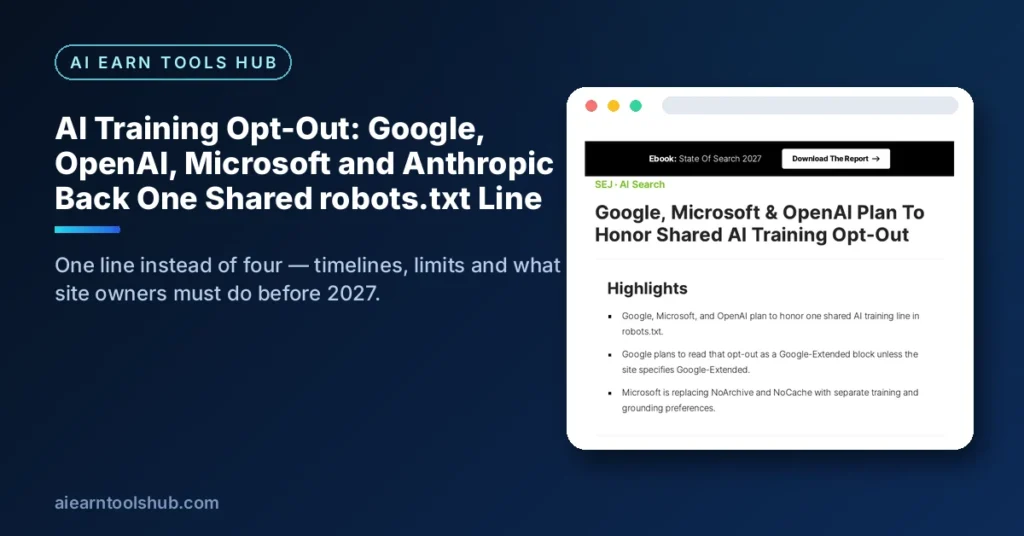
The biggest AI news of the week is a rare moment of agreement: Google, OpenAI, Microsoft and Anthropic have all backed one shared ai training opt-out — a single line in a website’s robots.txt file that tells every participating AI company not to use that site’s content for training. Announced on Friday, October 30, 2026, the move replaces four separate, company-specific opt-outs with one shared signal, but it is voluntary, it is not working everywhere yet, and the rollout stretches into 2027.
Key takeaways
- One new robots.txt policy token,
__usage_ai-training, lets a site state a single AI training preference for all four companies at once. - Anthropic is the only company using the signal today; OpenAI aims to follow in the coming months, Microsoft starts February 1, 2027, and Google plans early 2027.
- The signal is voluntary and covers future training only — it does not stop crawling, and it does not remove content from models already trained.
- Microsoft will stop recognizing the older NoArchive and NoCache tags as training and grounding signals after March 1, 2027 — sites using those tags must switch.
- Existing company-specific controls (like GPTBot and Google-Extended) keep working, so there is no need to change anything today.
Table of Contents
- What exactly was announced?
- How does the shared ai training opt-out work?
- When will each company honor it?
- What the signal does NOT do
- What site owners should do now
- What it means for readers and AI answers
- Also in AI today: OpenAI cuts its funding target
- FAQs
- Bottom line
What exactly was announced?
On October 30, 2026, Google, OpenAI and Microsoft each announced plans to honor a shared robots.txt line for AI training preferences, built on a proposal from Anthropic. The proposal comes from an Internet Draft submitted the same day by Kevin Kelley, Anthropic’s technical lead for standards, to the AI Preferences working group at the IETF, the body that develops many of the internet’s core technical standards. Anthropic has already begun building support for it. Search Engine Journal reported the announcements on November 1, 2026.
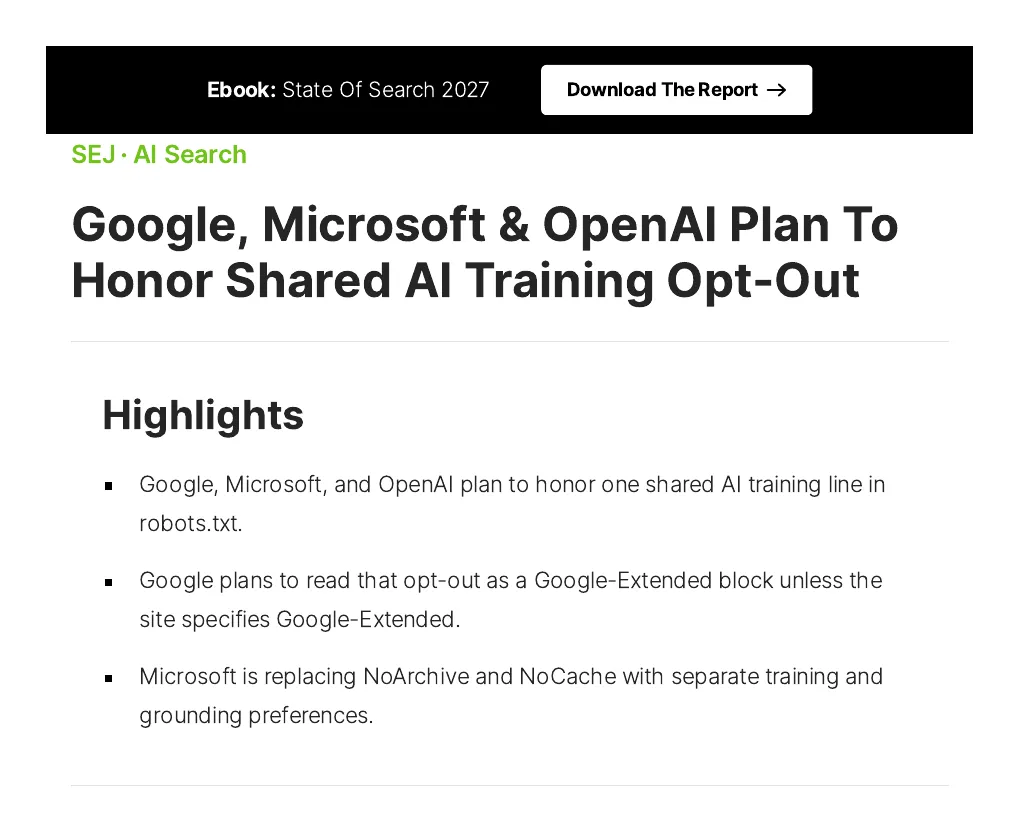
Until now, a site owner who wanted an ai training opt-out had to write a separate rule for each company’s crawler — Google-Extended for Google, GPTBot for OpenAI, ClaudeBot for Anthropic, and Bing’s controls for Microsoft. The new approach replaces that patchwork with one purpose-based rule that every participating company reads the same way.
How does the shared ai training opt-out work?
The draft deliberately adds nothing new to robots.txt grammar. Instead of naming a company’s crawler in the User-Agent line, a site names a purpose: the policy token __usage_ai-training. Ordinary Allow and Disallow rules then apply. The draft’s own example opts an entire site out of AI training except for a press-kit folder:
User-Agent: __usage_ai-training

Disallow: /

Allow: /press-kit/
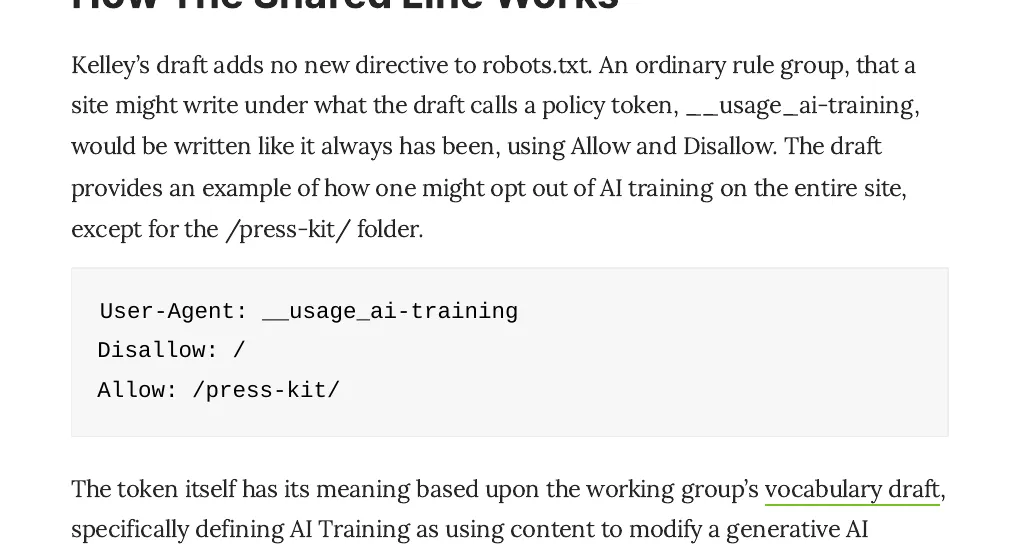
Three details matter. First, “AI training” here means using content to change a generative AI model’s learned parameters — models that only do non-generative work, like classification or ranking, fall outside that definition. Second, a wildcard group (User-Agent: *) can never match the token, so the rule must be written explicitly. Third, a robots.txt file with no __usage_ai-training group signals no preference — which is true of every robots.txt file published today. The token does not control crawling: it is a preference signal about training, not a directive that changes what a crawler fetches.
When will each company honor it?
| Company | Status | Timeline |
|---|---|---|
| Anthropic | Building support now | Already started; rollout across services takes time |
| OpenAI | Announced, not yet implemented | Aims to honor it “in the coming months”; current GPTBot policy stays in effect |
| Microsoft | Announced | Starts honoring the new options from February 1, 2027 |
| Announced | Plans support in early 2027; a shared opt-out will be read as if Google-Extended were disallowed |
The staggered rollout is the story’s main catch: based on the timelines the companies gave, none of Google, Microsoft or OpenAI supports the line yet, so until those dates arrive the shared ai training opt-out is a promise, not a working switch. Site owners who add it today are preparing for 2027, not changing anything this week.
What the signal does NOT do
- It is not enforceable. The signal is voluntary. Companies that do not join the effort are not bound by it, and there is no penalty mechanism in the draft.
- It does not stop crawling. A crawler can still visit and index a page for search; the token only states a preference about training use.
- It does not un-train models. It covers future training only. Content already used to train an existing model is not removed by adding the line.
- It is not yet an official standard. The IETF tracker lists the document as an individual draft, which does not represent official IETF standardization activity. The draft expires May 3, 2027 unless a new version replaces it.
- Conflicts are unresolved. As of October 30, OpenAI had not said what happens when a shared rule conflicts with an existing GPTBot rule.
What site owners should do now
For most site owners, the honest answer on the new ai training opt-out is: nothing urgent, but two deadlines deserve a calendar note. First, keep your existing controls in place — GPTBot, Google-Extended, ClaudeBot and Bing’s tags all keep working, and the companies say existing controls will continue to be honored alongside the new token. Second, if your site relies on Microsoft’s NoArchive or NoCache tags for training and grounding preferences, migrate to the new options before March 1, 2027, when Microsoft stops recognizing those tags for that purpose.
When support lands, adding one group is all it takes:
User-Agent: __usage_ai-training

Disallow: /
Sites that want to stay visible in AI answers while opting out of training should note Google’s handling: where a site opts out through the shared line and does not specify Google-Extended, Google plans to read it as if Google-Extended were disallowed — and Google-Extended also covers grounding in Gemini Apps and on Vertex AI. Both Google and Microsoft have cautioned that opting out of training could reduce how often a site surfaces in AI apps, so the choice is a trade-off, not a free win.
What it means for readers and AI answers
For readers, the practical effect of the shared ai training opt-out will be slow and mostly invisible. AI companies have spent years scraping the open web to train models; a shared opt-out gives publishers a single, simpler lever to say no to future training. If many publishers use it, future models may be trained on a narrower slice of the web — which could make AI answers thinner on some topics, or push companies toward licensed content deals instead. For publishers, the win is simplicity: one line, four companies, instead of a growing list of per-company tokens to maintain.
Also in AI today: OpenAI cuts its funding target
Separately, OpenAI has lowered the target for its new funding round from $30 billion to $20 billion, and cut its target valuation from $1.4 trillion to $1.25 trillion, according to the Financial Times, with the Wall Street Journal counting about $11 billion in commitments so far. OpenAI has also added card and device limits to paid ChatGPT subscriptions, and from December 2026, Plus, Pro and Business plans will share one budget across ChatGPT and Codex, its coding tool. The funding news is reported, not confirmed by OpenAI itself, and it lands as investors grow more cautious about AI spending after a rough October for tech stocks.
FAQs
What is the new ai training opt-out?
It is a shared robots.txt policy token, __usage_ai-training, backed by Google, OpenAI, Microsoft and Anthropic — one ai training opt-out that all four companies read the same way. A site writes one rule group under that token to state its AI training preference for all participating companies at once, instead of one rule per company crawler.
Is the shared ai training opt-out working right now?
Not yet, except at Anthropic, which has begun building support. OpenAI aims to honor it in the coming months, Microsoft starts February 1, 2027, and Google plans early 2027. Existing per-company controls keep working in the meantime.
Does opting out stop Google from indexing my site?
No. The token states a preference about AI training only; it does not control crawling or search indexing. Googlebot can still visit and index the page, and the token is separate from the rules that govern search visibility.
Do I need to remove my GPTBot or Google-Extended rules?
No. The companies say existing controls will continue to work alongside the new shared token, so your current ai training opt-out setup stays valid. Keep them until the shared signal is actually honored across all four companies.
Is the shared opt-out legally binding?
No. The shared ai training opt-out is a voluntary signal described in an individual IETF draft, not a law and not yet an official standard. Companies that do not participate are not bound by it.
Bottom line
One line instead of four is genuine progress for publishers — but only once it works. Until early 2027, the shared ai training opt-out is a promise with a staggered timetable, not a switch you can flip today. Keep your existing opt-outs, note Microsoft’s March 1, 2027 deadline if you use NoArchive or NoCache, and add the shared group when the companies actually start honoring it.
Last checked: November 2026. Sources: Search Engine Journal’s November 1, 2026 report on the announcements, and the IETF Internet Draft on the __usage_ai-training policy token. For more AI news, see our October AI news roundup and our free tools library.
- AI Citation Generator: 7 Best Free APA & MLA Tools (2026)
- AI Quiz Generator: 7 Best Tools for Studying Smarter (2026)
- AI Homework Helper: 8 Best Tools That Explain (2026)
- AI Tattoo Generator: 6 Best Tools for Your Next Ink (2026)
- Best AI Resume Builder: 7 Top Tools Tested (2026)
- Best AI Study Tools for Students: 9 Tools Compared (2026)
- Free AI Presentation Maker: 7 Best Free Tools (2026)
- AI Story Generator Free: 8 Best Tools for 2026 (Tested)
- Free AI Resume Builder: 7 Best Tools That Work in 2026
- AI Slide Maker: 6 Best Tools for Fast Decks (2026)
- OpenAI LifeVal: AI Now Graded on Everyday Life (Nov 2026)
- ChatGPT and Codex Will Share One Usage Limit in December — Plus DeepSeek’s Super-Agent and Apple Intelligence in China
- AI News November 2026: One Line to Opt Out of AI Training
- AI Training Opt-Out: One robots.txt Rule Now Backed by OpenAI, Google, Microsoft and Anthropic
- Google Genie 4: AI Worlds That Talk Back (Oct 27–29, 2026)