
Last checked: October 2026
Key Takeaways
- ChatGPT, Claude, Gemini, Copilot, and Rytr are the best free AI writing tools in 2026, each with a genuinely usable free plan.
- Match the tool to the job: ChatGPT and Claude for blog posts, Copilot for emails, Rytr for social captions.
- The free plans of these free AI writing tools limit usage, output length, and premium features, but they rarely block real work.
- Always fact-check and edit AI drafts before publishing; human review makes the content trustworthy.
Free AI writing tools are becoming essential for bloggers, marketers, freelancers, and businesses that want to create content faster without spending a lot of money. These AI-powered platforms can help with blog writing, SEO optimization, social media captions, email copy, and content ideas in just a few seconds. In 2026, free AI writing tools are more advanced than ever, offering smart features like grammar correction, keyword suggestions, and long-form content generation for free users.
The best part is that many of these tools are free. In 2026, companies are competing aggressively in the AI market, which means free plans are becoming more powerful than ever. According to recent reports, Free AI writing tools are changing the way bloggers, marketers, and businesses create content online. From writing SEO articles to generating social media captions and email copy, AI tools now help creators save time and boost productivity faster than ever. In 2026, many free AI platforms offer powerful features like content generation, grammar correction, keyword optimization, and idea brainstorming without expensive subscriptions. (computertech.co)
If you are searching for the best Free AI writing tools, this guide will help you understand which platforms are worth using and how they can improve your workflow.
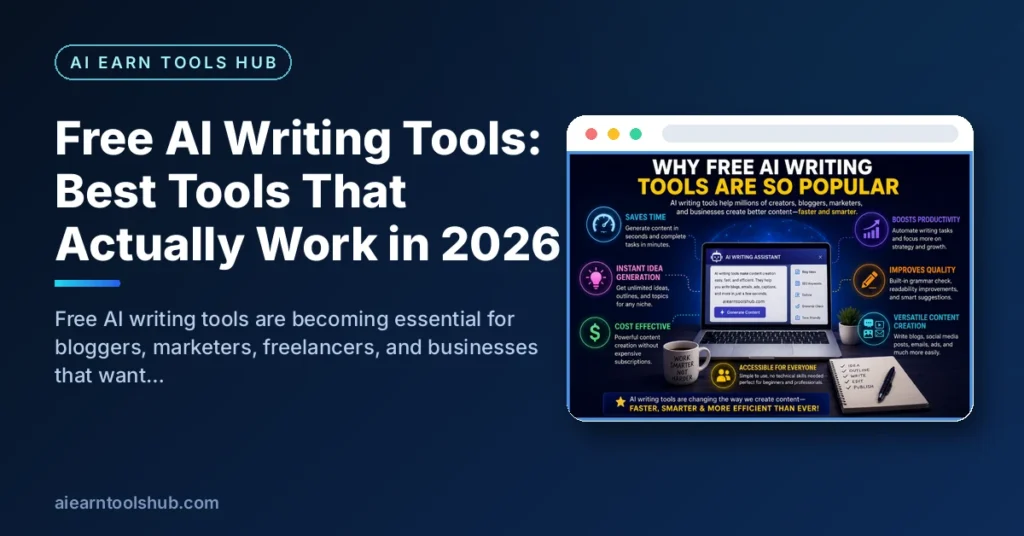
Why Are Free AI Writing Tools So Popular?
Short answer: Free AI writing tools are popular because they remove the slowest work — blank-page starts, drafting, and polishing — for free. Bloggers and businesses use them to publish more content in less time.

AI writing tools have become extremely popular because content creation is now a major part of online business. Websites need blog posts, social media pages need captions, YouTube creators need scripts, and businesses constantly require marketing copy. Producing all this content manually takes a lot of time and energy.
Free AI tools solve this problem by helping writers generate ideas, outlines, and drafts quickly. Instead of spending an hour staring at a blank screen, users can type a simple prompt and receive usable content in seconds. Recent reports show that free AI platforms are improving rapidly because companies want to attract more users to their ecosystems. (computertech.co)
Another reason these tools are growing fast is accessibility. You do not need technical skills to use them. Most AI tools work like chat assistants where you simply ask for the content you need. This simplicity makes AI useful for beginners and professionals alike.
Growth of Free AI Content Tools
A few years ago, advanced AI writing tools were expensive and mostly limited to businesses. Today, many companies provide strong free plans to stay competitive in the market.
This is excellent news for bloggers and freelancers with limited budgets. Users can now test multiple AI platforms without paying upfront. Many creators combine several free tools together for better results. One tool may help with research, while another improves grammar or SEO optimization.
Benefits of AI Writing Tools for Bloggers
AI writing tools provide several important benefits:
- Faster content creation
- Better productivity
- Quick idea generation
- Improved grammar and readability
- SEO assistance
- Reduced writer’s block
Think of AI as a digital writing assistant. It helps you work faster while allowing you to focus on creativity and strategy.
Features to Look for in AI Writing Tools
Short answer: Look for natural writing quality, flexibility across content types, and built-in SEO and editing help. A free plan covering those three handles most everyday writing jobs.
Not every AI writing tool is worth using. Some generate repetitive or robotic content, while others limit free users too heavily. Choosing the right platform depends on your goals and writing needs.
The most important feature is writing quality. Good AI-generated content should sound natural and conversational. If the output feels robotic, you will spend too much time editing it.
Another important feature is flexibility. Some tools are better for blog posts, while others work best for social media captions or ad copy. A strong AI platform should handle multiple content types easily.
Writing Quality
High-quality AI tools understand tone, context, and structure. They can generate engaging introductions, organize ideas logically, and adapt writing styles based on your instructions.
Modern AI models are much better than earlier versions. According to industry reviews, many free AI tools now produce content that feels surprisingly human-like. (whatif-ai.com)
SEO and Editing Features
SEO optimization is essential for bloggers and website owners. Some AI tools can help generate:
- SEO titles
- Meta descriptions
- Keyword suggestions
- FAQ sections
- Blog outlines
Editing features are also important because AI content still requires human review. Grammar correction and readability improvements can save significant editing time.
Best Free AI Writing Tools in 2026

Short answer: The best free AI writing tools in 2026 are ChatGPT, Claude, Google Gemini, Microsoft Copilot, and Rytr. Each one below stands out for a different writing job.
The AI writing market is crowded, but a few platforms consistently stand out because of their quality and ease of use.
ChatGPT Free AI Writing Tool
ChatGPT remains one of the most popular free AI writing tools available today. It is widely used for blog writing, brainstorming, social media content, email drafting, and SEO article creation.
One reason ChatGPT is so effective is versatility. Users can ask for outlines, rewrite paragraphs, generate headlines, or simplify complex ideas. Many bloggers use it daily because it adapts well to conversational writing styles.
The free version continues to improve, offering stronger reasoning and writing capabilities than earlier releases. (whatif-ai.com)
Claude AI Writing Assistant
Claude is another powerful AI writing assistant known for producing natural and coherent long-form content. Many writers prefer Claude because the responses often feel more thoughtful and less robotic.
Claude works especially well for detailed articles, summaries, and editing tasks. It can handle large documents effectively, making it useful for content creators working on long projects.
Google Gemini for AI Content Writing
Google Gemini is becoming increasingly popular because of its integration with Google services like Gmail, Docs, and Drive.
Gemini is useful for research-heavy writing tasks. Users can gather information, organize ideas, and create structured drafts quickly. Google is heavily investing in AI productivity tools, making Gemini a strong competitor in the AI writing space. (theverge.com)
Microsoft Copilot Writing Tool
Microsoft Copilot is integrated into Microsoft products like Word and Outlook, making it convenient for professional users.
It performs well for:
- Email writing
- Quick summaries
- Professional documents
- Productivity tasks
Users already working in the Microsoft ecosystem often find Copilot extremely practical.
Rytr Free AI Content Generator
Rytr focuses mainly on marketing and short-form content creation. It is useful for social media captions, ad copy, and quick promotional content.
The interface is simple and beginner-friendly, making it a popular choice for affiliate marketers and small business owners. (aiinformation.in)
This side-by-side comparison of free AI writing tools shows where each one performs best:
| Tool | Best For | Standout Strength | Free Plan |
|---|---|---|---|
| ChatGPT | Blog posts and SEO articles | All-round drafting and ideas | Free tier with usage limits |
| Claude | Long articles and editing | Natural, coherent long-form writing | Free plan; upgrade for heavy use |
| Google Gemini | Research-heavy writing | Works inside Google services | Free with a Google account |
| Microsoft Copilot | Emails and documents | Built into Word and Outlook | Free; more in Microsoft 365 |
| Rytr | Captions and ad copy | Fast short-form templates | Free plan for light use |
How Do Bloggers Use Free AI Writing Tools?
Short answer: Bloggers use free AI writing tools to brainstorm ideas, research faster, draft sections, and optimize posts for search, while adding their own experience and voice.
Bloggers are among the biggest users of AI writing technology. Running a successful blog requires constant content production, keyword research, and optimization. AI tools help simplify these tasks significantly.
One major advantage is faster brainstorming. AI can instantly generate dozens of article ideas, titles, and subtopics based on a niche keyword.
Faster Research
Research is often the slowest part of content creation. AI tools help summarize information and organize ideas quickly.
Writers can use AI to:
- Create outlines
- Explain difficult topics
- Generate FAQs
- Suggest subheadings
- Simplify research material
This speeds up the entire writing process and helps creators publish content more consistently.
Content Optimization
Many bloggers also use AI for SEO optimization. AI tools can suggest keywords, improve readability, and generate optimized meta descriptions.
Recent discussions in online SEO communities show that creators increasingly rely on AI-assisted workflows to scale content production. (reddit.com)
The smartest bloggers combine AI efficiency with personal experience and storytelling. This balance creates content that ranks well while still feeling authentic.
Which Free AI Writing Tool Is Best for Each Writing Job?
Short answer: Among free AI writing tools, ChatGPT and Claude lead for blog posts, Copilot fits emails, Rytr is built for social captions, and Gemini suits research and academic-style writing.
Best for Blog Posts: ChatGPT and Claude
ChatGPT is the best starting point for outlines, section drafts, and rewrites, while Claude keeps long drafts natural and coherent. Give either of these free AI writing tools your own facts and examples for the strongest results.
Best for Emails: Microsoft Copilot
Copilot works inside Word and Outlook, so it drafts replies, summarizes long threads, and sharpens professional wording where you already write.
Best for Social Captions: Rytr
Rytr’s templates and tone choices make captions, hooks, and ad copy fast, and ChatGPT is a strong backup for generating several variations at once.
Best for Academic Writing: Gemini and Claude
Gemini helps organize research inside Google Docs and Drive, while Claude turns notes into clear, structured explanations. Verify every fact and citation, and follow your institution’s AI rules.
What Do Free AI Writing Plans Actually Limit?
Short answer: Free plans limit how much you can generate, how long outputs can be, and which premium features you can open — not whether the tool can write.
- Usage caps: most free AI writing tools restrict generations or messages over a set period, and busy times can mean slower access.
- Output length: long documents often need drafting section by section instead of in one request.
- Premium features: the newest models, priority speed, and advanced research tools are usually paid extras.
- Editing depth: free grammar and SEO suggestions are lighter than dedicated pro tools.
In practice, most writers combine two or three free AI writing tools, so one plan’s limit never stops a deadline.
What Mistakes Should You Avoid With AI Writing Tools?
Short answer: Avoid publishing unedited AI drafts, trusting AI facts without checking them, and letting AI replace your own voice.
AI writing tools are powerful, but they are not perfect. Many users make the mistake of publishing AI-generated text without proper editing.
AI can sometimes produce repetitive phrases, vague statements, or incorrect information. Human review is still necessary to ensure quality and accuracy.
Publishing Without Editing
Editing is essential for making AI-generated content feel natural. Writers should always:
- Check facts
- Improve flow
- Add personal insights
- Adjust tone
- Remove repetitive wording
Even the best AI output benefits from human polishing.
Overusing AI
Another common mistake is relying too heavily on AI. Readers connect with human emotion, storytelling, and personality. Pure AI-generated content often feels generic and forgettable.
AI should support creativity, not replace it. The best results come when writers use AI as a helper rather than a complete replacement.
How Do You Edit an AI Draft Before Publishing?
Short answer: Verify the facts, fix the flow, and add your own experience. Run this checklist before publishing:
- Check every fact, name, and date against a trusted source.
- Read sentences aloud; rewrite anything robotic or repetitive.
- Add one personal example or opinion the AI could not invent.
- Make sure each heading matches what its section delivers.
- Cut vague filler and replace it with specific detail.
- Confirm the first lines of each section answer its heading.
The Bottom Line on Free AI Writing Tools
The bottom line: free AI writing tools are powerful enough for serious blogging, marketing, and everyday business writing in 2026. Pick the free AI writing tools that fit your main jobs, learn their limits, and always edit before you publish.
Conclusion
Free AI tools for content writing have transformed the way creators work online. Bloggers, marketers, freelancers, and businesses now have access to advanced writing assistance without paying large subscription fees.
Tools like ChatGPT, Claude, Gemini, Copilot, and Rytr each offer unique strengths. Some are better for long-form blogging, while others excel at short-form marketing content.
The key to success is using AI strategically. AI can speed up research, generate ideas, and improve productivity, but human creativity still matters most. Writers who combine AI efficiency with authentic storytelling will have a major advantage in the future of digital content creation.
FAQs
1. What is the best free AI tool for content writing?
ChatGPT is currently one of the best free AI writing tools because of its flexibility, ease of use, and strong writing quality.
2. Can free AI tools write SEO articles?
Yes, many free AI tools can help create SEO-friendly articles, including outlines, keywords, meta descriptions, and FAQs.
3. Are AI writing tools safe to use?
Yes, AI writing tools are generally safe, but users should always review content for accuracy before publishing.
4. Do AI tools replace human writers?
No. AI improves productivity, but human creativity, storytelling, and expertise remain essential.
5. Which AI tool is best for social media content?
Rytr and ChatGPT are popular choices for creating captions, ad copy, and short-form social media posts.
6. Can I use free AI writing tools for academic writing?
Yes, free AI writing tools can help with outlining, summarizing sources, and improving clarity in academic writing. Always verify facts and citations yourself, and follow your school or university rules on AI assistance.

[…] these with free AI writing tools for the listing titles and […]
[…] remembers your topic, audience, and style across all seven steps. New to AI writing? Start with our free AI writing tools […]