What is an AI Chatbot? 7 Mind-Blowing Ways It Works & 2026 Guide
Digital communication has undergone a monumental shift in recent years. When exploring what is an AI chatbot, we are looking at one of the most widely adopted applications of modern conversational artificial intelligence. From virtual support agents on e-commerce storefronts to generative language models assisting programmers, conversational software has evolved from simple scripted bots into intelligent systems capable of natural, human-like dialogue.
Understanding what is an AI chatbot and how it integrates into commercial workflows is crucial for business leaders, customer support executives, and digital marketers alike. To stay updated on cutting-edge software reviews and digital transformation insights, check out our latest guides on AI Earn Tools Hub. To explore how conversational interfaces are modeled at the infrastructure level, researchers often refer to authoritative technical documentation like IBM’s Guide to Conversational AI Chatbots.
This comprehensive 2026 guide breaks down the underlying technology, core architectural frameworks, business benefits, key industry applications, and future trends that answer the fundamental question: what is an AI chatbot and how is it reshaping global digital interactions?
What is an AI Chatbot? (Core Definition & Evolution)
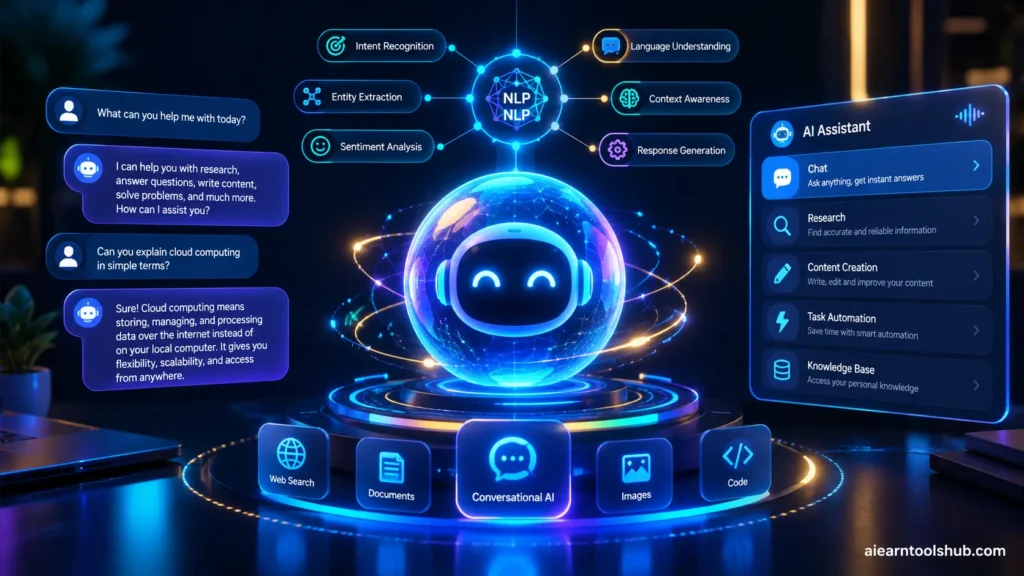
To provide an exact technical definition when asking what is an AI chatbot, an AI chatbot is a software application designed to simulate human conversation through natural language processing (NLP), natural language understanding (NLU), and machine learning (ML) algorithms. Unlike early conversational interfaces that relied strictly on pre-defined keyword scripts, modern AI chatbots analyze user intent, maintain context across multi-turn exchanges, and synthesize original answers dynamically.
The evolution of conversational interfaces spans several distinct technological phases:
- First-Generation (Rule-Based Bots): Built on fixed, branching decision trees (e.g., “Press 1 for Sales, Press 2 for Support”). They fail completely when a user inputs a query outside their pre-coded script.
- Second-Generation (Intent-Based NLU Bots): Utilized pattern matching to recognize predefined intents and entities. While more flexible, they still relied on rigid template responses.
- Third-Generation (Generative AI Chatbots): Powered by Large Language Models (LLMs) and Transformer neural network architectures. These systems comprehend subtle linguistic nuances, draft original contextual responses on the fly, and execute complex multi-step tasks across external APIs.
AI Chatbot vs. Traditional Rule-Based Chatbot: Key Differences
To thoroughly understand what is an AI chatbot, it helps to contrast modern conversational AI systems with legacy rule-based software. The differences lie in how each framework handles unstructured human language.
Traditional rule-based chatbots operate like interactive flowcharts. If a user types “My order hasn’t arrived yet,” a rule-based system looks for explicit matching keywords like “order” or “arrived” to trigger a generic template response. However, if the user asks, “Where is my package? It was supposed to be here yesterday,” a rule-based system often breaks down, resulting in frustrating “I didn’t understand that” loops.
In contrast, when analyzing what is an AI chatbot, we see a framework built on deep semantic understanding. Generative AI chatbots parse the context, sentiment, and underlying intent of the user’s sentence regardless of phrasing. They can pull live tracking information from an integrated inventory system and formulate a clear, personalized update in real-time.
| Feature / Capability | AI Chatbot (Conversational AI) | Traditional Rule-Based Chatbot |
|---|---|---|
| Core Technology | Large Language Models, NLP, & Machine Learning | If/Then conditional logic & fixed decision trees |
| Query Handling | Understands unstructured, natural language & typos | Requires exact keyword matches or menu selections |
| Context Retention | Remembers previous dialogue turns across long conversations | Evaluates each input in isolation without memory |
| Learning Capability | Improves over time using interaction data & fine-tuning | Static; requires manual developer updates for new rules |
| Response Generation | Synthesizes fresh, contextual answers dynamically | Retrieves fixed, pre-written script templates |
7 Mind-Blowing Ways an AI Chatbot Works Under the Hood
Examining what is an AI chatbot from an architectural perspective reveals a sophisticated pipeline of algorithms working together in milliseconds. Here are the 7 core technical stages behind modern conversational AI:
1. Natural Language Understanding (NLU) & Tokenization
When a user sends a message, the system first breaks the raw text into smaller units called tokens (words, sub-words, or characters). The NLU engine strips out grammatical noise, identifies core linguistic entities (such as dates, product names, or order numbers), and determines the user’s primary intent.
2. Vector Embedding & Semantic Mapping
Tokens are transformed into high-dimensional numerical vectors. This mathematical representation allows the neural network to plot the query within a semantic vector space, evaluating how closely the user’s input relates to thousands of concepts learned during training.
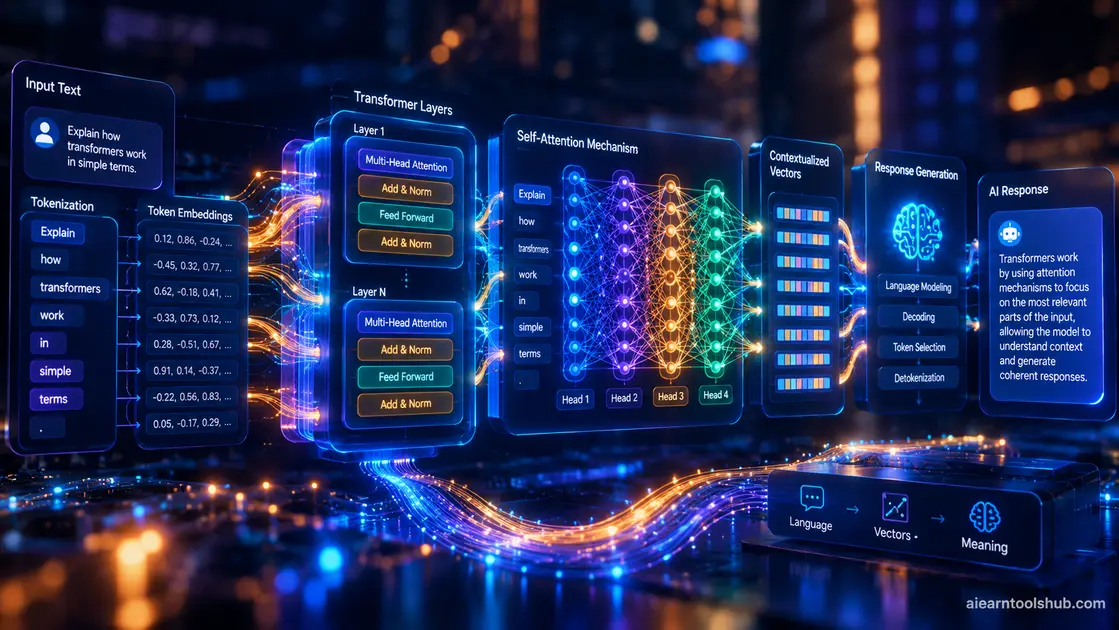
3. Transformer Models & Self-Attention Mechanisms
Modern conversational engines utilize the Transformer neural network architecture. Through Self-Attention, the model weighs the relationships between every word in a sentence simultaneously rather than sequentially. This grants the system a human-like grasp of tone, sarcasm, and complex sentence structure.
4. Retrieval-Augmented Generation (RAG)
To ensure accuracy and eliminate factual errors, business-oriented AI chatbots use RAG technology. When a query is received, the system queries the company’s private knowledge base or CRM, retrieves relevant documents, and feeds that verified data directly into the generative model to synthesize a grounded answer.
5. Multi-Turn Context & Dialogue Management
A major breakthrough when defining what is an AI chatbot is its ability to maintain a conversational state. The dialogue manager tracks context across multiple exchanges, allowing users to ask follow-up questions using pronouns like “it” or “that” without re-explaining the topic.
6. API Integration & Function Calling
Advanced AI chatbots do not merely answer questions; they perform real-world actions. Through function calling, a chatbot can securely execute API requests—such as booking a flight, processing a credit card refund, or updating an account address—in real time.
7. Reinforcement Learning from Human Feedback (RLHF)
To keep responses safe, professional, and helpful, developers use RLHF. Human evaluators review and score chatbot outputs, creating a continuous feedback loop that refines the model’s tone and safety parameters over time.
Primary Business Benefits of Deploying AI Chatbots
Understanding what is an AI chatbot value proposition explains why enterprises across retail, healthcare, finance, and software are rapidly deploying these conversational assistants:
- Instant 24/7/365 Customer Availability: Consumers expect rapid support. AI chatbots deliver instant responses around the clock, eliminating hold times and queue backlogs.
- Massive Reduction in Operational Costs: Automating up to 80% of routine tier-1 support requests significantly reduces support desk expenses and minimizes human staffing overhead.
- Scalable Support Without Hiring Spikes: During seasonal promotional rushes or product launches, an AI chatbot scales automatically to handle thousands of simultaneous chats without performance degradation.
- Higher Lead Conversion Rates: Proactive chatbots engage website visitors, answer product questions instantly, recommend relevant items, and qualify sales leads before routing them to sales teams.
- Multilingual Customer Engagement: Advanced LLM models can fluently converse in over 100 languages, allowing small businesses to support international markets instantly.
Top Examples of Popular AI Chatbots in 2026
When reviewing what is an AI chatbot in practice, conversational systems generally fall into two categories: general-purpose AI assistants and specialized enterprise business tools.
General-Purpose Conversational Assistants
- ChatGPT (OpenAI): The pioneer of modern generative conversational AI, widely used for creative writing, coding assistance, research, and general problem-solving.
- Google Gemini: Integrated deeply into the Google ecosystem, capable of processing multimodal text, code, audio, and visual inputs natively.
- Anthropic Claude: Famous for its massive context window and strong focus on AI safety, nuanced writing, and complex logical reasoning.
Specialized Business & Customer Support Chatbots
- Intercom Fin: An enterprise customer service bot powered by AI that resolves complex support tickets using company help desk articles.
- Tidio (Lyro AI): Designed for e-commerce platforms like Shopify, automatically handling order status inquiries, product recommendations, and return requests.
- Drift: A conversational marketing bot built to qualify sales leads, schedule sales calls, and personalize visitor experiences in real time.
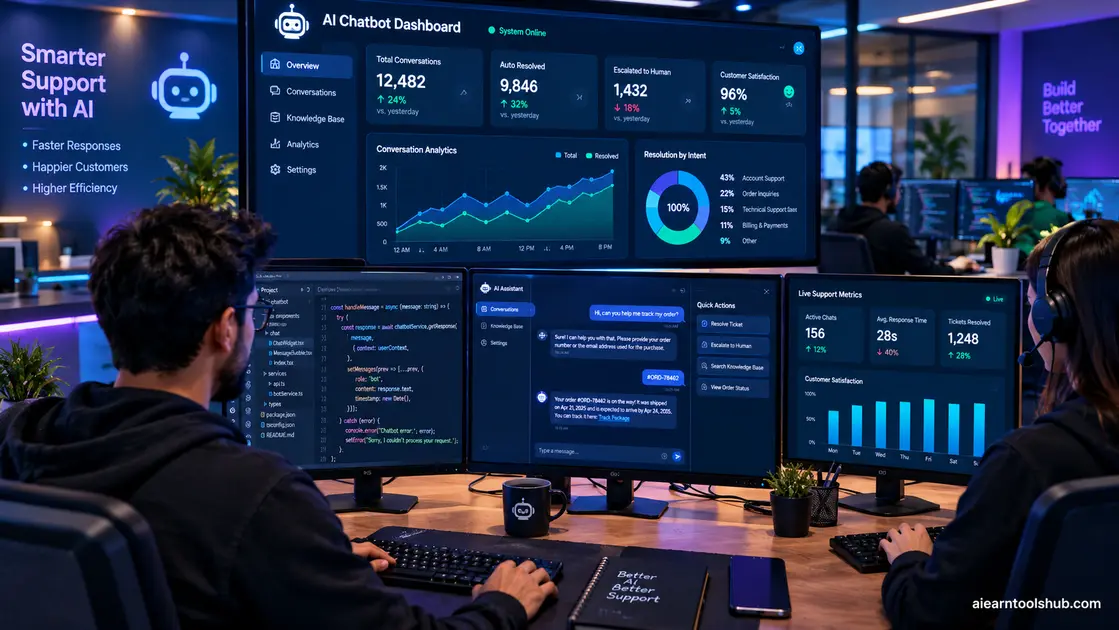
Key Challenges & Ethical Considerations
While exploring what is an AI chatbot reveals, enormous efficiency gains, organizations must navigate operational and ethical risks when deploying these systems:
1. Hallucinations & Incorrect Information
Because language models calculate token probabilities rather than strict database rules, an ungrounded chatbot can present false statements confidently. Implementing Retrieval-Augmented Generation (RAG) and human oversight mitigates this risk.
2. Data Privacy & Regulatory Compliance
AI chatbots frequently handle sensitive customer data. Enterprise systems must comply with international privacy regulations like GDPR, CCPA, and HIPAA, ensuring user conversation logs are encrypted and protected from public training pipelines.
3. Preserving Authentic Human Touch
While chatbots excel at handling routine queries, complex or emotionally sensitive issues still require human empathy. Designing seamless handoff triggers from chatbot to human support agents remains a critical best practice.
The Future of AI Chatbots: What Comes Next?
As conversational technology continues to advance, the answer to what is an AI chatbot is expanding toward **Autonomous AI Agents**. Future conversational interfaces will not merely answer questions in a chat box; they will operate across background systems to reason, plan, execute complex multi-step goals, and coordinate with other AI models independently.
Mastering conversational AI tools today equips organizations with the infrastructure required to thrive in a fully automated digital economy.
Frequently Asked Questions (People Also Ask)
What is an AI chatbot in simple terms?
When asking what is an AI chatbot, it refers to a software program powered by natural language processing and machine learning that can simulate human-like conversations through text or speech, answering queries dynamically without relying on rigid decision trees.
What is the primary difference between a rule-based chatbot and an AI chatbot?
Rule-based chatbots follow fixed, pre-programmed decision trees and can only answer explicit keyword commands. An AI chatbot uses natural language understanding and generative AI models to comprehend context, intent, and complex conversational nuanced prompts.
What are the most popular examples of AI chatbots today?
Popular general-purpose AI chatbots include ChatGPT, Google Gemini, Anthropic Claude, and Microsoft Copilot. For business customer service, leading tools include Intercom Fin, Tidio, and Drift.
Can an AI chatbot integrate with existing business tools?
Yes. Modern AI chatbots integrate seamlessly with enterprise platforms like HubSpot, Salesforce, Shopify, Zendesk, and WhatsApp to retrieve real-time account data, automate order tracking, and sync CRM leads.
Are AI chatbots safe for enterprise customer data privacy?
Enterprise-grade AI chatbots comply with strict data security standards like SOC 2, GDPR, and HIPAA. However, businesses must configure proper data privacy controls to ensure non-public corporate info is protected.