What is an AI Chatbot? 7 Mind-Blowing Ways It Works & 2026 Guide
Last checked: October 2026
Key Takeaways
- What is an AI chatbot? It is software that uses natural language processing and machine learning to hold human-like conversations by text or voice, instead of following fixed scripts.
- AI chatbots understand intent and keep context across messages, while rule-based bots only follow pre-written decision trees.
- They work by splitting your message into tokens, mapping its meaning, checking trusted sources where available, and then generating a reply.
- Businesses use them for 24/7 support, lead capture and routine tasks, but they can still give wrong answers and need human oversight.
Digital communication has undergone a monumental shift in recent years. When exploring what is an AI chatbot, we are looking at one of the most widely adopted applications of modern conversational artificial intelligence. From virtual support agents on e-commerce storefronts to generative language models assisting programmers, conversational software has evolved from simple scripted bots into intelligent systems capable of natural, human-like dialogue.
Understanding what is an AI chatbot and how it integrates into commercial workflows is crucial for business leaders, customer support executives, and digital marketers alike. To stay updated on cutting-edge software reviews and digital transformation insights, check out our latest guides on AI Earn Tools Hub. To explore how conversational interfaces are modeled at the infrastructure level, researchers often refer to authoritative technical documentation like IBM’s Guide to Conversational AI Chatbots.
This comprehensive 2026 guide breaks down the underlying technology, core architectural frameworks, business benefits, key industry applications, and future trends that answer the fundamental question: what is an AI chatbot and how is it reshaping global digital interactions?
What is an AI Chatbot? (Core Definition & Evolution)
Simple answer: What is an AI chatbot in plain English? It is a computer program you can chat with in normal words. It understands your question and replies like a helpful person, instead of making you pick from fixed menu options.
To provide an exact technical definition when asking what is an AI chatbot, an AI chatbot is a software application designed to simulate human conversation through natural language processing (NLP), natural language understanding (NLU), and machine learning (ML) algorithms. Unlike early conversational interfaces that relied strictly on pre-defined keyword scripts, modern AI chatbots analyze user intent, maintain context across multi-turn exchanges, and synthesize original answers dynamically.
The evolution of conversational interfaces spans several distinct technological phases:
- First-Generation (Rule-Based Bots): Built on fixed, branching decision trees (e.g., “Press 1 for Sales, Press 2 for Support”). They fail completely when a user inputs a query outside their pre-coded script.
- Second-Generation (Intent-Based NLU Bots): Utilized pattern matching to recognize predefined intents and entities. While more flexible, they still relied on rigid template responses.
- Third-Generation (Generative AI Chatbots): Powered by Large Language Models (LLMs) and Transformer neural network architectures. These systems comprehend subtle linguistic nuances, draft original contextual responses on the fly, and execute complex multi-step tasks across external APIs.
AI Chatbot vs. Traditional Rule-Based Chatbot: Key Differences
In short: The practical difference behind what is an AI chatbot is flexibility. A rule-based bot follows a fixed script and can only answer set keywords or menu choices. An AI chatbot understands meaning, keeps context and writes a fresh reply, so it handles rephrased questions far better.
To thoroughly understand what is an AI chatbot, it helps to contrast modern conversational AI systems with legacy rule-based software. The differences lie in how each framework handles unstructured human language.
Traditional rule-based chatbots operate like interactive flowcharts. If a user types “My order hasn’t arrived yet,” a rule-based system looks for explicit matching keywords like “order” or “arrived” to trigger a generic template response. However, if the user asks, “Where is my package? It was supposed to be here yesterday,” a rule-based system often breaks down, resulting in frustrating “I didn’t understand that” loops.
In contrast, when analyzing what is an AI chatbot, we see a framework built on deep semantic understanding. Generative AI chatbots parse the context, sentiment, and underlying intent of the user’s sentence regardless of phrasing. They can pull live tracking information from an integrated inventory system and formulate a clear, personalized update in real-time.
| Feature / Capability | AI Chatbot (Conversational AI) | Traditional Rule-Based Chatbot |
|---|---|---|
| Core Technology | Large Language Models, NLP, & Machine Learning | If/Then conditional logic & fixed decision trees |
| Query Handling | Understands unstructured, natural language & typos | Requires exact keyword matches or menu selections |
| Context Retention | Remembers previous dialogue turns across long conversations | Evaluates each input in isolation without memory |
| Learning Capability | Improves over time using interaction data & fine-tuning | Static; requires manual developer updates for new rules |
| Response Generation | Synthesizes fresh, contextual answers dynamically | Retrieves fixed, pre-written script templates |
7 Mind-Blowing Ways an AI Chatbot Works Under the Hood
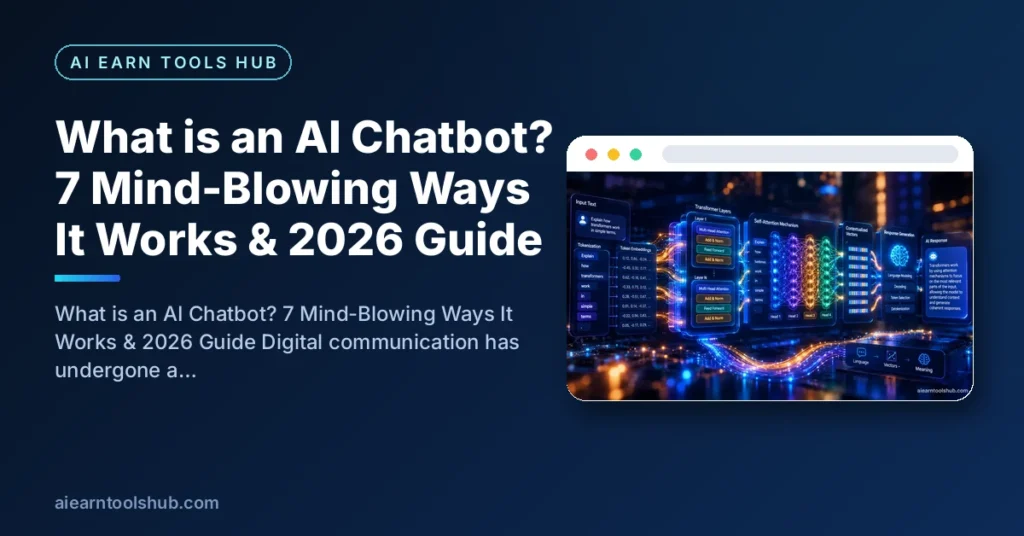
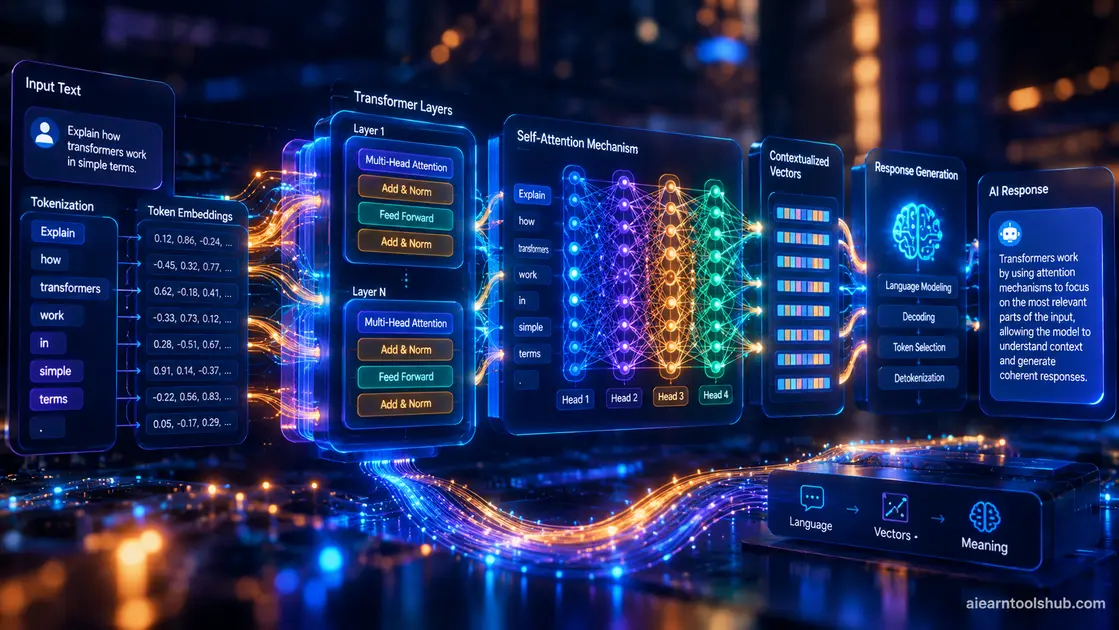
Examining what is an AI chatbot from an architectural perspective reveals a sophisticated pipeline of algorithms working together in milliseconds. Here are the 7 core technical stages behind modern conversational AI:
How a Chatbot Works, Step by Step, in Plain English
Here is what is an AI chatbot doing from the moment you press send, in five simple steps:
- You type or speak. The chatbot receives your message as text, or converts your voice to text first.
- It works out what you mean. It splits the message into tokens and identifies your intent and key details, such as a product name or order number.
- It checks what it knows. The model uses patterns learned in training and, in business bots, searches a trusted knowledge base for exact facts.
- It drafts a reply. The language model produces a clear, relevant response that fits the conversation so far.
- It acts or answers. If needed, it calls another tool or system, such as a calendar or online shop, and then replies to you.
1. Natural Language Understanding (NLU) & Tokenization
When a user sends a message, the system first breaks the raw text into smaller units called tokens (words, sub-words, or characters). The NLU engine strips out grammatical noise, identifies core linguistic entities (such as dates, product names, or order numbers), and determines the user’s primary intent.
2. Vector Embedding & Semantic Mapping
Tokens are transformed into high-dimensional numerical vectors. This mathematical representation allows the neural network to plot the query within a semantic vector space, evaluating how closely the user’s input relates to thousands of concepts learned during training.
3. Transformer Models & Self-Attention Mechanisms
Modern conversational engines utilize the Transformer neural network architecture. Through Self-Attention, the model weighs the relationships between every word in a sentence simultaneously rather than sequentially. This grants the system a human-like grasp of tone, sarcasm, and complex sentence structure.
4. Retrieval-Augmented Generation (RAG)
To ensure accuracy and eliminate factual errors, business-oriented AI chatbots use RAG technology. When a query is received, the system queries the company’s private knowledge base or CRM, retrieves relevant documents, and feeds that verified data directly into the generative model to synthesize a grounded answer.
5. Multi-Turn Context & Dialogue Management
A major breakthrough when defining what is an AI chatbot is its ability to maintain a conversational state. The dialogue manager tracks context across multiple exchanges, allowing users to ask follow-up questions using pronouns like “it” or “that” without re-explaining the topic.
6. API Integration & Function Calling
Advanced AI chatbots do not merely answer questions; they perform real-world actions. Through function calling, a chatbot can securely execute API requests—such as booking a flight, processing a credit card refund, or updating an account address—in real time.
7. Reinforcement Learning from Human Feedback (RLHF)
To keep responses safe, professional, and helpful, developers use RLHF. Human evaluators review and score chatbot outputs, creating a continuous feedback loop that refines the model’s tone and safety parameters over time.
What Are the Main Benefits of Using AI Chatbots?
The main benefits are faster replies, lower support costs and help that is available at any hour. A business that understands what is an AI chatbot can let it answer repeat questions instantly, while human staff handle complex or sensitive cases. The result is shorter waiting times for customers and more time for teams to do skilled work.
Understanding what is an AI chatbot value proposition explains why enterprises across retail, healthcare, finance, and software are rapidly deploying these conversational assistants:
- Instant 24/7/365 Customer Availability: Consumers expect rapid support. AI chatbots resolve common queries instantaneously at scale without wait times, even on holidays.
- Massive Reduction in Operational Costs: Automating up to 80% of routine tier-1 support inquiries significantly reduces help-desk staffing, training, and infrastructure expenses.
- Scalable Support Without Hiring Spikes: During seasonal promotional rushes or product launches, conversational AI systems effortlessly handle thousands of simultaneous, concurrent user chats.
- Higher Lead Conversion Rates: Proactive chatbots engage website visitors, answer product queries instantly, capture lead parameters, and book calendar meetings autonomously.
- Multilingual Customer Engagement: Advanced LLM models can fluently converse in over 95 global languages, eliminating translation barriers for international commerce.
What Are the Most Popular AI Chatbots in 2026?
The best-known examples are general assistants such as ChatGPT, Google Gemini and Anthropic Claude, plus business tools built for support and sales. Seeing what is an AI chatbot in these products is easy: each one takes a natural question and replies in context. The right choice depends on whether you need general help or a bot trained on your own company information.
When reviewing what is an AI chatbot in practice, conversational systems generally fall into two categories: general-purpose AI assistants and specialized enterprise business tools.
General-Purpose Conversational Assistants
- ChatGPT (OpenAI): The pioneer of modern generative conversational AI, widely used for consumer productivity, complex reasoning, code generation, and general content drafting.
- Google Gemini: Integrated deeply into the Google ecosystem, capable of processing multimodal inputs including raw text, images, audio, and source code natively.
- Anthropic Claude: Famous for its massive context window and strong focus on AI safety, popular among researchers and developers for processing long enterprise documents.
Specialized Business & Customer Support Chatbots
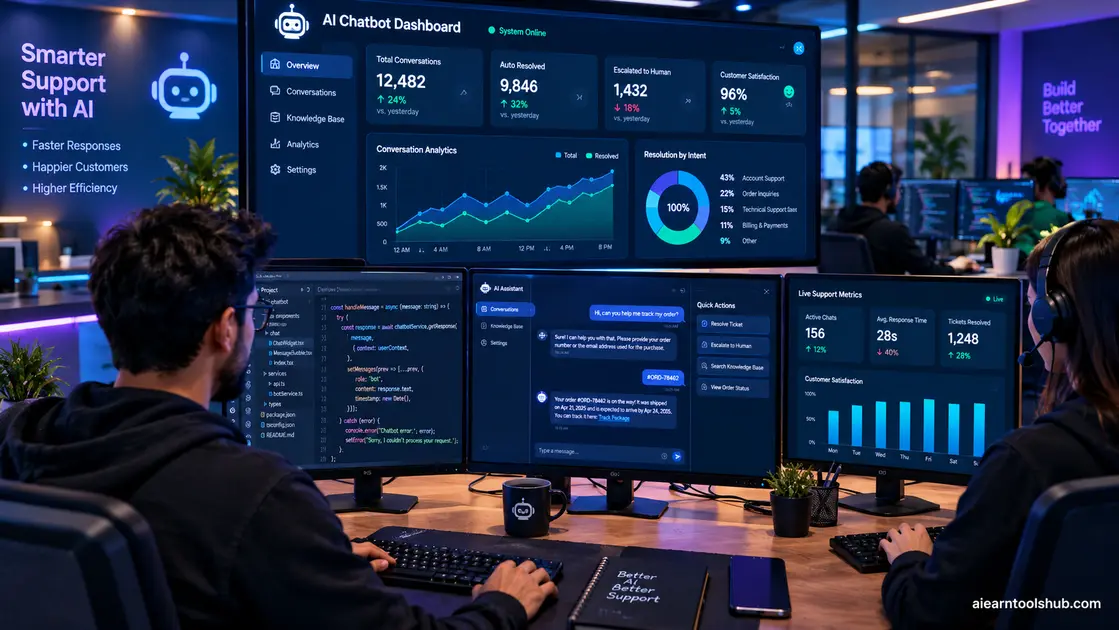
- Intercom Fin: An enterprise customer service bot powered by AI that resolves complex technical support tickets using internal corporate help-center documentation.
- Tidio (Lyro AI): Designed for e-commerce platforms like Shopify, automatically answering delivery status, shipping, and product availability queries in real-time.
- Drift: A conversational marketing bot built to qualify sales leads, schedule sales team meetings, and personalize account-based marketing flows dynamically.
What Are the Key Challenges and Ethical Risks of AI Chatbots?
The short answer is that chatbots can be wrong, careless with data, or frustrating when a person needs empathy. Knowing what is an AI chatbot can and cannot do helps you set clear limits, check important answers, and keep a human option visible at all times.
While exploring what is an AI chatbot reveals, enormous efficiency gains, organizations must navigate operational and ethical risks when deploying these systems:
1. Hallucinations & Incorrect Information
Because language models calculate token probabilities rather than strict database rules, an ungrounded AI chatbot can occasionally generate confident but factually incorrect statements (hallucinations). Organizations mitigate this through strict RAG grounding and continuous quality assurance audits.
2. Data Privacy & Regulatory Compliance
AI chatbots frequently handle sensitive customer data. Enterprise systems must comply with international privacy standards including GDPR, CCPA, and HIPAA, ensuring that confidential inputs are never used to train public foundational models.
3. Preserving Authentic Human Touch
While chatbots excel at handling routine queries, complex or emotionally sensitive issues still require direct access to a human agent. Businesses must ensure seamless escalation paths so customers never feel “trapped” with a virtual bot.
What AI Chatbots Still Cannot Do
An AI chatbot does not truly understand the world like a person, and it does not know when it is wrong. It can invent facts, miss sarcasm or cultural nuance, and struggle with unusual requests that fall outside its training or its knowledge base.
It also cannot take responsibility for a decision, guarantee that an answer is safe or legal, or replace human judgement in medical, financial or emergency situations. Treat its replies as a helpful first draft, verify anything important, and ask a qualified human when the stakes are high.
The Future of AI Chatbots: What Comes Next?
As conversational technology continues to advance, the answer to what is an AI chatbot is expanding toward **Autonomous AI Agents**. Future conversational interfaces will not merely answer questions in a chat box; they will operate across background systems to reason, plan, execute complex multi-step goals, and coordinate with other AI models independently.
Mastering conversational AI tools today equips organizations with the infrastructure required to thrive in a fully automated digital economy.
Frequently Asked Questions (People Also Ask)
What is an AI chatbot in simple terms?
When asking what is an AI chatbot, it refers to a software program powered by natural language processing and machine learning that can simulate human-like conversations through text or speech, answering queries dynamically without relying on rigid decision trees.
What is the primary difference between a rule-based chatbot and an AI chatbot?
Rule-based chatbots follow fixed, pre-programmed decision trees and can only answer explicit keyword questions. AI chatbots leverage machine learning to understand context and generate original, dynamic responses on the fly.
What are the most popular examples of AI chatbots today?
Popular general-purpose AI chatbots include ChatGPT, Google Gemini, Anthropic Claude, and Microsoft Copilot. Specialized enterprise tools include Intercom Fin, Tidio, and Drift.
Can an AI chatbot integrate with existing business tools?
Yes. Modern AI chatbots integrate seamlessly with enterprise platforms like HubSpot, Salesforce, Shopify, and Slack via APIs, allowing them to fetch live customer data, order details, and calendar appointments.
Are AI chatbots safe for enterprise customer data privacy?
Enterprise-grade AI chatbots comply with strict data security standards like SOC 2, GDPR, and HIPAA. They encrypt sensitive user information and ensure personal conversation data is never used to publicly train foundational AI models.
Can an AI chatbot replace human customer support?
No. An AI chatbot works best for common, repeat questions and simple tasks. Complex complaints, sensitive personal issues and decisions with serious consequences still need a human, so good services always offer an easy handoff to a real person.