AI Agents vs Chatbots: Key Differences & 2026 Comparison Guide
Artificial intelligence software has crossed a major evolutionary threshold. For years, conversational interfaces answered user questions using pre-programmed scripts or language models. Today, the market shift toward autonomous digital workforces makes understanding ai agents vs chatbots a critical priority for business leaders, software engineers, and digital operational teams.
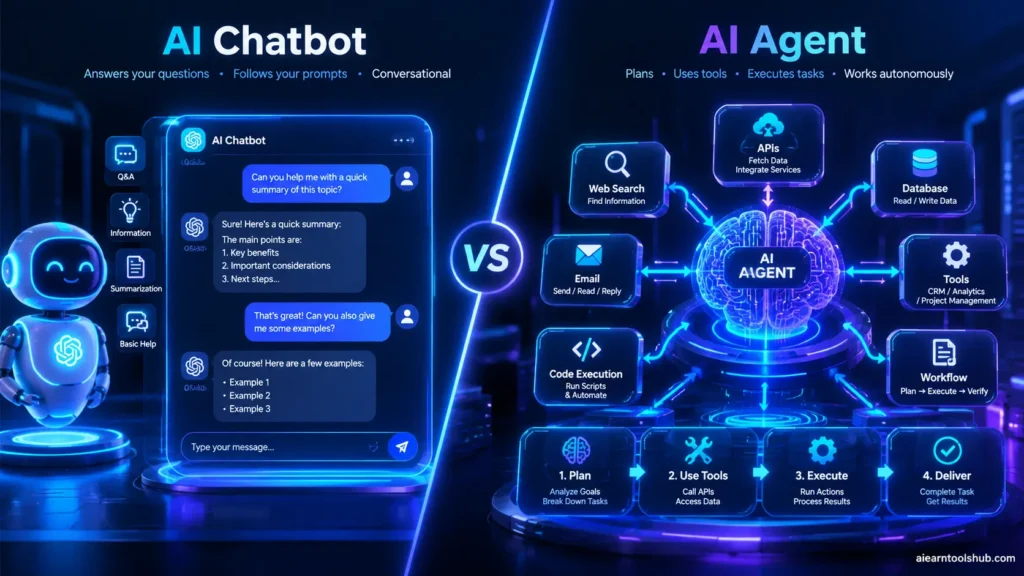
While standard chatbots converse, advise, and retrieve information, autonomous AI agents reason across multi-step objectives, execute API calls, modify system databases, and resolve complete end-to-end workflows independently. To explore actionable guides on implementing artificial intelligence solutions for business growth, visit AI Earn Tools Hub. For technical research regarding autonomous decision-making and multi-agent coordination frameworks, developers frequently refer to IBM’s Enterprise Architecture Guide for AI Agents.
In this detailed 2026 comparison guide, we break down core architectural differences, operational mechanics, real-world enterprise use cases, and strategic evaluation frameworks in the debate surrounding ai agents vs chatbots.
Defining the Core Technologies: Chatbots vs. Autonomous Agents
To accurately compare ai agents vs chatbots, one must look past marketing terms and examine the underlying software architecture. Both systems leverage artificial intelligence, but their fundamental execution loops differ completely.
What is a Chatbot?
A chatbot is a conversational interface built to process text or voice inputs and deliver natural language responses. Chatbots range from basic rule-based trees (if/then logic) to sophisticated Large Language Model (LLM) interfaces that utilize Retrieval-Augmented Generation (RAG).
The defining characteristic of a chatbot is that it is read-only and conversational. It provides answers, summarizes documents, and suggests next steps, but relies entirely on human users to execute tasks in external systems.
What is an AI Agent?
An AI agent is an autonomous goal-driven software system that combines reasoning capabilities with external tool access, memory systems, and planning frameworks. Rather than merely predicting text, an agent decomposes complex objectives into sub-tasks, calls external APIs, inspects data results, adjusts its strategy, and completes workflows.
As industry experts state in the ai agents vs chatbots analysis: “A chatbot responds. An AI agent acts.”
5 Core Dimensions Separating AI Agents from Chatbots
To systematically evaluate ai agents vs chatbots, enterprise architects focus on five core dimensions:
1. Perception vs. Pattern Matching
Traditional chatbots evaluate incoming prompts using keyword matching or vector embedding retrieval. If the user query closely aligns with existing documentation, the response is accurate. AI agents parse rich context across multiple integrated platforms (e.g., verifying customer account tier, current order status, recent software updates, and billing logs simultaneously) to form an accurate picture before acting.
2. Conversation vs. Execution (Read vs. Write)
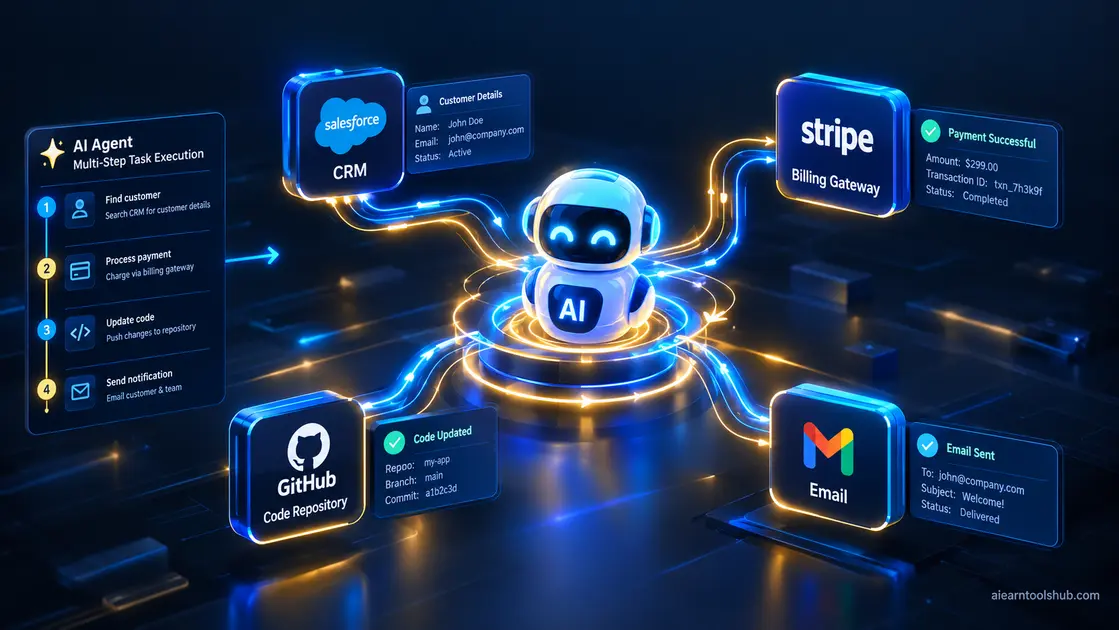
When analyzing ai agents vs chatbots, tool access represents the primary line of demarcation. A support chatbot says, “You can request a refund in your settings menu.” An AI agent verifies account policy, initiates the refund via payment gateway APIs, updates the CRM record, and issues a confirmation receipt.
3. Static Scripts vs. Dynamic Planning
Chatbots follow linear dialogue flows or single-turn response loops. When encountering an unanticipated user state, standard chatbots fail or trigger a human handoff. In contrast, autonomous agents feature dynamic planning loops that adapt when initial API calls fail or return unexpected parameters.
4. Episodic Amnesia vs. Persistent Context Memory
While standard chat sessions forget historical context once closed, enterprise AI agent platforms maintain persistent long-term memory structures. They reference past interactions, user preferences, and enterprise knowledge graphs across months of operation.
5. Passive Guidance vs. Proactive Monitoring
A chatbot waits passively for user inputs. An AI agent can run continuously in background environments—monitoring system performance logs, detecting API rate failures, or scanning leads—and take corrective action without human initiation.
Watch & Learn
In-Depth Comparison: AI Agents vs Chatbots
The structured breakdown below details how performance characteristics, integration levels, and operational metrics compare across ai agents vs chatbots:
| Feature / Dimension | Traditional / LLM Chatbot | Autonomous AI Agent |
|---|---|---|
| Primary Purpose | Information delivery & conversational support | Autonomous multi-step task execution |
| Operational Role | Conversational Advisor (Read-Only) | Digital Employee / Workforce (Read + Write) |
| System Integrations | Limited (Static Knowledge Bases, RAG) | Deep (APIs, Databases, CRMs, ERPs, Web Browsers) |
| Reasoning Capability | Pattern matching & single-prompt response | Decomposition, tool choice, & dynamic replanning |
| Response Latency | Near instantaneous (milliseconds) | Iterative processing (1–10 seconds per task loop) |
| Resolution Rate | 10% – 20% complete issue resolution | 40% – 60%+ autonomous end-to-end resolution |
| Maintenance Cost | Grows as intent taxonomies expand | Decreases over time as feedback memory refines |
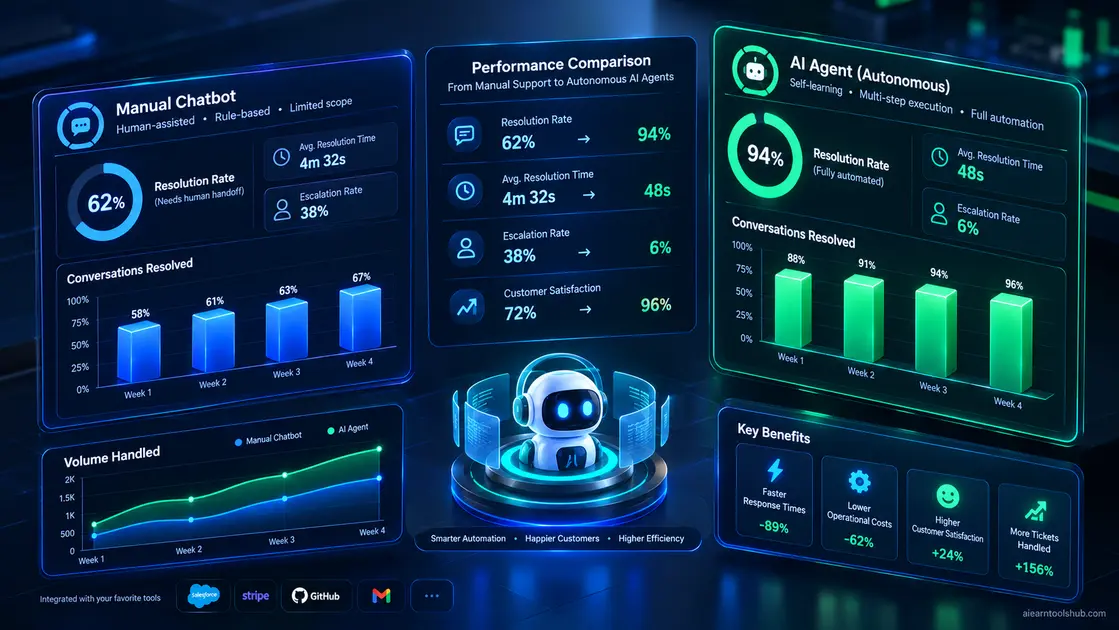
Real-World Enterprise Use Cases
To see how the contrast between ai agents vs chatbots plays out in real business operations, consider these side-by-side scenario examples:
1. Customer Support & Order Management
- Chatbot Scenario: A customer asks, “Where is my package?” The chatbot retrieves tracking policy links or displays static shipping status.
- AI Agent Scenario: An agent checks shipping APIs, detects a customs delay, issues a partial shipping refund via Stripe, updates Zendesk notes, and emails an updated delivery window to the customer.
2. Software Engineering & IT Operations
- Chatbot Scenario: A developer pastes an error code into a chatbot to receive suggested code snippets or troubleshooting steps.
- AI Agent Scenario: An AI coding agent reads repository code, identifies failing integration tests, rewrites buggy modules, runs test builds, and opens a GitHub Pull Request automatically.
3. Lead Generation & Sales Operations
- Chatbot Scenario: Captures contact information via a web form script and delivers standard pricing PDF downloads.
- AI Agent Scenario: Researches corporate domain info, scores incoming prospects against ICP rules, drafts personalized outreach emails, checks sales rep availability, and books calendar invites.
How to Choose: When to Deploy Chatbots vs. AI Agents
Deploying the right system requires matching your team’s budget, risk tolerance, and operational complexity.
Select a Chatbot When:
- Your primary goal is answering simple, high-volume FAQs.
- No direct read/write API actions are required in external applications.
- Deployment budgets and timelines require rapid implementation.
- Strict regulatory compliance demands static, pre-approved text templates.
Select an AI Agent When:
- Tasks require multi-step planning, tool usage, and database writes.
- Workflows span across disconnected enterprise tools (Salesforce, Jira, Slack, and ERP).
- You want to eliminate manual administrative work and lower operational costs.
- You need proactive monitoring and automated error recovery.
Governance & Human-in-the-Loop (HITL) Safeguards
While evaluating ai agents vs chatbots, organizational leaders must account for governance and risk management. Because chatbots only generate text, their maximum risk involves incorrect answers or hallucinations. Because AI agents possess write permissions across connected software, unmonitored agent errors can alter production databases or trigger erroneous payments.
Best practices for enterprise agent deployment mandate Human-in-the-Loop (HITL) governance boundaries. Under HITL framework design, agents autonomously analyze context and construct execution plans but require explicit human approval before executing irreversible actions like sending bulk emails, publishing production code, or processing financial transactions.
Frequently Asked Questions (People Also Ask)
What is the main difference between an AI agent and a chatbot?
The primary difference lies in action and autonomy. A chatbot answers questions using text or retrieved documents, requiring a human to execute tasks. An AI agent is given a goal and independently plans, executes multi-step workflows, and interacts with real systems through APIs.
Is ChatGPT considered an AI agent or a chatbot?
By default, ChatGPT operates primarily as an AI chatbot that answers conversational prompts. However, when equipped with custom actions, code execution environments, memory systems, and API integrations, it functions as an AI assistant or agent.
Which option does my business need: an AI agent or a chatbot?
Select a chatbot if you need low-cost, instant responses for high-volume customer FAQs or guided information retrieval. Choose an AI agent if your tasks involve multi-step execution, database updates, software tool integrations, or automated workflow completion.
Are AI agents more expensive to build and deploy than chatbots?
Yes, AI agents generally cost more initially because they require API integration setup, custom tool connectors, security guardrails, and multiple LLM reasoning calls. However, they yield higher long-term ROI by replacing manual repetitive labor.
Can an AI agent work autonomously without human supervision?
While AI agents can complete tasks autonomously, enterprise implementations typically incorporate Human-in-the-Loop (HITL) checkpoints. This ensures human review before executing high-risk, irreversible operations like financial refunds or database deletions.