
ChatGPT for SEO: A Practical Workflow That Actually Ranks (2026)
Last checked: November 2026
Search engine optimization has undergone a seismic transformation. Modern search engines no longer rely strictly on backlink counting and exact keyword density matching. Today, using ChatGPT for SEO is a vital strategy for digital marketers, content creators, and site owners striving to maintain organic visibility.
The rise of Generative Engine Optimization (GEO), Google AI Overviews, and conversational answer engines means that search engines prioritize structured clarity, extractable facts, and deep topical authority. Learning ChatGPT for SEO enables you to automate tedious research, discover hidden content gaps, structure machine-readable schema, and produce human-centric content that search engine crawlers and answer engines cite. For more insights into monetization and digital workflows, explore AI Earn Tools Hub. To review foundational search policies directly from search providers, read Google’s Official Guidance on AI-Generated Content.
In this comprehensive guide, we examine step-by-step techniques, essential prompt workflows, and practical applications showing exactly how to use ChatGPT for SEO effectively while staying compliant with Google AdSense and quality standards.
Key Takeaways
- ChatGPT for SEO works best as a workflow, not a shortcut: research, brief, draft, optimize, publish and measure.
- Start each section with a direct answer, then add steps, examples and evidence a reader can act on.
- Keep humans in charge of facts, links, search intent and final wording — AI output is a draft, not a source.
- Structure pages for people, search engines and answer engines alike, with clear headings, lists, tables and FAQ schema.
- Most AI content fails for three fixable reasons — sameness, missing E-E-A-T signals and weak on-page SEO — and the sections below show how to fix each one before you publish.
Why Is AI Now Essential for Your SEO Strategy?
AI is now essential because search results are shaped by machine-learning systems that reward clear, structured and current pages. Learning ChatGPT for SEO helps you match that pace in research and updating, without handing over judgment.
Search engines process billions of queries daily using sophisticated machine learning algorithms. To rank effectively, your optimization workflows must match the speed and depth of these modern systems.
When marketers research how to use ai for seo, they often assume it simply means hitting “generate” on blog posts. However, using artificial intelligence for search optimization spans much broader operational areas:
- Intent Decoding: Analyzing thousands of search engine results pages (SERPs) to pinpoint user search intent instantly.
- Semantic Keyword Clustering: Organizing keywords into topical hubs rather than isolated keywords.
- Generative Search Visibility (GEO): Optimizing content so AI answer engines summarize and link to your website as a primary reference.
- Technical Automation: Generating JSON-LD schema markups, audit logs, and optimized meta elements automatically.
7 Actionable Ways to Use ChatGPT for SEO
The practical answer to ChatGPT for SEO is to use ChatGPT at every stage of a single page, one stage at a time: research, brief, human-edited draft, optimize, publish and measure. The seven strategies below follow that order.
Below are 7 proven strategies demonstrating ChatGPT for SEO across your entire publishing pipeline.
1. Advanced Semantic Keyword Research & Clustering
Instead of manually sorting keywords into spreadsheets, large language models can analyze search queries and group them into semantic topical clusters. This approach establishes strong topical authority.
Prompt Example for Keyword Clustering:
Act as a senior SEO strategist. I will provide a list of 50 raw keywords related to "digital photography". Group these keywords into 5 primary pillar categories based on user search intent (Informational, Commercial, Transactional). For each cluster, recommend an optimized H1 headline and URL slug.2. Generating AI-Friendly Content Outlines (Information Gain)
Search algorithms penalize repetitive, shallow content that duplicates existing search results. Learning how to use ai for seo involves prompting AI to identify missing subtopics—a concept known as information gain.
Instruct the AI to evaluate top-ranking pages and identify unaddressed user questions, unique comparison criteria, or recent industry developments to ensure your page offers distinct value.

3. Optimizing for Generative Engine Optimization (GEO) & AI Overviews
Generative Engine Optimization (GEO) focuses on getting your content cited inside generative answer cards (like Google AI Overviews or Perplexity). AI engines favor content designed for simple extraction:
- Direct Lead In: Answer the target query clearly within the first 40–60 words.
- Structured Tables: Use clean HTML comparison tables for specifications and statistics.
- Bulleted Summaries: Present key takeaways in clean, scannable list formats.
- Verifiable Citations: Include precise data points and expert quotes that validate credibility.
4. Automating Structured Schema Markup (JSON-LD)
Structured data helps search engine bots read and understand page context effortlessly. You can use AI models to construct valid Schema.org code instantly.
Example Schema Generation Prompt:
Generate a valid Schema.org Article and FAQPage JSON-LD script for a blog post titled "ChatGPT for SEO: A Practical Workflow". Include 3 Q&A pairs with concise, factual responses. Do not include extra commentary, output raw script tags only.5. Crafting High-CTR Title Tags & Meta Descriptions
Click-Through Rate (CTR) remains a vital ranking factor. You can leverage AI to generate high-converting title tags and meta descriptions that incorporate focus keywords while using natural phrasing to drive clicks.
Try this prompt to generate options you can actually choose from:
Write 10 title tags under 60 characters and 10 meta descriptions under 155 characters for a page targeting "chatgpt for seo". Each one must read like a human wrote it — no clickbait, no superlatives, no keyword stuffing. Rank them by likely click-through rate and say why the top one wins.Pick the winner, then edit it in your own words before you publish it.
6. Internal Linking Analysis & Content Audits
Maintaining a clean internal linking architecture distributes page authority across your domain. Feed your sitemap URLs into AI analysis tools to locate contextually relevant internal link opportunities and identify orphaned content pages.
7. Refreshing & Updating Legacy Content
Search engines favor fresh, accurate information. Instead of constantly writing new pages from scratch, apply AI workflows to update outdated stats, replace broken code, expand thin sections, and realign older articles with current search intent.
How Do You Use ChatGPT for SEO, Step by Step?
Use this six-step workflow when you apply ChatGPT for SEO to a new or updated page. It keeps AI on the repetitive work and a person on the decisions.
- Research keywords. Export real queries from your keyword and Search Console data, then ask AI to group them into intent-based clusters and flag questions you have not answered.
- Write a brief. Turn the chosen cluster into a brief with the search intent, the direct answer, the headings and the evidence the page must include.
- Draft with ChatGPT. Draft one section at a time against the brief, adding your own examples and experience, rather than generating a whole article in one pass.
- Optimize the draft. Check headings, internal links, image alt text, titles and schema, and make sure the focus keyword reads naturally wherever it appears.
- Publish cleanly. Preview the page, test that table of contents links, images and video work, and confirm the page answers its main question early.
- Measure and refresh. Watch impressions, clicks and rankings after publishing, then update the sections that underperform instead of rewriting the whole page.
ChatGPT for SEO Prompts That Actually Work
The workflow above works with any AI tool, but most readers will run it in ChatGPT. These five prompts are the ones to copy first — each one maps to a stage of the workflow, and each one keeps a person in charge of the final call.
1. Keyword clustering. Paste real queries from Search Console or a keyword tool — never invent the list.
Act as a senior SEO strategist. Here is a list of 50 raw keywords about [topic]. Group them into 5 pillar clusters by search intent (informational, commercial, transactional). For each cluster, suggest one H1 and one URL slug, and flag any keyword that fits none of the clusters.2. Content outline with information gain. Use this before you write a single paragraph.
Here are the H2s of the top 3 ranking pages for [keyword]. List the subtopics they all cover, then list the questions and angles none of them answer. Turn the gaps into an outline for a stronger page.3. Titles and meta descriptions. Generate options, then choose like an editor — never publish the first output untouched.
Write 10 title tags under 60 characters and 10 meta descriptions under 155 characters for a page targeting [keyword]. Each one must read like a human wrote it — no clickbait, no superlatives, no keyword stuffing. Rank them by likely click-through rate and say why the top one wins.4. Internal linking. Give ChatGPT your real sitemap, not a description of it.
Here is my sitemap: [paste URLs]. For my new page about [keyword], suggest 5 internal links from existing pages, with the exact anchor text and one sentence explaining why each link helps the reader.5. Content refresh. Ask for a change list, not a rewrite — the rewrite is your job.
Here is my old article about [topic]: [paste text]. List every claim that is outdated, every section thinner than the current top-ranking pages, and three specific updates that would make this page competitive again. Do not rewrite the article — list the changes only.Run one prompt, check the output against real search results, then move on. The prompts save time; they do not replace the checks in the workflow above.
How Does AI-Enhanced SEO Compare With Traditional SEO?
AI-enhanced SEO does not replace traditional SEO — it speeds it up. That is the real difference in how to use ai for seo today: the foundations stay the same, while AI changes how quickly you can research topics, structure pages and spot what to update next.

To understand why learning how to use ai for seo provides a major competitive edge, examine the core differences between traditional manual workflows and modern AI-driven frameworks:
| SEO Component | Traditional Manual SEO Framework | Modern AI-Enhanced SEO Strategy |
|---|---|---|
| Keyword Focus | Single target keywords & exact phrase match | Semantic keyword clusters & natural language entities |
| Content Creation | Manual writing with slow turnarounds | Hybrid workflow: AI draft + human expert polish |
| Search Targets | Standard Google 10-blue-links SERP | Google AI Overviews, Perplexity, & traditional SERPs |
| Schema & Tech | Manual coding or complex WordPress plugins | Automated AI JSON-LD schema generation |
| Content Refreshing | Infrequent quarterly manual edits | Continuous AI-assisted audit and gap updates |
What Are the Best Practices for Google E-E-A-T Compliance?
When using ChatGPT for SEO, you protect E-E-A-T by keeping a person accountable for everything the page claims. AI can organize research and suggest wording, but experience, verification and honest sourcing must come from the author or editor.
When applying how to use ai for seo, maintaining Google’s E-E-A-T (Experience, Expertise, Authoritativeness, and Trustworthiness) standards is essential for long-term organic success. Follow these guidelines:
- Incorporate Real Lived Experience: Add original personal anecdotes, case studies, screenshots, and custom data points that AI cannot replicate.
- Fact-Check Every Claim: Large language models can hallucinate facts or statistics. Always verify stats and link directly to authoritative primary sources.
- Maintain Human Editorial Control: Treat AI output as a draft co-pilot. Edit for natural brand voice, correct tone, and readable prose.
- Display Clear Author Credentials: Feature visible author bios detailing real-world expertise and professional experience.
What Should You Not Trust AI With in SEO?
AI is confident even when it is wrong, so never publish its output on trust alone when you use ChatGPT for SEO. Three areas always need an independent check.
- Facts and figures. Models can invent dates, product details and statistics, or repeat information that is out of date. Verify every claim against the original source before it goes live.
- Links. AI can suggest pages that do not exist and anchor text that misleads. Open every link it proposes, confirm the destination supports the sentence, and only then keep it.
- Search intent. A model can guess what searchers want, but only real results pages and your own performance data show what a query actually expects. Check both before you brief a page.
What Should a Human Check Before Publishing AI-Assisted Content?
Run this human-review checklist before you publish, however the draft was produced. It catches errors that automated tools and confident AI wording both miss.
- Does the page answer its main question in the first section, in plain language?
- Is every fact, date and quotation checked against a primary source you opened yourself?
- Does every internal and external link work, and does the destination match its anchor text?
- Do headings follow a logical order, and does the table of contents link to each one?
- Do all images load, with alt text that describes the image rather than repeating the keyword?
- Would you be comfortable defending this page, line by line, to a reader who knows the topic?
Why Does Most AI Content Fail to Rank on Google?
Most AI content fails to rank for three repeatable reasons: it sounds like every other page on the topic, it shows no real experience or expertise, and it is published without proper on-page optimization. Fixing those three problems first is the foundation of how to rank on Google with AI content — everything else in this guide builds on it.
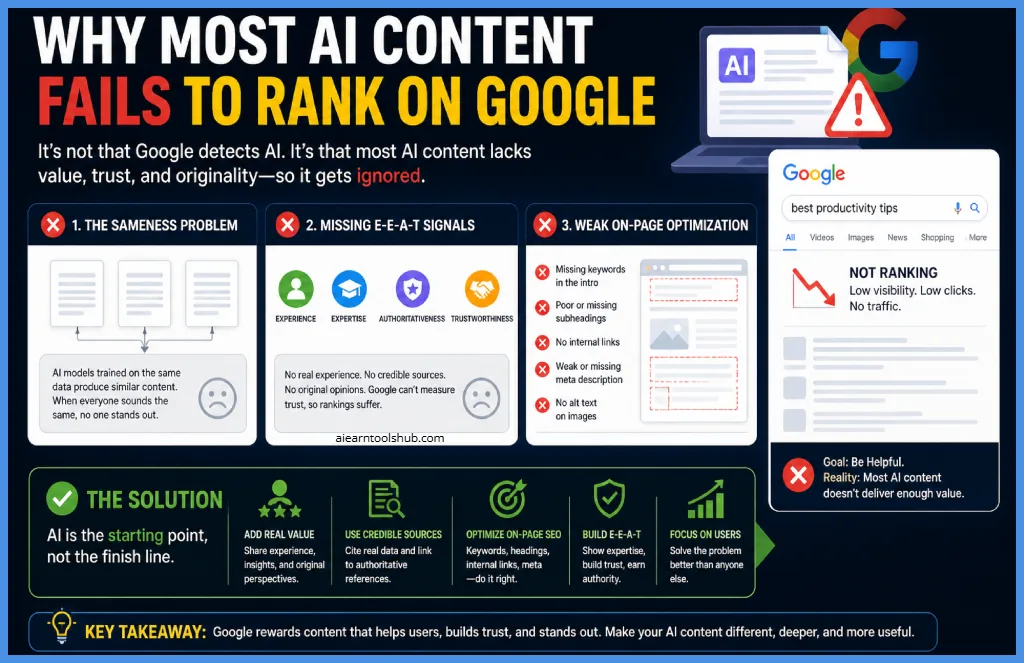
Before getting into what works, it is worth being honest about why most AI content underperforms in search. It almost always comes down to three fixable problems.
The Sameness Problem
AI models trained on the same internet produce similar outputs. When ten websites publish AI-generated articles on the same topic using the same tools, they all sound like each other. Google has no reason to rank any of them highly because none of them add anything unique.
This is the single biggest reason AI content fails. It is not that Google detects AI. It is that the content is generic — and generic content has never ranked well, regardless of who or what wrote it.
Missing E-E-A-T Signals
Google’s E-E-A-T framework—Experience, Expertise, Authoritativeness, Trustworthiness — rewards content that demonstrates real knowledge. Raw AI output has none of these signals. It has no personal experience, no original research, no author identity, and no reason for a reader to trust it over a competitor.
Google cannot always tell how content was written. But it can measure whether content earns clicks, keeps readers engaged, and attracts links. Raw AI content underperforms on all three — and that is what the algorithm actually measures.
Weak On-Page Optimization
Most people publish AI drafts without proper SEO optimization. The focus keyword is missing from the title. Internal linking is random or nonexistent. Heading structure is broken or absent. Alt text is empty. These are fixable problems—but most people never fix them before publishing.
What Do Google’s Helpful Content Guidelines Actually Say?
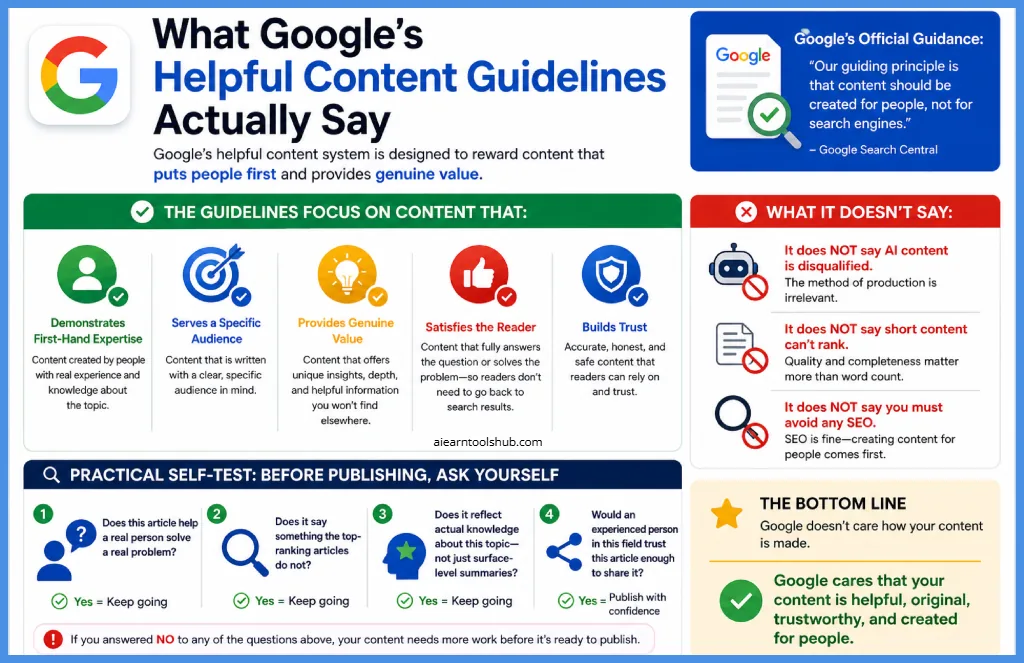
In one line: Google rewards helpful, original, people-first content, however it was produced — and that is why how to rank on Google with AI content is really a quality question, not a tools question.
Google’s helpful content system is designed to reward pages that provide genuine value to real readers — and to demote pages created primarily to manipulate search rankings. It does not contain a single line that penalizes content for being produced with AI assistance.
What it does not say is that AI content is disqualified. The method of production is irrelevant. The output is what gets judged. A human-written article that is thin, generic, and unhelpful will underperform an AI-assisted article that is thorough, accurate, and genuinely useful — and Google’s guidelines have been consistent on this point since the helpful content system launched.
The practical self-test before publishing any AI article:
- Does this article help a real person solve a real problem?
- Does it say something the top-ranking articles do not?
- Does it reflect actual knowledge about this topic — not just surface-level summaries?
- Would an experienced person in this field trust this article enough to share it?
If you can answer yes to all four, the article is ready to publish. If not, it needs more editing before it goes anywhere near the publish button.
What Does a Publish-Ready Workflow for How to Rank on Google with AI Content Look Like?
A publish-ready workflow turns a raw AI draft into an article Google can trust, in five stages: research, draft, human edit, fact-check, and on-page checks. Run the same five stages every time and how to rank on Google with AI content stops being guesswork — it becomes a repeatable production system.
Stage 1: Research Before You Write
Start with the search results, not the prompt. Read the top-ranking pages for your keyword, note the questions they answer and the gaps they leave, and choose one clear search intent to satisfy. Good research is where how to rank on Google with AI content really begins, because a draft built on a weak brief stays weak no matter how carefully you edit it.
Stage 2: Draft With AI, Deliberately
Give the AI a detailed brief: the keyword, the reader, the structure, and the points it must cover. Generate one section at a time instead of asking for a whole article at once, and keep your own notes beside the draft. A careful draft is the raw material of how to rank on Google with AI content — the stages after it decide whether it deserves to rank.
Stage 3: Edit Like a Human Editor
Rewrite generic lines in your own voice, cut repetition, and add the examples, opinions, and observations only a person can supply. Read every paragraph aloud: if it sounds like any website could have published it, it is not finished. This human edit is the stage that separates publish-ready pages in how to rank on Google with AI content from raw output that goes nowhere.
Stage 4: Fact-Check Every Claim
Check every date, name, statistic, and tool claim against a primary source, and delete anything you cannot verify. AI models state wrong facts confidently, and one invented claim can undermine the trust of the whole page. Fact-checking is a non-negotiable part of how to rank on Google with AI content, because Google rewards content readers can rely on.
Stage 5: Run the On-Page Checks
Finish with the mechanics: the focus keyword in the title, introduction, and subheadings; descriptive alt text on every image; internal links to related guides; a meta description that earns the click; and FAQ schema where the page answers questions. These checks put how to rank on Google with AI content into the page itself, so the quality you created is visible to search engines as well as readers.
The comparison below shows what changes between a raw draft and a finished page, so you can see what how to rank on Google with AI content actually requires at each stage.
| Check | Raw AI output | Publish-ready AI content |
|---|---|---|
| Research | Written from a one-line prompt | Built on search intent and a real brief |
| Originality | Sounds like every competing page | Adds examples, experience, and a point of view |
| Facts | Unchecked claims and invented details | Every claim verified against a source |
| Editing | Published exactly as generated | Rewritten, tightened, and read aloud |
| On-page SEO | Keyword missing or stuffed | Keyword placed naturally, with internal links and alt text |
| Trust | No author, no sources, no schema | Named author, cited sources, and FAQ schema |
Follow this workflow on every article and how to rank on Google with AI content becomes a process you can repeat, measure, and improve — instead of a gamble on a single prompt.
AI is changing search and ads together — read how ChatGPT ads will work in 2026.
Frequently Asked Questions (People Also Ask)
Short answers first: AI-assisted content is acceptable when it is helpful, original and reviewed by a person. The questions below explain ChatGPT for SEO in practice, including GEO, keyword tools and internal linking.
How do I use ChatGPT for SEO?
Use ChatGPT for SEO in five steps: research keywords and group them by intent, brief the page with the search intent and the direct answer, draft one section at a time against the brief, optimize titles, meta descriptions, internal links and schema, then measure and refresh. ChatGPT handles the repetitive work — research, outlines, first drafts and meta elements — while a person checks every fact, link and claim before publishing.
How to use AI for SEO without getting penalized by Google?
Google rewards high-quality content regardless of how it is created, provided it demonstrates E-E-A-T (Experience, Expertise, Authoritativeness, and Trustworthiness). To avoid penalties, use AI as a co-pilot for research and drafting while adding original insights, expert review, and real-world experience.
What is Generative Engine Optimization (GEO)?
Generative Engine Optimization (GEO) is the practice of structuring content so that artificial intelligence search assistants (such as ChatGPT, Perplexity, and Google AI Overviews) easily extract, summarize, and cite your site as a trusted source.
Can AI replace traditional keyword research tools?
AI models enhance keyword research by identifying semantic clusters, search intent variations, and natural language long-tail phrases. However, they work best when paired with traditional database tools to verify exact monthly search volume and difficulty metrics.
Which AI tools are best for SEO in 2026?
For ChatGPT for SEO, ChatGPT itself handles content strategy, structured data and prompt-driven research; Claude is a strong second for long-form drafting, while Surfer SEO and MarketMuse cover on-page optimization, and custom Python LLM scripts handle technical log analysis and automated meta tag generation.
How does AI affect internal linking and site architecture?
AI tools can analyze site maps to find contextual internal linking opportunities, build semantic content hubs, and detect orphaned pages, making site crawling more efficient for search engines.
How do I make AI content rank on Google faster?
Target low-competition informational keywords, add the focus keyword to your introduction and at least two subheadings, build internal links from existing pages, submit the URL in Google Search Console immediately after publishing, and add FAQ schema to increase rich snippet eligibility.
Can AI content rank without backlinks?
Yes, on low-competition keywords with thorough on-page optimization. For competitive terms, backlinks remain a significant ranking factor. AI content does not change the role of authority in SEO — it just changes how efficiently you can produce the content itself.
How long should an AI SEO article be for Google ranking?
For most informational keywords, 1,500 to 2,000 words is the minimum for competitive ranking. For pillar pages and high-competition topics, 2,500 to 3,500 words is more appropriate. Match the depth of the top-ranking results — not just the word count.
What is the biggest mistake people make with AI content SEO?
Publishing raw AI output without editing, adding original insight, or checking on-page optimization. AI produces a starting draft. The editing, fact-checking, keyword optimization, and human insight added after the draft is generated are what actually determine whether the article ranks.
Is AI content good enough for AdSense approval?
Yes — if the content is original, well-edited, genuinely useful, and published on a site with a clear niche, proper navigation, and an About page. AdSense reviewers look for content quality and site legitimacy, not the method of production.