The chatgpt codex shared usage limit is the biggest change coming to OpenAI’s tools in December 2026. In a few weeks, ChatGPT and Codex users on the same OpenAI account will no longer get separate usage limits. Instead, both products will draw from one shared pool of tokens.
That change matters more than it sounds at first. If you write with ChatGPT during the day and code with Codex at night, your evening work will no longer start with a fresh allowance. Your daytime chats, your coding sessions, and your agent runs will all count against the same total, because the chatgpt codex shared usage limit applies to both products together.
OpenAI says the change is designed to make usage simpler and fairer, especially for people who already use both tools. In practice, it also means heavy users will need to plan more carefully, watch their token use, and decide which product deserves the budget on a busy day under the chatgpt codex shared usage limit.
If you use both products, this article explains the chatgpt codex shared usage limit in plain terms: what changes, what stays the same, how the new pool works, and what to do before December. It also covers two other stories from the same news cycle — DeepSeek’s new open super-agent and Apple Intelligence’s arrival in China — because they show where the wider AI market is heading.
ChatGPT Codex Shared Usage Limit: What Exactly Changes in December
From December 2026, ChatGPT and Codex will share one usage allowance per account. OpenAI announced the change in its Help Center, framing it as a single, unified limit that replaces the separate limits users have today, and the chatgpt codex shared usage limit is the core of that announcement.
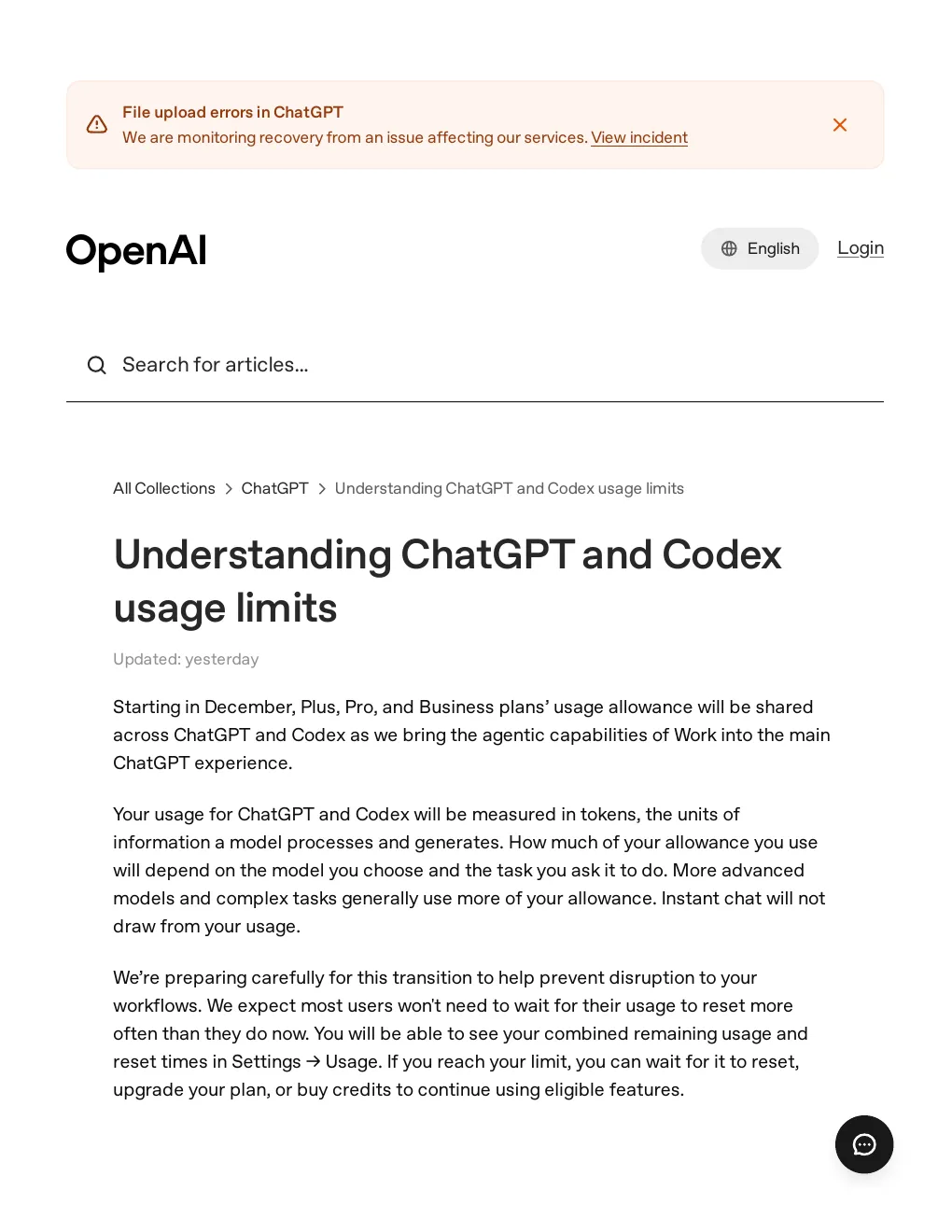
In practice, that means:
- ChatGPT and Codex will no longer have independent weekly or monthly allowances on the same account.
- Usage in either product will reduce the same shared pool, which is the chatgpt codex shared usage limit in action.
- Once the pool is used up, both products will be limited until it resets, unless you buy extra usage or upgrade.
OpenAI has not presented this as a price cut or a price rise. It is a structural change to how usage is counted. For light users, who rarely hit a limit in either product, the change may be invisible. For power users, developers, and teams that use Codex heavily, it could be the difference between a smooth week and a blocked afternoon, because the chatgpt codex shared usage limit makes every token count twice in planning terms.
Why OpenAI is pooling the limits
The simplest explanation is that ChatGPT and Codex are converging. Codex started as a coding tool, but it now uses the same underlying models, the same reasoning, and increasingly the same workflows as ChatGPT. Keeping two separate allowances for what is effectively one system was confusing, and it created odd incentives — for example, switching products just to get a fresh limit, which the chatgpt codex shared usage limit now prevents.
A single pool is also easier to explain, easier to bill, and easier to manage for teams. OpenAI can show one number, one reset date, and one set of extra-credit options, rather than two overlapping systems.
There is a commercial angle too. A shared pool makes it harder to use a cheap plan in one product to do heavy work that should be on a higher plan. It also pushes the heaviest users toward Pro, Team, or Enterprise plans, or toward buying additional usage, rather than spreading work across two allowances.
What happens to the $20 and $200 plans?
OpenAI has said the change does not change the price of its subscriptions by itself. Plus users will still pay $20 a month, and Pro users will still pay $200 a month, but the usage they get for that money will now be a single shared allowance rather than two separate ones, under the chatgpt codex shared usage limit.
That distinction matters. If you are on Plus and you currently use ChatGPT lightly but Codex heavily, you may find the shared pool runs out sooner than your old Codex allowance did. If you use both lightly, you may find you actually have more flexibility, because unused ChatGPT allowance can now help cover a busy coding day, and vice versa.
OpenAI has also said users will still be able to buy additional usage beyond their plan, and that enterprise and team plans will have their own arrangements. The exact token numbers, reset periods, and extra-credit pricing will be shown in account settings before the change takes effect, so check your own dashboard rather than relying on general figures about the chatgpt codex shared usage limit.
What does not change
Not everything is changing. Your account, your history, your custom instructions, and your saved projects are not affected. The models themselves are not changing as part of this announcement, and the change does not mean ChatGPT and Codex are merging into one product, even though the chatgpt codex shared usage limit now links their allowances.
ChatGPT remains the general chat product, and Codex remains the coding-focused product, with its own interface, its own agent workflows, and its own integrations with editors and terminals. What changes is only how usage is counted behind the scenes.
A brief history of separate allowances
When Codex launched as a separate product, it made sense to give it its own limit. It was a new tool, with a different user base, and OpenAI wanted to encourage developers to try it without eating into their ChatGPT allowance.
As Codex became more popular, and as ChatGPT itself gained coding features, the line blurred. Many users now do coding in ChatGPT, agent work in Codex, and general writing in both. A single pool reflects how people actually work in 2026, and the chatgpt codex shared usage limit is the formal version of that reality.
How to prepare for the chatgpt codex shared usage limit
If you use both products, do three things before December:
- Check your current usage in both products. Look at how much you use ChatGPT and Codex in a typical week, and whether you regularly hit either limit under the chatgpt codex shared usage limit.
- Plan your heaviest work. If you have a big coding project, a large refactoring, or a week of agent runs, schedule it early in your allowance period, or spread it across weeks.
- Use lighter models for routine work. Save the most powerful models for tasks that need them, and use faster, cheaper models for drafts, summaries, and simple edits.
Teams should also decide who gets priority when the pool is tight. If one developer’s agent run can consume a whole team’s allowance, that needs a rule before December, not after, because the chatgpt codex shared usage limit will apply to the team pool as well.
DeepSeek’s New Super-Agent: Open, Capable, and Built for Real Work
While OpenAI is simplifying its limits with the chatgpt codex shared usage limit, DeepSeek is pushing in the opposite direction: more capability, more openness, and more autonomy. The Chinese lab has released a new super-agent that can plan, use tools, write and run code, browse, and complete multi-step tasks with less human supervision than earlier models.
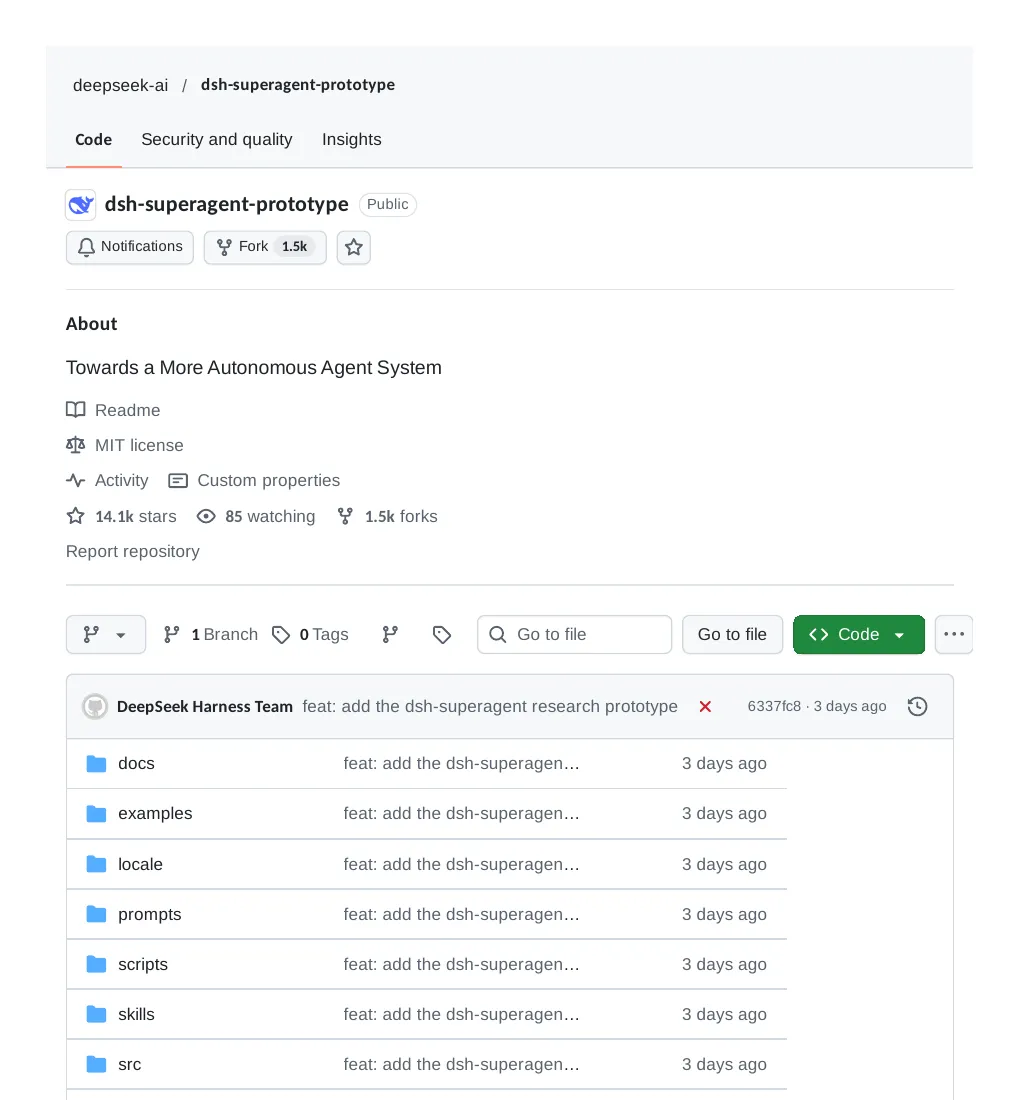
The agent is open in the sense that its weights and code are available for researchers and developers to inspect, run, and build on. That is a deliberate contrast with closed, API-only agents from larger US labs. DeepSeek is betting that openness will attract developers who want to customise the agent, run it privately, or integrate it into their own products without depending on a single provider.
What DeepSeek’s agent does in practice
In demonstrations, the agent can take a high-level goal — for example, research a topic, build a small web app, or analyse a dataset — and break it into steps, choose tools, execute code, check its own work, and fix errors. It can also work across files, terminals, and web sources, rather than just answering in a chat window.
That is the definition of a super-agent in 2026: not a chatbot that answers questions, but a system that does work. The difference matters for productivity, but it also raises questions about safety, oversight, and cost. An agent that can run code and use tools needs guardrails, logging, and a human in the loop for important decisions.
Why DeepSeek’s release matters
DeepSeek has a track record of releasing powerful models at a fraction of the cost of its competitors, and of forcing the whole market to rethink pricing. Its earlier models pushed OpenAI, Anthropic, and Google to cut prices and open up more capability. A capable, open super-agent could do the same for agent tools, even as the chatgpt codex shared usage limit reshapes OpenAI pricing.
For developers, the appeal is clear: an agent you can run yourself, customise, and inspect, without paying per-token API prices for every run. For businesses, the appeal is control — data stays in-house, workflows can be audited, and costs are predictable.
For the wider market, DeepSeek’s release is a reminder that the AI race is not just between US labs. Open models from China are now competitive on many tasks, and they are shaping what users expect from agents: more autonomy, lower cost, and more transparency.
Apple Intelligence Arrives in China — With Local Partners
The third story in this news cycle is Apple Intelligence’s arrival in China, a market where Apple has long faced regulatory and competitive challenges. Apple will bring its AI features to Chinese iPhones, iPads, and Macs, but it will do so with local partners, as required by Chinese regulations.
That partnership model is important. Apple cannot simply run its US AI infrastructure in China. It needs local data handling, local model partners, and compliance with Chinese rules on content, privacy, and security. The result will be an Apple Intelligence experience that looks familiar, but runs on a different backend in China.
What Chinese users will get
Chinese users can expect the core Apple Intelligence features: writing tools, summarisation, image tools, smarter Siri, and on-device processing where possible. Some features may roll out later than in the US, and some may work differently because of local model choices.
For Apple, China is too big to ignore. It is one of its largest markets, and AI is now a key selling point for premium phones. Without Apple Intelligence, Chinese iPhones risk looking behind local competitors from Huawei, Xiaomi, and others, who already offer advanced AI features.
What it means for the global AI market
Apple’s China launch shows how fragmented the AI market is becoming. There is no single global AI stack. Instead, there are regional stacks, with different models, different partners, and different rules. Companies that want to operate globally must build for that fragmentation, not ignore it, just as OpenAI users must adapt to the chatgpt codex shared usage limit.
It also shows how AI features are becoming table stakes for hardware. A phone without good AI in 2026 is like a phone without a good camera in 2016 — technically usable, but hard to sell at a premium price.
What to Watch Next
Three things to watch in the coming weeks:
- OpenAI’s exact numbers: The token amounts, reset dates, and extra-credit prices for the chatgpt codex shared usage limit will determine whether most users notice the change at all.
- DeepSeek’s real-world performance: Demonstrations are one thing; reliable, safe, multi-step work in production is another. Watch for independent tests and developer reports.
- Apple’s China rollout: Which features launch first, how well local models perform, and whether Chinese users see Apple Intelligence as a reason to upgrade.
Together, these stories point in the same direction: AI is moving from chatbots to agents, from single products to shared systems, and from a US-centric market to a genuinely global one. The chatgpt codex shared usage limit is part of that shift — a sign that usage, not just capability, is now a core part of the product.
Final Takeaways
- ChatGPT and Codex will share one usage limit from December 2026, replacing separate allowances on the same account, under the chatgpt codex shared usage limit.
- Light users may barely notice, but heavy users and teams should plan their token use before the change.
- DeepSeek’s open super-agent raises the bar for autonomous, multi-step AI work, and for openness.
- Apple Intelligence in China shows how AI is becoming essential for hardware, and how regional the market has become.
Check your OpenAI usage before December, try DeepSeek’s agent if you build with AI, and watch Apple’s China rollout if you follow the hardware market. The next few weeks will tell us whether these changes are smooth transitions or disruptive ones, especially for users affected by the chatgpt codex shared usage limit.
Sources
- OpenAI Help Center — ChatGPT and Codex shared usage announcement
- DeepSeek — super-agent release and repository
- Apple — Apple Intelligence in China announcement
For more AI news, see the AI Earn Tools Hub homepage.
- AI Citation Generator: 7 Best Free APA & MLA Tools (2026)
- AI Quiz Generator: 7 Best Tools for Studying Smarter (2026)
- AI Homework Helper: 8 Best Tools That Explain (2026)
- AI Tattoo Generator: 6 Best Tools for Your Next Ink (2026)
- Best AI Resume Builder: 7 Top Tools Tested (2026)
- Best AI Study Tools for Students: 9 Tools Compared (2026)
- Free AI Presentation Maker: 7 Best Free Tools (2026)
- AI Story Generator Free: 8 Best Tools for 2026 (Tested)
- Free AI Resume Builder: 7 Best Tools That Work in 2026
- AI Slide Maker: 6 Best Tools for Fast Decks (2026)
- OpenAI LifeVal: AI Now Graded on Everyday Life (Nov 2026)
- AI Training Opt-Out: Google, OpenAI, Microsoft and Anthropic Back One Shared robots.txt Line
- AI News November 2026: One Line to Opt Out of AI Training
- AI Training Opt-Out: One robots.txt Rule Now Backed by OpenAI, Google, Microsoft and Anthropic
- Google Genie 4: AI Worlds That Talk Back (Oct 27–29, 2026)